


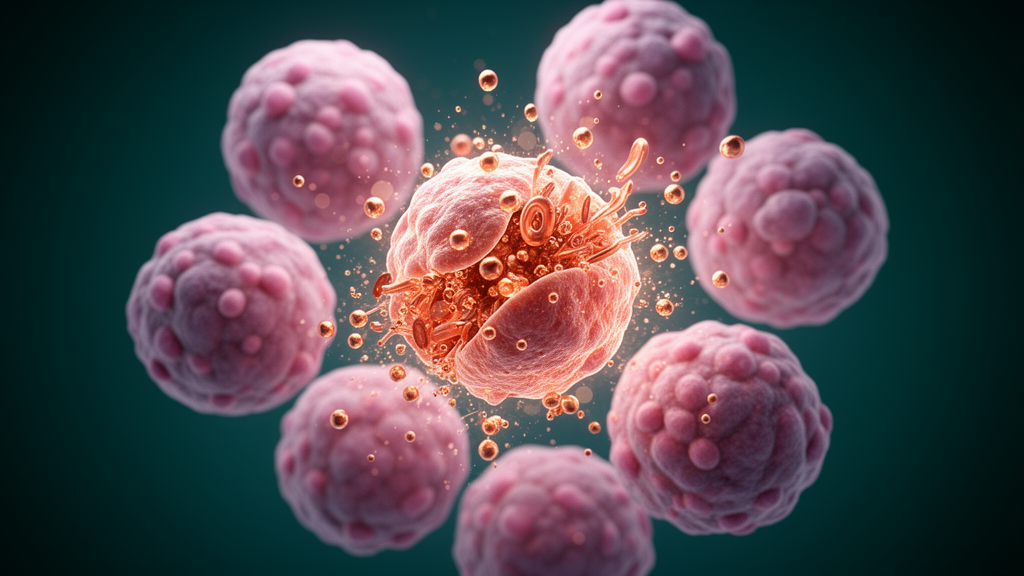
Triple-negative breast cancer, the most aggressive subtype of breast cancer, lacks expression of the estrogen receptor, progesterone receptor, and HER2, leaving patients ineligible for endocrine therapy and anti-HER2 targeted treatments. Although the disease often responds initially to chemotherapy, drug resistance develops frequently, and options become extremely limited at recurrence. Immune checkpoint inhibitors have helped a subset of PD-L1-positive patients, but resistance and relapse persist, and overall survival remains significantly inferior to that of other breast cancer subtypes. A newly published review in Frontiers in Molecular Biosciences argues that a recently discovered form of cell death, cuproptosis, may open a fresh therapeutic direction for this hard-to-treat malignancy.
Cuproptosis was formally defined in 2022 as a form of programmed cell death driven by copper ion overload and highly dependent on mitochondrial respiration. Unlike apoptosis or necroptosis, it arises when excess copper ions bind directly to lipoylated proteins in the mitochondrial tricarboxylic acid cycle, such as dihydrolipoyl S-acetyltransferase (DLAT) and dihydrolipoyl S-succinyltransferase (DLST). This binding triggers abnormal oligomerization and functional loss of these proteins, producing proteotoxic stress that ends in mitochondrial collapse and cell death. At the center of this process sits FDX1, or ferredoxin 1, a small iron-sulfur cluster protein localized to the mitochondria that the review describes as the molecular switch initiating cuproptosis.
FDX1 reduces Cu2+ to Cu+, the more toxic form of copper, which rapidly penetrates the mitochondrial membrane and accumulates within mitochondria. It also drives protein lipoylation by promoting the functional interaction between lipoic acid synthase and the lipoyl carrier protein GCSH, supplying the electrons needed for lipoylation of TCA cycle enzymes. Copper then acts downstream, binding the already-lipoylated DLAT and DLST and inducing their oligomerization. Loss of FDX1 function impairs these lipoylation-dependent enzymes, leaving copper ions without binding targets and rendering cells resistant to cuproptosis, alongside metabolic abnormalities such as loss of respiratory function and increased sensitivity to glucose starvation. Physiologically, iron-sulfur cluster biogenesis is mainly mediated by the related protein FDX2, which can partially compensate when FDX1 is absent but cannot rescue lipoylation deficiency.
The human FDX1 gene sits on chromosome 11, comprises four exons, and encodes a 184-amino-acid protein of 19.4 kilodaltons. Beyond cuproptosis, it participates in steroid and bile acid synthesis, heme formation, vitamin A and D metabolism, and iron-sulfur cluster biogenesis. Its expression is highest in adrenal tissue, followed by kidney and testis, consistent with its role in steroid synthesis, and is extremely low or undetectable in most other normal tissues. In tumors, its behavior is tissue-specific: it is downregulated in triple-negative breast cancer, lung adenocarcinoma, hepatocellular carcinoma, renal cell carcinoma, and colorectal cancer, where low expression is associated with poor prognosis, metastasis, and cuproptosis resistance, but upregulated in glioblastoma and ovarian cancer, where high expression correlates with malignancy and invasiveness.
FDX1 transcription is governed by a complex, cell-type-specific network. The repressors YY1, acting through the MAPK-ERK1/2 pathway, NRF2 under oxidative stress, and FOXO3 downstream of PI3K/AKT signaling suppress FDX1 transcription in ovarian cancer, cervical cancer, and clear cell renal cell carcinoma respectively, while SF-1 and NF-κB act as activators in a mouse Leydig cell model and glioblastoma. Epigenetic mechanisms add further layers: promoter hypermethylation can silence the gene, the lncRNA PVT1 raises H3K27 acetylation to activate transcription, and in gastric cancer cells lactylation of METTL16 enhances m6A modification of FDX1 mRNA, promoting cuproptosis. MicroRNAs, lncRNAs, and circular RNAs also tune FDX1 expression, and in colorectal and lung cancer models FGFR4 drives ubiquitin-proteasome-dependent degradation of the FDX1 protein, diminishing cuproptosis sensitivity.
In triple-negative breast cancer specifically, the picture is intricate. FDX1 mRNA levels are significantly lower in TNBC than in other subtypes and correlate with poor prognosis, yet single-cell sequencing has revealed an FDX1-high epithelial subpopulation within the tumor microenvironment whose FDX1 levels exceed those of corresponding populations in other breast cancer subtypes. The review explains that this apparent paradox reflects spatial and cellular heterogeneity: bulk RNA sequencing averages signals across all cells, so a small FDX1-high subpopulation is masked by the many FDX1-low cells, whereas single-cell resolution can isolate it. The two findings, the authors argue, are not in conflict.
A key resistance mechanism has emerged from recent studies. Although copper levels are significantly higher in TNBC tissues than in normal tissues, tumor cells resist cuproptosis because AKT1 kinase, activated by high copper, directly binds FDX1 and phosphorylates it at serine 63, a residue within the domain responsible for electron transfer and protein-protein interactions. This phosphorylation impairs electron transfer, diminishes lipoylation of DLAT and other targets, and interrupts the cuproptosis pathway. Site-directed mutagenesis substituting serine 63 with alanine reversed AKT1-induced resistance and restored cuproptosis sensitivity in TNBC cells. Phosphorylated FDX1 also suppresses mitochondrial oxidative phosphorylation and pushes cells toward glycolytic metabolism, although the review notes that this specific claim rests on a single report and has not been independently reproduced, while broader evidence links FDX1 inactivation to impaired lipoylation and compensatory glycolysis.
Therapeutically, the AKT1 inhibitor MK-2206 combined with the copper ionophore elesclomol synergistically restored cuproptosis sensitivity in TNBC in both in vitro and in vivo preclinical experiments, providing the rationale for combination strategies of AKT1 inhibitors and copper ionophores. Nanomedicine approaches add further possibilities: a ROS-responsive nanoparticle integrating elesclomol and Cu2+ with anti-PD-L1 immunotherapy transformed an immunosuppressive tumor microenvironment into an immunogenic one, and a core-shell nanoparticle combining copper release with the ferroptosis inducer erastin directly killed tumor cells, activated antitumor immunity, and enhanced anti-PD-L1 efficacy in a TNBC 4T1 mouse model. However, the review stresses that nanodelivery therapies have been validated only in animal models, and no human clinical trial has yet confirmed the efficacy or safety of AKT1 inhibitor plus copper ionophore combinations, leaving a clear translational gap.
FDX1 also connects cuproptosis to antitumor immunity. One study established a bidirectional feedback loop in which cuproptosis acts as immunogenic cell death releasing damage-associated molecular patterns to activate CD8+ T cells, while interferon-gamma from those T cells upregulates FDX1 transcription through STAT1-IRF1, increasing tumor cell sensitivity to cuproptosis; cuproptosis inducers combined with PD-L1 blockade overcame primary and acquired immunotherapy resistance in that work. Conversely, in a colorectal cancer model, high FDX1 expression exerted immunosuppressive effects through the FDX1-DICER1-DMBT1 axis, illustrating bidirectional biological effects. In TNBC, single-cell analyses associate FDX1-positive epithelial cells with reduced CD8+ T cell infiltration, but the review cautions that evidence that FDX1 directly inhibits CD8+ T cells in TNBC remains limited and unvalidated.
Significant bottlenecks temper the enthusiasm. Existing studies rely predominantly on retrospective analyses of public databases such as TCGA and GEO plus in vitro experiments, lacking prospective clinical cohorts, so the clinical value of FDX1 as a diagnostic biomarker or therapeutic target remains unestablished. FDX1 is highly expressed in the liver and adrenal glands, where it sustains hepatic metabolic homeostasis and adrenal steroid synthesis, and no tumor-specific isoforms or conformations have been reported, raising systemic toxicity risks for any targeted intervention. Copper ionophores face pharmaceutical challenges including poor in vivo stability and off-target toxicity. The authors call for standardized immunohistochemical and serum detection systems, multicenter prospective validation, tissue-specific delivery strategies, and tumor-selective FDX1 modulators before cuproptosis-based therapy can move from bench toward the clinic for triple-negative breast cancer.
Subject of Research: The role of the cuproptosis regulator FDX1 in triple-negative breast cancer biology and therapy
Article Title: Research progress on the key cuproptosis regulator FDX1 and its relevance to triple-negative breast cancer
Article References: Yuping, F., Hongmiao, Z., Songlin, Y., Chenchen, P., & Kepeng, Z. (2026). Research progress on the key cuproptosis regulator FDX1 and its relevance to triple-negative breast cancer. Frontiers in Molecular Biosciences, 13, Article 1985506. https://doi.org/10.3389/fmolb.2026.1985506
Image Credits: AI Generated
DOI: 10.3389/fmolb.2026.1985506
Keywords: cuproptosis, FDX1, triple-negative breast cancer, copper ionophores, mitochondrial metabolism, AKT1 phosphorylation, tumor microenvironment, immunotherapy, nanomedicine, programmed cell death, drug resistance, biomarker
Cite Scienmag News
Nathaniel Bowman. (October 27, 2026). Copper-Driven Cell Death Offers a New Angle on Triple-Negative Breast Cancer. Scienmag. https://scienmag.com/copper-driven-cell-death-offers-a-new-angle-on-triple-negative-breast-cancer/
Nathaniel Bowman. "Copper-Driven Cell Death Offers a New Angle on Triple-Negative Breast Cancer." Scienmag, 27 October 2026, https://scienmag.com/copper-driven-cell-death-offers-a-new-angle-on-triple-negative-breast-cancer/. Accessed 27 October 2026.
Nathaniel Bowman. "Copper-Driven Cell Death Offers a New Angle on Triple-Negative Breast Cancer." Scienmag. October 27, 2026. https://scienmag.com/copper-driven-cell-death-offers-a-new-angle-on-triple-negative-breast-cancer/


