


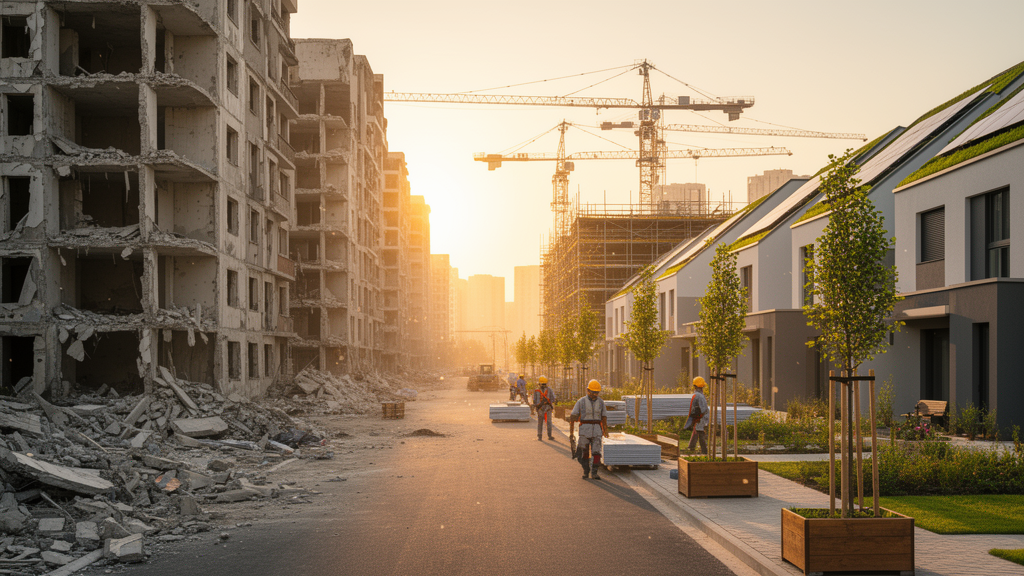
Aghdam, a city in the Karabakh economic region of southwestern Azerbaijan, was left in a state of near-total destruction by conflict. Now it has become the subject of a detailed academic analysis of how a city can be rebuilt from almost nothing while trying to embed sustainability into every layer of its planning. A new open-access study, published in Discover Cities on 27 October 2026, examines the reconstruction of Aghdam as a case of sustainability-driven urban development under what the author calls near-tabula rasa conditions, where the near-erasure of the built environment allows planning principles to be designed in from the start rather than retrofitted later.
The research, conducted by Rashad Mahmudov, uses an embedded mixed-methods case-study design. It combines document and policy analysis, spatial interpretation of planning materials, site-based observations, and an exploratory stakeholder survey that gathered 65 valid responses from the Karabakh Economic Region. The analysis is organised around five dimensions: master planning, energy-efficient urban design, green infrastructure and environmental sustainability, social sustainability, and cultural identity and urban memory preservation. Importantly, the study distinguishes between measures already implemented, work still ongoing and longer-term planning objectives, rather than presenting Aghdam as a finished sustainable city.
The methodological framing matters because the survey is explicitly not a statistically representative assessment of Aghdam’s population. Instead, it serves to triangulate the documentary findings and to gauge broader stakeholder priorities in the region. Azerbaijani-language documents were reviewed in the original language and translated by the author, with key planning, heritage and sustainability terminology checked for consistency. Quantitative information was classified as realised, ongoing, planned or projected, and figures drawn from a single source were attributed directly to that source, a discipline that guards against treating official targets as achieved outcomes.
The new master plan sits at the centre of the reconstruction framework. It was developed around four strategic objectives: establishing Aghdam as a regional centre, a smart city, a competitive city and a sustainable city. The plan translates these goals into a functional structure of residential, industrial, transport, recreational, blue and green zones. Notably, the proposed urban form reflects the outline of the pre-war city, preserving a degree of spatial continuity with the historical settlement pattern. Principal road axes organise the city into functional sectors, the historical centre remains a symbolic core, and a new administrative and multifunctional centre nearby integrates public, educational, healthcare, sports, commercial and service functions.
Energy efficiency is treated as an integral component of the urban framework rather than a separate technical add-on. The 110/35/10 kV Aghdam-1 and Aghdam-2 substations, a Digital Management Center of the Karabakh Regional Electric Network, and the later Aghdam Junction substation have strengthened supply stability and operational control; the Junction substation is connected to Aghdam-1 by a 10-kilometre double-circuit 110 kV transmission line and fibre-optic cable. LED and hybrid solar-powered street lighting are being incorporated into new streets and public spaces. The wider Karabakh region receives approximately 2,400 to 3,200 hours of sunshine annually, and a multi-criteria assessment ranked solar above hydro and wind for the plain part of the region. According to the Ministry of Energy, more than 2,000 solar panels had been installed across the reconstructed territories, a figure reflecting the wider regional programme rather than Aghdam specifically.
One of the most technically specific findings comes from an Aghdam-specific simulation of an evacuated-tube solar water-heating system, which found a solar fraction of 0.47 and annual auxiliary-energy savings of 2,863 kilowatt-hours, indicating the district’s residential decarbonisation potential. Potential applications in the city include building-integrated photovoltaics in hospitals, schools and administrative buildings, together with standalone systems for smart bus stops, electric-vehicle charging points and automated irrigation. The master-plan framework also provides for a 125-hectare green belt, and the planned green system includes an inner-city green belt, an artificial lake with canals, and a multifunctional Central Park, positioning green infrastructure as part of the city’s spatial skeleton rather than decorative landscaping.
The social dimension is where the scale of the challenge becomes most concrete. Before the war, Aghdam district had approximately 143,000 residents, including 36,000 in the city itself. The new master plan envisages a population of 100,000 by 2040, supported by 23,000 apartments and 1,750 individual houses. A target announced in 2023 aimed to resettle 42,000 people in Aghdam city and surrounding villages by the end of 2026. In surrounding settlements such as Sarijali and Khidirli, reconstruction extends beyond housing to schools, kindergartens, medical centres, administrative buildings, community clubs and communal amenities. On the economic side, the Aghdam Industrial Park had created more than 650 permanent jobs by June 2025, rising to nearly 970 by December 2025, most held by residents of Aghdam and surrounding districts.
Cultural identity and urban memory form the fifth dimension, and the study argues they are structural components of recovery rather than optional extras. The Aghdam Juma Mosque, built between 1868 and 1870 by Karbalayi Safikhan Karabakhi, is one of the few major structures to survive the widespread destruction and has been restored as both a religious building and a major urban landmark. The Imarat complex and the Palace of Panahali Khan are similarly important heritage sites, while the historic centre and bazaar connect to everyday life and collective memory. The study draws on international comparisons to make the point sharply: Mostar shows that symbolic restoration alone cannot overcome social division, Mosul demonstrates that monument-centred reconstruction must respond to local communities’ needs and memories, and Hiroshima illustrates how memory can be integrated into long-term civic reconstruction through planning that links memorial space with future urban identity.
The stakeholder survey adds an empirical layer to this picture. Employment and job opportunities emerged as the highest priority, selected by 73.8 percent of respondents, followed by quality of life at 66.2 percent and education and healthcare at 61.5 percent. Cultural heritage and security were each selected by 58.5 percent, green spaces and environmental quality by 56.9 percent, public transport and accessibility by 46.2 percent, renewable energy and smart technologies by 41.5 percent, and public participation by 33.8 percent. On a five-point agreement scale, all seven sustainability statements scored between 4.29 and 4.71, with the strongest agreement concerning the contribution of smart technologies to everyday life at 4.71, followed by adaptable master plans at 4.58 and employment and business opportunities at 4.54. Respondents, in short, favoured a broad development model rather than any single technological or environmental objective.
The study’s conclusions are deliberately cautious. Because reconstruction in Aghdam is ongoing, several quantitative indicators represent official targets or projections rather than independently verified outcomes, and the long-term social, environmental and economic results of the master plan cannot yet be fully evaluated. The author’s academic and professional familiarity with the study context informed the interpretation of documents and site observations, a potential bias mitigated through triangulation across official documents, scientific literature, spatial evidence, observations and the survey. The principal value of the case, the paper argues, lies not in presenting Aghdam as a universally applicable model but in identifying transferable principles: integrated planning, clear differentiation between planned and realised outcomes, coordination between housing and employment, the inclusion of environmental and social indicators, and the treatment of heritage and collective memory as structural elements of sustainable recovery. Future research, the study suggests, should examine the experiences of returning residents, the performance of new neighbourhoods and public spaces, and the evolving relationship between reconstructed heritage and community identity.
Subject of Research: Sustainability-driven urban reconstruction of the post-conflict city of Aghdam, Azerbaijan
Article Title: Sustainability-driven urban development in the reconstruction of post-conflict Aghdam, Azerbaijan
Article References: Mahmudov, R. (2026). Sustainability-driven urban development in the reconstruction of post-conflict Aghdam, Azerbaijan. Discover Cities, 3(1), Article 211. https://doi.org/10.1007/s44327-026-00392-z
Image Credits: AI Generated
DOI: 10.1007/s44327-026-00392-z
Keywords: Aghdam, Azerbaijan, post-conflict reconstruction, sustainable urban development, master planning, green infrastructure, renewable energy, cultural heritage, urban memory, stakeholder survey, Karabakh, social sustainability
Cite Scienmag News
Courtney Benton. (October 27, 2026). Rebuilding Aghdam: how a destroyed city is testing sustainable urban recovery. Scienmag. https://scienmag.com/rebuilding-aghdam-how-a-destroyed-city-is-testing-sustainable-urban-recovery/
Courtney Benton. "Rebuilding Aghdam: how a destroyed city is testing sustainable urban recovery." Scienmag, 27 October 2026, https://scienmag.com/rebuilding-aghdam-how-a-destroyed-city-is-testing-sustainable-urban-recovery/. Accessed 27 October 2026.
Courtney Benton. "Rebuilding Aghdam: how a destroyed city is testing sustainable urban recovery." Scienmag. October 27, 2026. https://scienmag.com/rebuilding-aghdam-how-a-destroyed-city-is-testing-sustainable-urban-recovery/

