


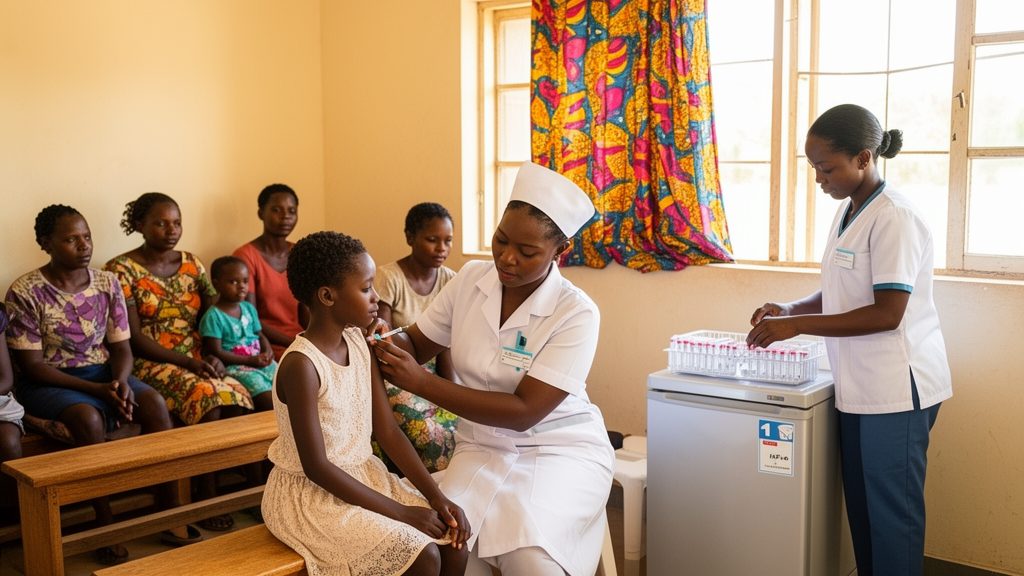
HPV vaccination coverage across Africa has improved substantially in recent years, yet it remains below the thresholds needed for cervical cancer elimination, and the programs that achieved those gains now face an uncertain financing future. That tension between progress and fragility framed the fifth regional symposium of the Coalition to Strengthen the HPV Immunization Community, or CHIC, held in Nairobi, Kenya, in October 2025 in collaboration with Kenya’s Ministry of Health. A new meeting report published in BMC Proceedings summarizes the three-day gathering, which convened more than 100 participants from 22 African countries, including national immunization program managers, ministry officials, researchers, civil society representatives, and global partners such as the World Health Organization, UNICEF, Gavi, PATH, and the Gates Foundation.
The regional data presented at the meeting illustrate both how far programs have come and how far they still must go. At the time of the symposium, 95 percent of Eastern and Southern African countries, 19 of 20, had introduced HPV vaccination, with 74 percent of them adopting the single-dose schedule. Coverage in that region rose from 52 percent in 2021 to 74 percent in 2024, a recovery attributed largely to rebound from the COVID-19 pandemic, but still short of the 90 percent elimination threshold. In West and Central Africa, 16 of 27 countries had introduced the vaccine, with Burkina Faso and Cabo Verde exceeding 99 percent coverage. Large-scale multi-age cohort campaigns demonstrated substantial reach: Nigeria vaccinated roughly 12.3 million girls, about 86 percent of its target, while Malawi and Mozambique each reported over 90 percent coverage in their multi-age campaigns.
The symposium’s agenda was not assembled top-down. The CHIC Secretariat, convened between the Centre for the Evaluation of Vaccination at the University of Antwerp, Jhpiego, and the Vaccine Confidence Project at the London School of Hygiene & Tropical Medicine, conducted 25 stakeholder consultations alongside scientific and advisory group meetings. That input was synthesized into six subthemes, all tied to the overarching question of program sustainability: finding the most efficient local mix of school, facility, and community-based delivery; raising new domestic funds; combining trusted methods with new technologies to overcome hesitancy; reaching adolescents who are out of school or otherwise hard to reach; taking an integrated approach to HPV vaccination and other services; and deciding whether to expand eligibility beyond girls aged 9 to 14. An open call for abstracts drew more than 50 submissions and supported 19 accepted presenters, the largest group of early- and mid-career researchers to contribute to a CHIC event to date.
Deliberate inclusion shaped the meeting as well. Because formative work had identified a gap in peer-learning exchanges between francophone and anglophone countries, organizers intentionally recruited representatives from both groups and provided simultaneous translation and bilingual materials. The event built on four previous regional symposia held in Addis Ababa in 2022, Delhi in 2022, Abidjan in 2023, and Manila in 2024, reflecting a growing community of practice across low- and middle-income country settings.
The meeting opened with a welcoming statement from Kenya’s Ministry of Health, which announced the country’s transition to a single-dose HPV schedule beginning in October 2025. National leaders framed the change as an evidence-driven decision intended to expand access, reduce logistical barriers, and improve sustainability under constrained fiscal resources. Kenya’s Director-General of Health emphasised that “no girl should be left behind,” calling for stronger collaboration with the Ministry of Education, community structures, and county governments to reach girls both in and out of school. World Health Organization presentations followed, highlighting the disproportionate cervical cancer burden in the African region and the persistent gap between vaccine availability and coverage, noting that several high-incidence countries continue to report some of the lowest HPV vaccination rates, driven partly by difficulty reaching out-of-school girls, sustaining routine delivery, and countering misinformation.
A major focus was Gavi 6.0, the Vaccine Alliance’s next five-year planning cycle covering 2026 to 2030, which will merge multiple grant windows into a single application with expanded co-financing obligations. While participants welcomed the simplified structure, many expressed concern that HPV vaccination could lose visibility within broader immunization budgets as overall resources are expected to decline amid radical shifts in global health financing. Gavi speakers reaffirmed HPV vaccination as a core priority and encouraged governments to embed the vaccine proactively into EPI microplanning, including school outreach, community mobilization, data systems, and cold chain requirements. Kenyan participants noted that re-entering Gavi’s preparatory phase has given the country more time to realign domestic resources for co-financing and local vaccine production efforts, citing the Kenya BioVax initiative. Middle-income and transition-phase countries, the report notes, face heightened sustainability pressures and need early integration of HPV vaccination into domestic health budgets and national immunization investment cases.
Country-level experience formed the practical core of the meeting. In the country snapshot session, 16 of the 19 countries with established programs reported a mixed delivery strategy combining school-based, facility-based, and community-based platforms, while Rwanda, South Africa, and Uganda relied primarily on school-based delivery alone. Uganda and Rwanda both described strong health-education sector partnerships behind effective school-based strategies, with Rwanda showcasing a national digital registry that enables real-time monitoring, improved accuracy, and automatic SMS reminders for caregivers. Zimbabwean participants described how peer mobilisation, district-level social mobilisation, and coordination with local leaders helped counter rumours and improve uptake in urban and rural settings. Kenyan participants highlighted multisectoral collaboration through national and county technical working groups involving health promotion teams, community health workers, faith-based organizations, and professional associations, while Nigerian participants emphasised that engaging traditional and religious leaders was instrumental in reaching millions of girls during the country’s phased introduction. Across countries, speakers echoed difficulties reaching out-of-school youth, nomadic populations, and conflict-affected communities, along with health worker turnover and fertility-related misinformation; several countries reported perceived efficiency gains after switching to a single-dose schedule, including reduced logistical burden and simpler coordination with schools.
On the third day, an electronic poll helped participants prioritize 12 candidate implementation themes. Of 75 responses, 10 from global partners and advisors and two duplicates were excluded, leaving an analytical sample of 64 responses, 45 from anglophone and 19 from francophone countries, which generated 192 individual votes. Sustainable service delivery received the largest share, 35 of 192 votes, followed by data systems with 24 and financing with 23, with hard-to-reach populations and service integration ranking next. Sixty participants were then assigned across nine round tables in the first discussion round and eight in the second, working through challenges, country-level good practices, and the resources and partnerships needed for implementation. Finally, the 22 country contingents reconvened to draft individual action plans identifying priority challenges, responsible stakeholders, and implementation timelines. The most common actionable themes were strengthening data systems, improving misinformation strategies and community engagement, ensuring sustainable service delivery, and securing sustainable financing mechanisms, with additional attention to service integration, hard-to-reach populations, and target population expansion. Data-related actions were grouped into five areas spanning data quality and use, target population estimation, digitalisation, data integration, and forecasting, while financing actions spanned domestic resource mobilisation, political and financial advocacy, budget planning, cost optimisation, and partner engagement.
The report’s cross-cutting synthesis surfaced recurring structural concerns. Discussions about decreasing HPV disease risk for people living with HIV appeared in the majority of sessions, and francophone participants in particular described expanding vaccination to young and adult women living with HIV as a first step in widening eligibility, calling on national leadership and donors to fund such expansion. Data systems were widely described as fragmented, with paper records at the point of service and slow-to-adapt digital systems at registry level, creating double work and risks to the confidentiality of people living with HIV who need additional doses. Notably, although communication strategies against mis- and dis-information did not rank among the highest priorities in the formal vote, they recurred across plenary discussions, breakout groups, and country plans, a disconnect the authors suggest reflects under-recognition of an evolving operational risk, particularly as social media and emerging AI-generated content amplify misinformation. Financing concerns threaded through nearly every discussion, shaped by constrained domestic budgets, evolving donor support, and rising expectations for program integration. The report concludes that durable HPV vaccination programs depend not only on technical design but on sustained political commitment, financing transition planning, digital system strengthening, and multisectoral integration across health, education, and community platforms, if the WHO’s goal of eliminating cervical cancer by 2030 is to remain within reach.
Subject of Research: A meeting report on sustaining HPV vaccination programs across Africa discussed at the fifth CHIC symposium in Nairobi
Article Title: Meeting report of the fifth symposium organized by the coalition to strengthen the HPV immunization community (CHIC): Nairobi, Kenya – advancing sustainable HPV vaccination programs in Africa
Article References: Bolio, A., Jennings, M. C., Burdier, R., Jindal, S., Kagan, S., Karafillakis, E., Chaurat, E., Njoh, A. A., Amponash-Dacosta, E., Guemgo, S., Bakouan, R. D., Njie, M., Jalang’o, R. E., Wangeci, C., Njogu, R. N., Ndiaye, A., Mashiringo, C., Morgan, C., Vorsters, A., & Waheed, D.-E.-N. (2026). Meeting report of the fifth symposium organized by the coalition to strengthen the HPV immunization community (CHIC): Nairobi, Kenya – advancing sustainable HPV vaccination programs in Africa. BMC Proceedings, 20(S38), Article 42. https://doi.org/10.1186/s12919-026-00403-2
Image Credits: AI Generated
DOI: 10.1186/s12919-026-00403-2
Keywords: HPV vaccination, cervical cancer, Africa, CHIC symposium, Gavi 6.0, immunization coverage, single-dose schedule, health financing, data systems, misinformation, Kenya, public health
Cite Scienmag News
Drew Townsend. (October 27, 2026). African Nations Chart a Path to Sustain HPV Vaccination Beyond Donor Funding. Scienmag. https://scienmag.com/african-nations-chart-a-path-to-sustain-hpv-vaccination-beyond-donor-funding/
Drew Townsend. "African Nations Chart a Path to Sustain HPV Vaccination Beyond Donor Funding." Scienmag, 27 October 2026, https://scienmag.com/african-nations-chart-a-path-to-sustain-hpv-vaccination-beyond-donor-funding/. Accessed 27 October 2026.
Drew Townsend. "African Nations Chart a Path to Sustain HPV Vaccination Beyond Donor Funding." Scienmag. October 27, 2026. https://scienmag.com/african-nations-chart-a-path-to-sustain-hpv-vaccination-beyond-donor-funding/


