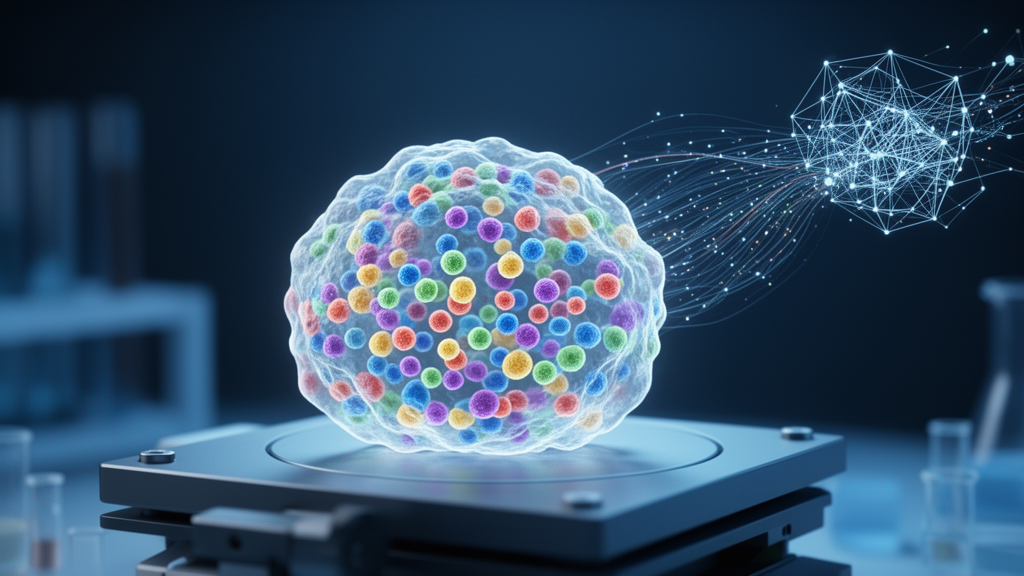
For decades, one of the most stubborn obstacles in cancer research has been a problem of averaging. When researchers grind up a tumor sample and measure its gene activity, they obtain a single bulk profile that blends together the signals of every cell in the mixture: malignant blasts, healthy immune cells, stromal support cells, and rare stem-like populations that may drive relapse. The result is a molecular portrait that looks like a blurry photograph of a crowd, in which the distinctive features of any individual face are lost. A new study published in PLOS Computational Biology tackles this problem head-on with a two-step machine-learning framework that can computationally pull apart those blended signals and assign drug responses to specific cell types, and even to individual cells, within a bulk sample.
The work, led by Alexandre Coudray, Romain Forey, and colleagues at EPFL and collaborating institutions, introduces two linked algorithms named CLIMB and CLIFF. CLIMB addresses the classical problem of deconvolution: given a bulk RNA-sequencing profile that represents the summed expression of thousands of cells, estimate both the proportions of each cell type present and the expression programs those cell types are running. CLIFF then builds on that decomposition to do something more ambitious: it resolves bulk drug sensitivity measurements, which normally report only an averaged response across an entire sample, into cell-subtype-specific and single-cell-specific estimates of how sensitive each cellular component is to a given compound.
The conceptual foundation of the approach rests on a mapping between two data worlds that rarely meet. Single-cell RNA sequencing provides exquisitely detailed snapshots of individual cells, but it is expensive, technically demanding, and difficult to pair with functional readouts such as drug screening. Bulk RNA sequencing is cheap, abundant, and routinely paired with drug-response data in large clinical cohorts, but it lacks cellular resolution. CLIMB and CLIFF act as a bridge between these worlds: they use single-cell reference data to teach a model what the expression signatures of specific cell types look like, and then apply that learned mapping to interpret bulk profiles. The authors describe this as single-cell-to-bulk transcriptome mapping, and it is this transfer of resolution from the single-cell domain to the bulk domain that gives the framework its power.
Validation began in a controlled setting. The team mixed leukemic cell lines together in the laboratory in known proportions and generated bulk profiles of these artificial mixtures. Because the true cellular composition was experimentally established, the researchers could measure exactly how well CLIMB recovered the ground truth. The algorithm performed accurately, and the same mixtures, which had also been profiled for their responses to drugs, allowed the team to verify that CLIFF could correctly attribute drug sensitivity to the constituent cell lines.
Real-world applications, however, are messier than laboratory mixtures. In clinical practice, the single-cell reference data used to train a deconvolution model rarely comes from the same patients, the same sequencing platforms, or even the same disease context as the bulk samples being analyzed. To test whether CLIMB could withstand these so-called reference-to-target mismatches, the researchers constructed large-scale pseudo-bulk analyses: they aggregated single-cell RNA-sequencing data from independent references across two disease contexts and five cancer types, deliberately introducing the kinds of discrepancies that arise in real studies. Even under these challenging conditions, CLIMB accurately inferred cellular composition and outperformed state-of-the-art bulk deconvolution methods, suggesting that the framework is robust to the imperfections of real reference data.
One of the most striking demonstrations of the method comes from acute myeloid leukemia, or AML, an aggressive blood cancer in which a rare population of leukemic stem cells is thought to sustain the disease and drive relapse after treatment. These cells are notoriously difficult to study because they are scarce and hard to isolate, yet they are believed to be a critical target for curative therapy. CLIMB proved capable of estimating leukemic stem cell fractions with high accuracy across three test datasets and three independent patient cohorts, offering researchers a computational window into a cell population that has long evaded routine measurement in bulk clinical samples.
With the deconvolution engine validated, the team turned to the question that motivates much of precision oncology: which drugs actually kill which cells? To answer it at scale, they applied their framework to the beatAML cohort, currently the most extensive database of ex-vivo drug screening data, in which primary AML samples from patients have been tested against hundreds of compounds while their molecular profiles were simultaneously recorded. Running CLIFF on this resource generated a cell-subtype-resolved drug sensitivity landscape covering 121 compounds, effectively transforming a database of averaged responses into a map of which drugs act on which cellular populations within the leukemia.
The analysis surfaced several compounds that appear putatively active against leukemic stem cells, a finding with direct therapeutic implications. Among the candidates identified were midostaurin, a multikinase inhibitor already approved for use in AML; A-674563, an AKT inhibitor; SNS-032, an inhibitor of cyclin-dependent kinases; and foretinib, another multikinase inhibitor. Because leukemic stem cells are implicated in treatment resistance and relapse, compounds that preferentially target them could inform new therapeutic strategies, particularly for patients whose disease persists after standard induction chemotherapy. The authors emphasize that these are computational predictions that would require experimental and clinical validation, but the framework provides a systematic way to prioritize candidates that would otherwise be hidden inside bulk averages.
Beyond the specific findings in leukemia, the study articulates a broader methodological vision. Bulk functional measurements, whether drug screens, CRISPR perturbation screens, or other phenotypic assays, are abundant in biomedicine precisely because they are scalable and inexpensive. The CLIMB-CLIFF framework offers a general recipe for endowing such measurements with cellular resolution by leveraging the growing library of single-cell atlases. The authors position the approach as an attractive new computational tool for drug development and precision medicine, one that could in principle be extended beyond oncology to any context where heterogeneous cell mixtures obscure the signals that matter, from autoimmune disease to neurodegeneration.
The work also arrives at a moment of intense interest in computational deconvolution, as the field grapples with how to reconcile the explosion of single-cell data with the continued dominance of bulk assays in clinical and pharmaceutical settings. By demonstrating accuracy across controlled mixtures, cross-dataset pseudo-bulk benchmarks, multiple cancer types, and a large clinical drug-screening cohort, the EPFL-led team has provided one of the more comprehensive validations of the deconvolution concept to date. If the predictions hold up in laboratory follow-up, the ability to computationally resolve which cells in a tumor respond to which drugs could reshape how drug screens are interpreted, how patient stratification is performed, and ultimately how therapies are matched to the specific cellular vulnerabilities hidden within each patient’s disease.
Subject of Research: Computational deconvolution of bulk transcriptomic and drug sensitivity data to single-cell resolution
Article Title: Computational deconvolution of drug sensitivity via single-cell–to–bulk transcriptome mapping
Article References: Coudray, A., Forey, R., Bejar Haro, B., Martins, F., Carlevaro-Fita, J., Sheppard, S., Offner, S. E., La Manno, G., Obozinski, G., & Trono, D. (2026). Computational deconvolution of drug sensitivity via single-cell–to–bulk transcriptome mapping. PLOS Computational Biology, 22(10), e1014862. https://doi.org/10.1371/journal.pcbi.1014862
Image Credits: AI Generated
DOI: 10.1371/journal.pcbi.1014862
Keywords: computational biology, deconvolution, single-cell RNA sequencing, bulk RNA-seq, drug sensitivity, acute myeloid leukemia, leukemic stem cells, machine learning, beatAML, precision medicine, drug development, bioinformatics
Cite Scienmag News
Nathaniel Bowman. (October 16, 2026). New AI Framework Maps Drug Sensitivity Down to Individual Cells in Bulk Tumor Samples. Scienmag. https://scienmag.com/new-ai-framework-maps-drug-sensitivity-down-to-individual-cells-in-bulk-tumor-samples/
Nathaniel Bowman. "New AI Framework Maps Drug Sensitivity Down to Individual Cells in Bulk Tumor Samples." Scienmag, 16 October 2026, https://scienmag.com/new-ai-framework-maps-drug-sensitivity-down-to-individual-cells-in-bulk-tumor-samples/. Accessed 16 October 2026.
Nathaniel Bowman. "New AI Framework Maps Drug Sensitivity Down to Individual Cells in Bulk Tumor Samples." Scienmag. October 16, 2026. https://scienmag.com/new-ai-framework-maps-drug-sensitivity-down-to-individual-cells-in-bulk-tumor-samples/