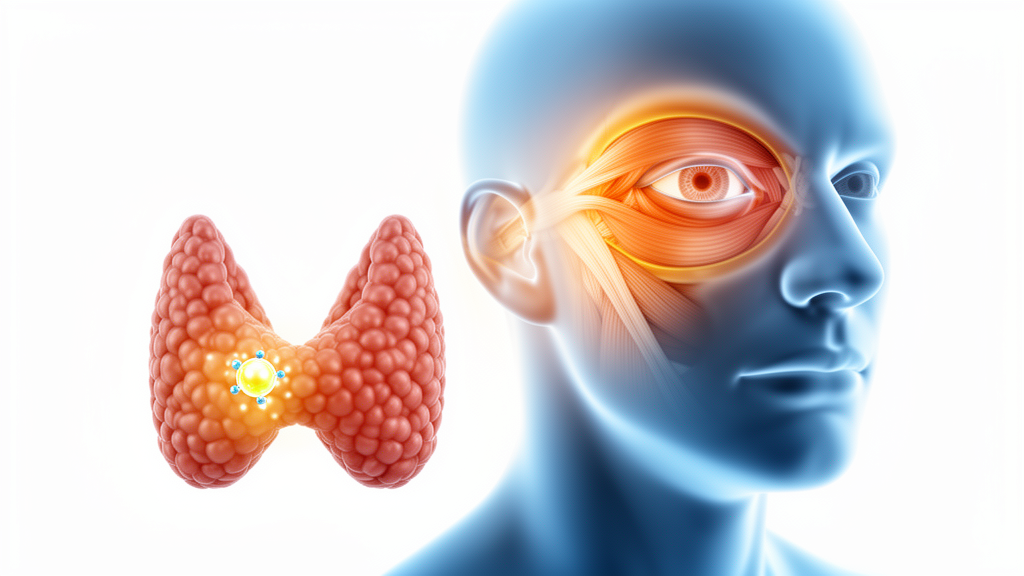
Graves’ disease is the most common cause of hyperthyroidism worldwide, and in roughly a quarter to half of patients it brings an unwelcome companion: thyroid-associated ophthalmopathy, an autoimmune attack on the tissues surrounding the eyes that can cause eyelid retraction, bulging eyes, double vision and, in the most severe cases, pressure on the optic nerve. A new study from a team of nuclear medicine physicians in Guangxi, China, now suggests that two surprisingly simple bedside measures recorded before treatment — how long a patient sleeps at night, and how active their eye disease appears — may help predict whether radioactive iodine therapy will restore normal thyroid function. The work, published in Frontiers in Endocrinology, examined 153 patients with Graves’ disease and concomitant eye disease who received a first course of radioactive iodine (iodine-131) at a single hospital between January 2020 and June 2025.
The researchers asked a deliberately narrow question. Their endpoint was not the cure of the eye disease itself, but thyroid functional remission: resolution of the overactive thyroid state after iodine-131 therapy. Following the response categories of the 2021 Chinese Society of Nuclear Medicine guideline, which are conceptually consistent with American Thyroid Association guidance, the team classified patients as being in remission if they ended follow-up either euthyroid, with normal free thyroxine and resolution of hyperthyroid symptoms, or hypothyroid, an expected and readily managed consequence of successful radioiodine treatment. Patients whose free thyroxine remained elevated despite reduced symptoms, or whose condition failed to improve at all, were classified as not in remission. Every patient was followed for at least twelve months, and no one received antithyroid drugs, repeat iodine-131, thyroid surgery or immunosuppressive therapy during that window, ensuring that the outcome reflected the effect of the initial treatment alone.
The headline finding is striking. Among the 31 patients who reported sleeping less than six hours per night before therapy, not a single one achieved thyroid functional remission — a remission rate of zero, with a 95 percent confidence interval stretching only from 0 to 9.2 percent. At the other end of the sleep spectrum, the picture reversed dramatically: of the 37 patients reporting eight hours of nocturnal sleep, 30, or 81.1 percent, ended follow-up in remission. At seven hours, 20 of 43 patients remitted, and at six hours only 3 of 39 did. No patient in the cohort reported more than eight hours of sleep. Viewed as a gradient, the unadjusted remission rates climb from complete absence below six hours to a plateau above seven, forming one of the sharpest sleep-outcome associations reported in the radioiodine literature.
To move beyond raw rates, the team deployed a sequence of statistical techniques designed for messy clinical data. They began by screening fourteen clinical variables with univariate logistic regression, applying Benjamini–Hochberg false discovery rate correction to guard against spurious findings. Four variables survived: duration of Graves’ disease, duration of the eye disease, nocturnal sleep duration and the Clinical Activity Score, a standard seven-point measure of orbital inflammatory activity developed by the European Group on Graves’ Orbitopathy. These candidates then entered a least absolute shrinkage and selection operator, or LASSO, regression — a penalized technique that systematically shrinks weak predictors to zero — with the penalty chosen by cross-validation and the conservative one-standard-error rule. Across fifty repeated cross-validation runs, sleep duration and the Clinical Activity Score were retained in every single run, while Graves’ disease duration appeared in 64 percent of runs. The final model retained three predictors: Graves’ disease duration, sleep duration and the Clinical Activity Score.
The numbers from the post-selection model are eye-catching. Each additional hour of pretreatment nocturnal sleep was associated with roughly a six-fold increase in the odds of remission, with an odds ratio of 6.13 and a 95 percent confidence interval of 3.16 to 11.91. Each additional point on the Clinical Activity Score was associated with a 36 percent reduction in the odds of remission, with an odds ratio of 0.64. Graves’ disease duration, by contrast, was no longer statistically significant once the other two variables were accounted for. Because the model was fitted in the same sample used for variable selection, the authors are careful to label these as post-selection estimates. They also ran a Firth bias-reduced logistic regression, a technique built for situations where the outcome is nearly perfectly separated by a predictor — precisely what happens below six hours of sleep — and the sleep odds ratio attenuated only modestly, to 5.64. A further sensitivity model adjusting for age, sex and smoking left the estimates materially unchanged, as did excluding the fifteen participants younger than eighteen years.
The relationship with the Clinical Activity Score turned out to be more complicated than a straight line. Using restricted cubic splines — flexible curves that can model non-linear dose–response relationships without imposing arbitrary cut-offs — fitted simultaneously for sleep and the score, the team found that the score’s association with remission departed significantly from linearity, with a non-linearity P value below 0.001 that persisted regardless of how many knots the spline used. The sleep curve, by contrast, remained consistent with a linear association, with a non-linearity P value of 0.585. An exploratory two-piecewise analysis searching for inflection points identified a maximum-likelihood break at four points on the score: below that value, each additional point was associated with sharply reduced odds of remission, while above it the direction reversed — though that high-score segment contained only 25 patients and a very wide confidence interval, and the authors attribute the reversal to possible confounding by intensified treatment rather than any genuine protective effect of severe inflammation.
Why might sleep matter for a thyroid treatment? The biological logic is plausible. Sleep and the immune system are deeply intertwined: sleep deprivation promotes inflammatory signaling, alters cytokine production and dysregulates innate immunity, processes documented extensively in the immunology literature. Orbital fibroblasts in Graves’ disease co-express the thyrotropin receptor and the insulin-like growth factor-1 receptor, driving the inflammation, hyaluronic acid deposition and fat expansion that characterize the eye disease. Adequate sleep might, in principle, temper the autoimmune milieu that radioiodine therapy must overcome. But the authors are equally candid about the alternative explanation, which may be the more likely one: hyperthyroidism itself destroys sleep. Thyrotoxicosis is a recognized cause of sleep dysfunction, and in one series summarized in a recent review, 66.4 percent of patients with Graves’ disease reported difficulty falling asleep. Short reported sleep may therefore mark more severe thyrotoxicosis rather than acting as an independent causal factor. Notably, baseline free triiodothyronine, free thyroxine and thyrotropin receptor antibody levels were similar between the remission and non-remission groups, which only partly addresses this concern, because thyroid volume, radioiodine uptake and administered activity — the true determinants of the absorbed dose — were not available for modeling.
The study’s limitations are substantial and the authors enumerate them with unusual thoroughness. Sleep was self-reported at only six discrete values, rounding is likely, and the complete absence of remission below six hours inflates the continuous odds ratio despite Firth attenuation. The administered iodine-131 activity followed a uniform institutional protocol of 70 to 120 microcuries per gram of thyroid tissue, but protocolized dosing does not eliminate confounding, since thyroid volume and uptake determine the absorbed dose and vary across patients. Twenty patients with more severe eye disease received prednisone before therapy, discontinued at least three days prior, and this glucocorticoid pretreatment was not modeled — although the Clinical Activity Score was assessed before any steroid intervention, making steroid-indication confounding an unlikely primary explanation for the score association. The retrospective, single-center design means the findings cannot establish causality, and the fitted inflection points are explicitly labeled exploratory post hoc observations, not validated clinical thresholds. The study also cannot inform the ocular prognosis of the eye disease after therapy, since post-therapy eye status was not systematically graded, though ocular symptoms were recorded as progressed in 37 patients, or 24.2 percent of the cohort.
What remains is a provocative and internally consistent signal. Longer pretreatment nocturnal sleep and a lower Clinical Activity Score were associated with thyroid functional remission after radioactive iodine therapy, with directions that held across Firth bias reduction, adjustment for age, sex and smoking, and exclusion of minors. The authors emphasize that these associations require prospective validation in studies that record objective sleep measures, charted administered activity and dosimetry covariates, with outcomes and assessment schedules defined in advance. Until then, the data cannot show that extending sleep improves treatment response, and clinical decisions should continue to follow established European Group on Graves’ Orbitopathy guidance. But for a disease in which millions of patients undergo radioiodine therapy each year, the idea that a good night’s sleep before the dose might matter — whether as cause or as marker — is a question now firmly on the research agenda, and one that prospective studies will need to answer before any sleep target can be recommended.
Subject of Research: Nocturnal sleep duration, clinical activity score, and thyroid functional remission after radioactive iodine therapy in Graves’ disease with thyroid-associated ophthalmopathy
Article Title: Nocturnal sleep duration, clinical activity score, and thyroid functional remission after radioactive iodine therapy in Graves’ disease with thyroid-associated ophthalmopathy
Article References: Liao, K., Wei, X., Chen, Y., Meng, D., Mo, S., Sun, Z., Song, F., Lu, L., & Huang, W. (2026). Nocturnal sleep duration, clinical activity score, and thyroid functional remission after radioactive iodine therapy in Graves’ disease with thyroid-associated ophthalmopathy. Frontiers in Endocrinology, 17, Article 1954035. https://doi.org/10.3389/fendo.2026.1954035
Image Credits: AI Generated
DOI: 10.3389/fendo.2026.1954035
Keywords: Nocturnal, sleep, duration, clinical, activity, score, thyroid, functional, remission, radioactive, iodine, therapy
Cite Scienmag News
Ophelia Keating. (October 16, 2026). Nocturnal sleep duration, clinical activity score, and thyroid functional remission after radioactive iodine therapy in Graves’ disease with thyroid-associated ophthalmopathy. Scienmag. https://scienmag.com/nocturnal-sleep-duration-clinical-activity-score-and-thyroid-functional-remission-after-radioactive-iodine-therapy-in-graves-disease-with-thyroid-associated-ophthalmopathy/
Ophelia Keating. "Nocturnal sleep duration, clinical activity score, and thyroid functional remission after radioactive iodine therapy in Graves’ disease with thyroid-associated ophthalmopathy." Scienmag, 16 October 2026, https://scienmag.com/nocturnal-sleep-duration-clinical-activity-score-and-thyroid-functional-remission-after-radioactive-iodine-therapy-in-graves-disease-with-thyroid-associated-ophthalmopathy/. Accessed 16 October 2026.
Ophelia Keating. "Nocturnal sleep duration, clinical activity score, and thyroid functional remission after radioactive iodine therapy in Graves’ disease with thyroid-associated ophthalmopathy." Scienmag. October 16, 2026. https://scienmag.com/nocturnal-sleep-duration-clinical-activity-score-and-thyroid-functional-remission-after-radioactive-iodine-therapy-in-graves-disease-with-thyroid-associated-ophthalmopathy/