


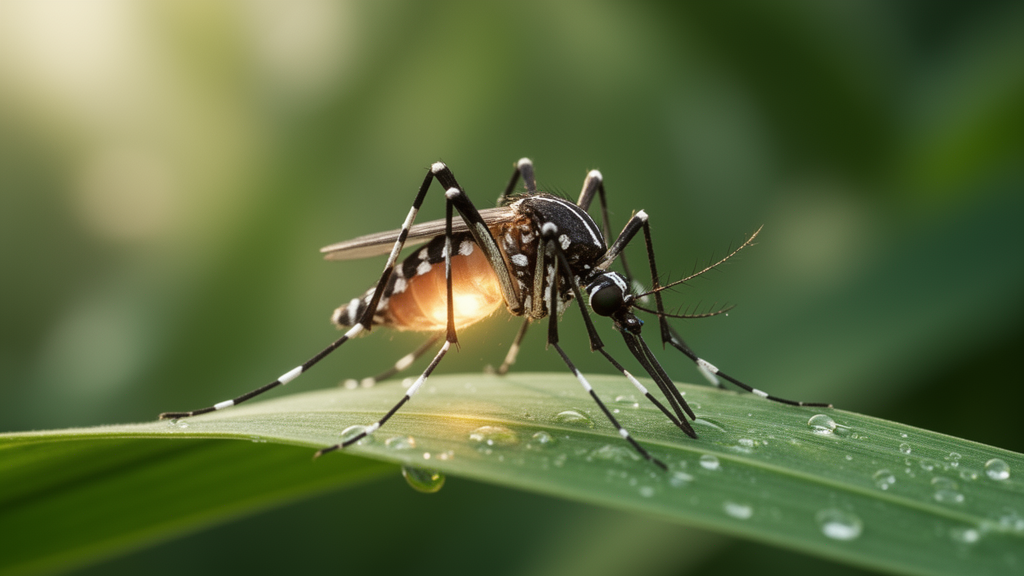
The Asian tiger mosquito, Aedes albopictus, carries a hidden ally that scientists have been trying to harness for years: Wolbachia, a maternally inherited bacterium that can interfere with the viruses the mosquito transmits. A new study published in PLOS Neglected Tropical Diseases by Abdullah A. Alomar, Dongmin Kim, Barry W. Alto, and Eric P. Caragata reveals that this natural partnership is more dynamic than previously appreciated. The researchers show that Wolbachia infection protects mosquitoes against lethal bacterial challenges, and that a prior brush with certain bacteria can prime the mosquito immune system in ways that reduce dengue virus infection—particularly when combined with native Wolbachia. The findings suggest that the interplay between resident microbes and immune memory in insects is more nuanced than laboratory models have implied.
Wolbachia is one of the most widespread bacterial endosymbionts in the animal kingdom, infecting a large proportion of arthropod species. It passes from mother to offspring through the egg cytoplasm, allowing it to spread through populations without any external intervention. In many host species, Wolbachia strains induce what researchers call pathogen blocking: a phenomenon in which the presence of the bacterium reduces the ability of viruses, parasites, or other microbes to establish productive infections in the host. This property has been exploited deliberately in Aedes aegypti, the primary vector of dengue, Zika, and yellow fever, where Wolbachia strains have been artificially introduced through microinjection to create mosquito populations that are refractory to viral transmission. Field trials using this strategy have shown substantial reductions in disease incidence in several tropical regions.
What has remained less clear is how native Wolbachia infections—those that mosquitoes acquire naturally rather than through laboratory manipulation—affect host immunity and pathogen resistance. Aedes albopictus, the Asian tiger mosquito, naturally harbors Wolbachia strains that have coevolved with the species over long evolutionary timescales. Understanding whether these native infections provide meaningful protection against bacterial or viral pathogens is important both for basic immunology and for public health planning, since Ae. albopictus is a competent vector for dengue and other arboviruses and is expanding its geographic range.
To investigate these questions, the research team challenged adult female Ae. albopictus mosquitoes, both with and without their native Wolbachia infection, using sub-lethal doses of four mosquito-associated bacteria. Two of these were Gram-positive species, Micrococcus and Staphylococcus, and two were Gram-negative species, Brevundimonas and Enterobacter. The sub-lethal dosing was deliberate: rather than killing the insects outright, the exposure was designed to activate immune pathways without causing overwhelming mortality, mimicking the kind of environmental microbial encounters mosquitoes experience in nature.
When the researchers tracked post-challenge mortality over time, a clear pattern emerged. Wolbachia-infected mosquitoes showed reduced cumulative mortality and a delayed onset of age-related decline compared to their Wolbachia-free counterparts across all four bacterial challenges. However, the protective effect was not uniform. It was consistently stronger against the Gram-positive bacteria, Micrococcus and Staphylococcus, than against the Gram-negative species. This asymmetry is significant because it suggests that native Wolbachia may interact preferentially with particular arms of the insect immune system—likely the Toll pathway, which is the primary defense against Gram-positive bacteria and fungi in insects—rather than providing broad-spectrum protection.
The concept underlying these results is immune priming, a form of adaptive-like immunity in insects. Unlike vertebrates, insects lack antibodies and the classical adaptive immune system. Yet research over the past two decades has demonstrated that insects can exhibit a form of immune memory: a sub-lethal exposure to a pathogen can increase the probability of surviving a subsequent, potentially lethal challenge with the same or a related microbe. This priming effect has been documented in diverse insect orders and is thought to involve persistent changes in immune gene expression, hemocyte activity, or antimicrobial peptide levels. Wolbachia infection itself has been linked to elevated baseline immune activity in several host species, raising the possibility that the bacterium acts as a continuous immune stimulus—essentially priming the host against future microbial encounters even without an explicit prior challenge.
Building on the mortality results, the team then asked whether bacterial priming could influence the outcome of a subsequent viral infection. Mosquitoes that had been pre-challenged with the four bacteria were later fed a blood meal containing dengue virus (DENV), the oral route by which mosquitoes naturally acquire the pathogen. The results revealed a striking interaction between bacterial Gram status and viral blocking. Mosquitoes pre-challenged with the Gram-negative bacteria, Brevundimonas and Enterobacter, showed reduced DENV prevalence and lower viral loads compared to unprimed controls. In other words, a prior encounter with these environmental Gram-negative species appeared to interfere with the mosquito’s ability to support a productive dengue infection.
When the researchers examined the role of native Wolbachia in this context, they found that Wolbachia-infected mosquitoes exhibited further reductions in viral load beyond those attributable to bacterial priming alone. This additive effect suggests that native Wolbachia and bacterial priming operate through partially independent mechanisms that converge on dengue blocking. The combination of a resident endosymbiont and a recent Gram-negative bacterial exposure produced the strongest suppression of DENV observed in the study, hinting that the microbial environment inside a mosquito—shaped by both inherited symbionts and transient environmental bacteria—could meaningfully influence vector competence.
The dependence on bacterial Gram status is one of the most intriguing aspects of the findings. In Drosophila fruit flies, previous work has shown that Wolbachia-mediated pathogen blocking against bacteria occurs after oral challenge but not after systemic challenge via injection, implying that the route of exposure matters. The current study extends this picture to Ae. albopictus and to viral pathogens, showing that the protective effects of priming and Wolbachia are not uniform across microbial types. The stronger protection against Gram-positive bacteria in the mortality experiments, combined with the enhanced dengue blocking after Gram-negative priming, suggests that different immune pathways—likely the Toll pathway for Gram-positive defense and the IMD pathway for Gram-negative defense—interact differently with native Wolbachia and with subsequent viral infection.
These results carry implications for both basic science and disease control. For mosquito immunology, the study provides evidence that native Wolbachia infections in Ae. albopictus are not passive passengers but active participants in host defense, capable of reducing bacterial mortality and interacting with priming effects that depend on microbial type. For adaptive immunity in insects, the work adds to a growing body of literature showing that immune memory in these animals is real, measurable, and shaped by the resident microbiome. For public health, the findings suggest that vector competence for dengue is not a fixed property of a mosquito species but a dynamic outcome of the microbial communities it harbors. As Wolbachia-based control strategies continue to expand, understanding how native infections and environmental bacterial exposures modulate viral blocking could refine predictions about which populations will be most refractory to transmission—and could open new avenues for manipulating mosquito microbiomes to reduce arbovirus burden in endemic regions.
Subject of Research: Bacterial immune priming and Wolbachia-mediated dengue blocking in Aedes albopictus mosquitoes
Article Title: Bacterial immune priming and Wolbachia -mediated dengue blocking in Aedes albopictus mosquitoes
Article References: Alomar, A. A., Kim, D., Alto, B. W., & Caragata, E. P. (2026). Bacterial immune priming and Wolbachia-mediated dengue blocking in Aedes albopictus mosquitoes. PLOS Neglected Tropical Diseases, 20(10), e0014807. https://doi.org/10.1371/journal.pntd.0014807
Image Credits: AI Generated
DOI: 10.1371/journal.pntd.0014807
Keywords: Wolbachia, Aedes albopictus, dengue virus, immune priming, pathogen blocking, mosquito immunity, vector competence, PLOS Neglected Tropical Diseases, Bacterial, immune, priming, mediated
Cite Scienmag News
Kristina Jarvis. (October 16, 2026). Native Wolbachia and bacterial priming team up to curb dengue in Asian tiger mosquitoes. Scienmag. https://scienmag.com/native-wolbachia-and-bacterial-priming-team-up-to-curb-dengue-in-asian-tiger-mosquitoes/
Kristina Jarvis. "Native Wolbachia and bacterial priming team up to curb dengue in Asian tiger mosquitoes." Scienmag, 16 October 2026, https://scienmag.com/native-wolbachia-and-bacterial-priming-team-up-to-curb-dengue-in-asian-tiger-mosquitoes/. Accessed 16 October 2026.
Kristina Jarvis. "Native Wolbachia and bacterial priming team up to curb dengue in Asian tiger mosquitoes." Scienmag. October 16, 2026. https://scienmag.com/native-wolbachia-and-bacterial-priming-team-up-to-curb-dengue-in-asian-tiger-mosquitoes/


