


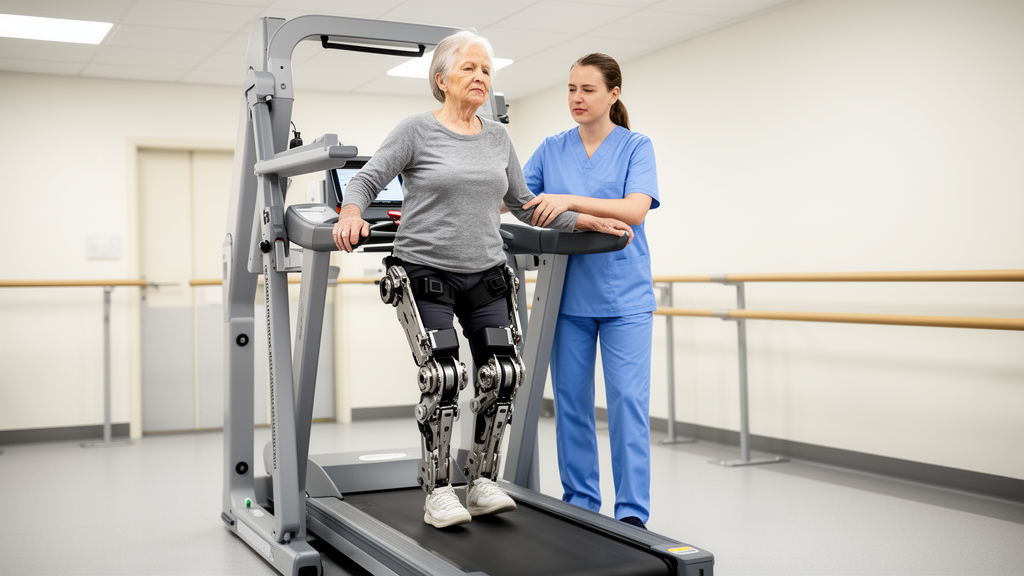
Wearable robotic exoskeletons—powered braces that strap onto the legs and drive the hips and knees through each step—have long promised to transform stroke rehabilitation by turning fragile, therapist-assisted walking practice into high-repetition, precisely controlled gait training. A new systematic review and meta-analysis published in Frontiers in Neurology now offers the most careful accounting yet of what these devices actually deliver. Pooling data from fourteen randomized controlled trials involving 565 stroke survivors, an international team of researchers led by Wanli Zang of Soochow University found that exoskeleton-assisted gait training produced small but statistically reliable gains in walking independence, balance, and lower-limb motor function compared with conventional rehabilitation. Yet the same analysis delivers a sobering caveat: for most outcomes, the true effect in any given clinic or patient population could plausibly be zero.
The review, registered prospectively on PROSPERO and conducted according to PRISMA 2020 guidelines, searched five major databases from inception to February 26, 2026, including PubMed, Embase, the Cochrane Central Register of Controlled Trials, Web of Science, and the China National Knowledge Infrastructure. The team deliberately narrowed its focus to wearable lower-limb robotic exoskeletons—devices physically coupled to the patient’s legs—excluding the end-effector and platform-based robotic gait trainers that previous reviews had lumped together with wearable systems. This distinction matters because the two device families differ fundamentally in how they deliver assistance: wearable exoskeletons move with the patient, whether overground or on a treadmill, while platform systems fix the patient in place and move the limbs beneath them.
The fourteen included trials, published between 2014 and 2025, spanned a striking range of technology. They included the single-leg version of Cyberdyne’s Hybrid Assistive Limb tested in Japan, the rigid Ekso GT used in Canadian and Polish inpatient wards, the harness-free Korean EXOWALK delivered overground, and a bilateral soft exosuit—the Yrobot Relink—tested in subacute Chinese patients. Training environments ranged from treadmill-based sessions with body-weight support to free overground walking, and daily doses varied from twenty minutes to an hour across protocols lasting two to eight weeks. Most trials enrolled between eight and thirty participants per arm, a scale that immediately signals the statistical challenges ahead.
When the researchers pooled the data using random-effects models with restricted maximum likelihood estimation and the conservative Hartung–Knapp adjustment, three outcomes emerged as consistent winners. Walking independence, measured on the Functional Ambulation Category scale, improved by a mean difference of 0.39 points (95% confidence interval 0.15–0.63), meaning patients in the exoskeleton groups typically required less physical assistance to walk. Balance, measured on the Berg Balance Scale, improved by 1.66 points (95% CI 0.52–2.81). Lower-limb motor function, measured on the Fugl–Meyer Assessment of the Lower Extremity, improved by 2.40 points (95% CI 1.63–3.16). Notably, heterogeneity across studies was essentially zero for all three outcomes—an unusual finding in rehabilitation meta-analysis that suggests the underlying effects are remarkably stable despite the technological diversity of the devices.
The six-minute walk test told a more ambiguous story. The pooled estimate favored the exoskeleton groups by 19.83 meters (95% CI 2.21–37.45), a statistically significant but clinically modest gain in endurance. However, the 95% prediction interval—which estimates the range of true effects a future study might observe—stretched from −0.35 to 40.02 meters, crossing the line of no effect. In other words, while the average trial showed a benefit, an individual clinic adopting exoskeleton training could plausibly see no improvement at all in walking endurance. This distinction between confidence intervals and prediction intervals is central to the review’s cautious tone.
For walking speed on the ten-meter walk test, functional mobility on the Timed Up and Go test, mobility on the Rivermead Mobility Index, lower-limb strength on the Motricity Index, and activities of daily living on the Modified Barthel Index, no statistically significant between-group differences emerged. The Timed Up and Go analysis was particularly noisy, with heterogeneity exceeding 81% and a prediction interval spanning nearly 253 seconds—a reminder that composite tasks involving turning, sit-to-stand transitions, and environmental adaptation depend on capacities that repetitive robotic stepping may not directly train. The authors suggest that gains at the impairment level, such as improved selective motor control reflected in the Fugl–Meyer score, may not translate into real-world functional performance without additional task-specific practice and longer follow-up.
From a neurorehabilitation perspective, the pattern of results is biologically coherent. Exoskeleton-assisted training provides high-repetition, task-specific gait practice that may enhance sensorimotor input and support activity-dependent neuroplasticity—the same principle underlying constraint-induced movement therapy and treadmill locomotor training. Improvements in balance may reflect increased opportunities to practice paretic-limb loading and weight-shift control, addressing the asymmetric weight bearing and impaired postural control that limit dynamic stability after stroke. Walking speed, by contrast, depends heavily on forward propulsion and power generation, capacities that vary with device mechanics, assistance strategy, and the degree of active patient engagement—variables that the included trials reported inconsistently or not at all.
The certainty of evidence, assessed using the GRADE framework, was moderate for walking independence, balance, and lower-limb motor function, but low for walking speed, endurance, and strength, and very low for functional mobility and activities of daily living. Downgrading was driven primarily by risk of bias—most trials could not blind participants or therapists to the intervention, an inherent limitation of device-based rehabilitation—alongside imprecision from small sample sizes. For the Berg Balance Scale, the one outcome with enough studies for formal testing, contour-enhanced funnel plots and Egger’s regression found no evidence of small-study effects or publication bias, lending further credibility to that estimate.
Subgroup analyses comparing overground with treadmill-based training found no statistically significant differences for walking independence or balance, though the authors caution that these exploratory analyses were underpowered. More fundamentally, the review could not disentangle the effects of device architecture, body-weight support, assistance strategy, training dose, or comparator content, because reporting of these characteristics was too inconsistent across trials. The pooled estimates therefore represent average contrasts across heterogeneous intervention–comparator packages rather than effects attributable to robotic assistance itself, and they cannot support device-specific or patient-specific prescribing recommendations.
The authors call for larger, well-designed randomized controlled trials with standardized intervention reporting, stratified analyses by stroke stage and baseline ambulatory capacity, and longer follow-up to determine whether early gains persist or fade once training ends. Until such trials arrive, the message for clinicians and patients is measured but not dismissive: wearable exoskeletons appear to offer real, if modest, advantages in helping stroke survivors walk with less assistance, stand more steadily, and recover motor control in weakened limbs—but the technology is not yet a proven shortcut to independent community walking, and its benefits likely depend as much on how, when, and to whom it is delivered as on the robot itself.
Subject of Research: Effects of wearable lower-limb robotic exoskeleton-assisted gait training on walking, balance, and daily living after stroke
Article Title: Effects of wearable lower-limb robotic exoskeleton–assisted gait training on balance, walking, and activities of daily living after stroke: a systematic review and meta-analysis
Article References: Zhang, Z., Zhang, X., Mao, S., Cao, L., Wang, Z., Wu, J., & Zang, W. (2026). Effects of wearable lower-limb robotic exoskeleton–assisted gait training on balance, walking, and activities of daily living after stroke: a systematic review and meta-analysis. Frontiers in Neurology, 17, Article 1818981. https://doi.org/10.3389/fneur.2026.1818981
Image Credits: AI Generated
DOI: 10.3389/fneur.2026.1818981
Keywords: stroke rehabilitation, robotic exoskeleton, gait training, meta-analysis, balance, walking independence, neuroplasticity, Fugl-Meyer Assessment, Berg Balance Scale, randomized controlled trials, neurorehabilitation, wearable robotics
Cite Scienmag News
Denise Maddox. (October 16, 2026). Robot Exoskeleton Gait Training Shows Modest Gains in Balance and Walking Independence After Stroke. Scienmag. https://scienmag.com/robot-exoskeleton-gait-training-shows-modest-gains-in-balance-and-walking-independence-after-stroke/
Denise Maddox. "Robot Exoskeleton Gait Training Shows Modest Gains in Balance and Walking Independence After Stroke." Scienmag, 16 October 2026, https://scienmag.com/robot-exoskeleton-gait-training-shows-modest-gains-in-balance-and-walking-independence-after-stroke/. Accessed 16 October 2026.
Denise Maddox. "Robot Exoskeleton Gait Training Shows Modest Gains in Balance and Walking Independence After Stroke." Scienmag. October 16, 2026. https://scienmag.com/robot-exoskeleton-gait-training-shows-modest-gains-in-balance-and-walking-independence-after-stroke/


