


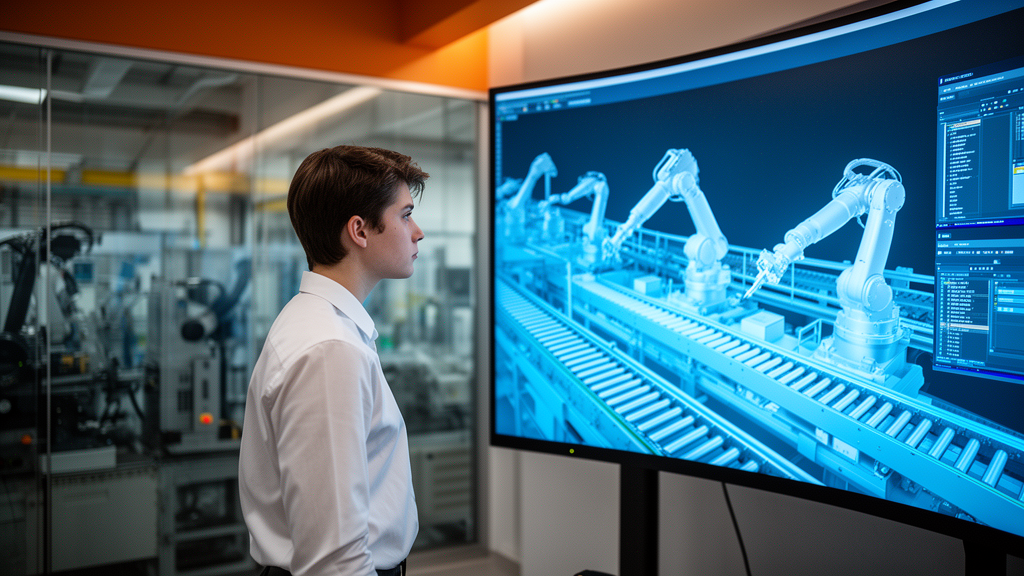
Control engineering rarely makes headlines, yet it is the invisible scaffolding holding up almost every technological promise of the modern age. The algorithms that keep a chemical plant from overheating, the loops that stabilize a drone in gusting wind, and the software that coordinates thousands of robotic movements on an automotive line all descend from the same discipline. Now, a new collection of research published in Frontiers in Control Engineering argues that this quiet field is undergoing a transformation as profound as any in its history, driven by the digitalization of manufacturing and the growing appetite for intelligent, self-correcting machines.
The editorial, authored by Antonio Visioli of the University of Brescia in Italy, introduces a special research topic titled Insights in Control and Automation Systems. Rather than presenting a single breakthrough, the collection surveys three fronts on which the discipline is being reshaped: how engineers are taught, how the workhorse controllers of industry are tuned, and how digital twins are redefining the relationship between physical plants and their virtual counterparts. Taken together, the papers sketch a field grappling with the demands of the Industry 4.0 paradigm, in which the automation pyramid—from field-level devices to enterprise-level planning—is increasingly saturated with data and software intelligence.
Visioli notes that the tremendous development of industrial control and automation systems over recent decades has been motivated by concrete economic pressures: the need for higher product quality, reduced costs, and greater production flexibility. In the context of Industry 4.0, with the almost complete digitalization of production, control systems now play a key role at every layer of the automation pyramid. That expansion, he suggests, is precisely what makes the field’s current challenges so urgent. The tools that worked for the factories of the twentieth century cannot simply be scaled up to meet the ambitions of smart manufacturing, and the three papers in the collection each confront a different dimension of that mismatch.
The first paper, by J. Anthony Rossiter of the University of Sheffield, tackles a question that might seem academic but has enormous industrial consequences: how should control engineering be taught in an era when the subject is everywhere? Rossiter argues that the advancements in control systems and their increased pervasiveness at all levels of technology demand a rethink of what belongs in a first, and possibly only, university control course. The traditional approach—heavy on mathematical derivations, light on intuition—may no longer serve students who will encounter control problems in fields as diverse as biotechnology, logistics, and renewable energy.
The COVID-19 pandemic accelerated this reckoning. As instructors were forced online almost overnight, the availability of web-based resources—videos, virtual and remote laboratories, and interactive tools—became not just a convenience but a necessity. The pandemic pushed educators to exploit these tools and, in doing so, raised students’ expectations of how the subject should be delivered. A recent survey organized by the Technical Committee on Education of the International Federation of Automatic Control has since offered guidelines: rather than drowning students in mathematical detail, a first control course should enthuse them and make them aware of the role control systems play across different fields. Software tools and online resources, the survey suggests, can help students focus on the main concepts rather than tedious calculations, which can be deferred to subsequent courses—leaving graduates better prepared for the diverse problems industry now poses.
The second paper shifts from the classroom to the factory floor, where the Proportional-Integral-Derivative, or PID, controller remains the undisputed workhorse. Alfaro and Vilanova address a subtle but consequential issue: PID controllers can be implemented in different forms, with the proportional and derivative actions applied either to the control error or directly to the process variable. Tuning rules developed for one form do not necessarily deliver the required performance and robustness when applied to another. The authors call this property resilience, and their analysis highlights the need to carefully consider the PID controller structure whenever a given tuning rule is selected—a warning with real consequences for plants where a misapplied tuning rule can degrade stability margins without any obvious alarm.
The stakes are higher than they might appear. Because PID controllers form the fundamental brick of the lowest layer in an automation system, their performance constrains everything built on top of them. Optimization algorithms such as model predictive control, which define set-points to optimize overall production, depend on the loops beneath them behaving exactly as designed. If a tuning rule calibrated for one controller structure is silently applied to another, the resulting mismatch can erode the robustness margins that keep a process stable, undermining the very optimization the higher layer is meant to achieve. In an Industry 4.0 environment, where layers of software intelligence are stacked atop classical feedback loops, such mismatches are not merely theoretical—they are a practical threat to the reliability of increasingly autonomous production systems.
The third paper, by Birk and colleagues, confronts one of the most hyped concepts in modern manufacturing: the digital twin. A digital twin is a virtual representation of a physical system, accurate enough to be used for estimation, control, and decision-making across the system’s entire life-cycle. The review examines the opportunities and challenges of creating and using digital twins for process industrial systems, focusing on the fundamental problem of learning—through data-driven approaches—validating, and updating large-scale, plant-wide equation-based process models. The authors survey the state of the art in autonomous model development, calibration, monitoring, and updating, and outline research directions toward a fully autonomous toolset for the automatic production, calibration, and updating of purpose-oriented digital twins.
What emerges from the collection as a whole is a portrait of a discipline in transition. The classical pillars of control theory—stability, robustness, and optimal performance—remain as relevant as ever, but the context in which they must be delivered has changed dramatically. Students must be trained differently, with an emphasis on intuition and software fluency over manual calculation. Practitioners must be more careful than ever about the assumptions embedded in the tools they use, down to the structural details of a PID implementation. And the promise of digital twins, while enormous, depends on solving hard problems in model learning, validation, and maintenance that are far from settled. The editorial expresses the hope that readers will find the collection inspiring and a useful reference for understanding the state of the art in automation and its future perspectives—a modest ambition for a field whose quiet advances will determine how quickly the factories of the future can learn.
For an industry racing toward autonomy, the message of the collection is clear: the future of smart manufacturing will not be built on new sensors or faster computers alone, but on a discipline willing to reinvent how it teaches, tunes, and models the systems it has spent a century perfecting.
Subject of Research: Control and automation systems research spanning control education, PID controller tuning resilience, and digital twins in Industry 4.0
Article Title: Editorial: Insights in control and automation systems
Article References: Visioli, A. (2023). Editorial: Insights in control and automation systems. Frontiers in Control Engineering, 4, Article 1228462. https://doi.org/10.3389/fcteg.2023.1228462
Image Credits: AI Generated
DOI: 10.3389/fcteg.2023.1228462
Keywords: control systems, automation, PID controllers, digital twins, Industry 4.0, control engineering education, model predictive control, process industries, Frontiers in Control Engineering, smart manufacturing, Editorial, Insights
Cite Scienmag News
Denise Maddox. (October 16, 2026). From the Classroom to the Digital Twin: How Control Engineering Is Rewriting the Rules of Modern Industry. Scienmag. https://scienmag.com/from-the-classroom-to-the-digital-twin-how-control-engineering-is-rewriting-the-rules-of-modern-industry/
Denise Maddox. "From the Classroom to the Digital Twin: How Control Engineering Is Rewriting the Rules of Modern Industry." Scienmag, 16 October 2026, https://scienmag.com/from-the-classroom-to-the-digital-twin-how-control-engineering-is-rewriting-the-rules-of-modern-industry/. Accessed 16 October 2026.
Denise Maddox. "From the Classroom to the Digital Twin: How Control Engineering Is Rewriting the Rules of Modern Industry." Scienmag. October 16, 2026. https://scienmag.com/from-the-classroom-to-the-digital-twin-how-control-engineering-is-rewriting-the-rules-of-modern-industry/


