


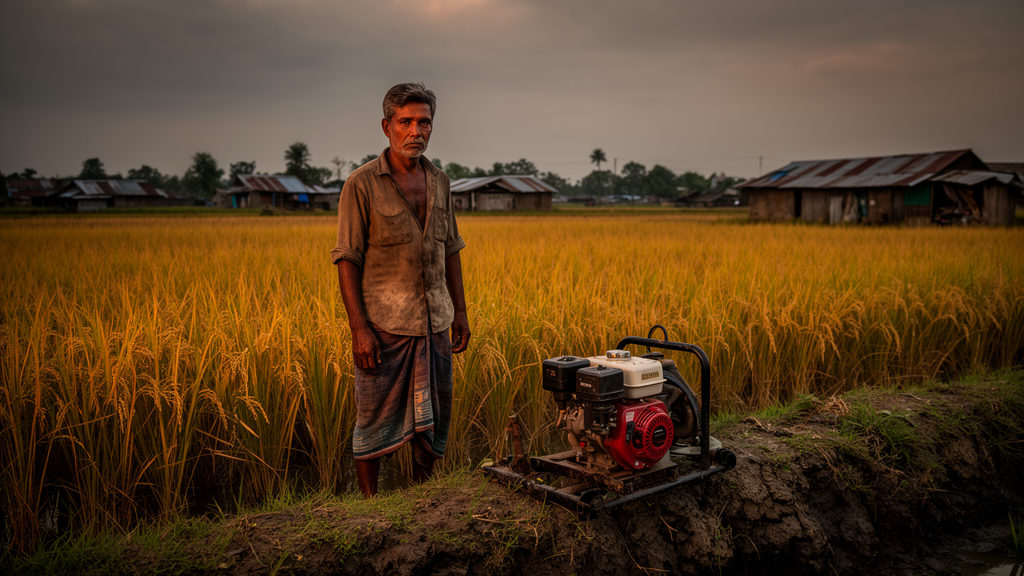
In the drought-prone farming villages of northern Bangladesh, the price of pumping groundwater is quietly deciding what families can afford to eat. A new study published in Frontiers in Sustainable Resource Management has put hard numbers on that connection, showing that when energy costs dominate irrigation expenses, household food spending falls measurably. The research, led by Tithy Dev of Memorial University and the University of Rajshahi, offers one of the clearest household-level demonstrations yet of the Water-Energy-Food (WEF) nexus—the idea that water, energy, and food systems are so tightly intertwined that a shock to one inevitably ripples through the other two.
The stakes are global as well as local. Agriculture accounts for roughly 70 percent of worldwide freshwater withdrawals, supplies nearly 40 percent of the world’s food through irrigation, and consumes more than a quarter of global energy for food production and distribution. By 2050, global water demand is projected to rise by 20 to 30 percent, water consumption for energy production is forecast to increase by 85 percent, and food demand is set to climb by 60 percent. Managing these resources as an integrated system rather than in separate silos has become a central theme of sustainability science, formalized at the Bonn 2011 Nexus Conference and championed by researchers such as Rabi H. Mohtar, who introduced the sustainability triangle framework in the late 1990s.
Northern Bangladesh is an ideal laboratory for testing that framework. The study focused on Rajshahi district, part of the Barind Tract, a region of hard red soils, high temperatures, and comparatively low rainfall. Rice is the dominant crop, providing nearly 90 percent of rural employment and about two-thirds of the average person’s calorie supply. But the district faces seasonal water scarcity, dropping groundwater levels, and unreliable electricity—conditions that make the water-energy-food triangle not an abstraction but a daily economic reality for farming households.
The research team surveyed 80 farming households between June 2019 and December 2020, collecting data on water usage patterns, energy sources, crop yields, and household income. They then applied a log-linear ordinary least squares regression model to identify the determinants of monthly household food expenditure. The key explanatory variable was a cost ratio: the proportion of energy cost relative to total irrigation cost. Because groundwater pumping is so energy-intensive in the region, this ratio serves as a direct indicator of how heavily a household’s water use depends on energy inputs.
The descriptive findings were striking. Energy costs represented 75 percent of total irrigation costs in the study area, driven primarily by the diesel-powered pumps that operate 80 percent of irrigation systems there. Irrigation itself was the largest single item in rice production costs, at roughly 30,000 Taka per acre—about 60 percent of the total. All survey respondents reported that irrigation costs had roughly doubled on an hourly basis over the past 10 to 15 years, a trend they attributed to rising temperatures, declining rainfall, and increased dependence on rice monoculture.
The regression results confirmed the central hypothesis. The cost ratio had a statistically significant negative impact on food expenditure, with a standardized coefficient of −0.225 and a p-value of 0.037. In practical terms, as energy costs come to dominate irrigation expenses, households spend less on food. Farm size (β = 0.238, p = 0.032) and household size (β = 0.157, p = 0.004) were both positively and significantly associated with food spending, while household income showed a positive but only marginally significant effect (β = 0.187, p = 0.091). The model explained 48.5 percent of the variance in food expenditure, with a Durbin-Watson statistic of 1.94 indicating no autocorrelation and variance inflation factors between 1.18 and 1.38 confirming the absence of problematic multicollinearity.
The food security picture was sobering. Households in the study area spent nearly 70 percent of their average monthly income on food, compared with less than 50 percent nationally. The required monthly food expenditure per household in the study area was 7,157.7 Taka, but actual spending averaged only 4,999.7 Taka—a shortfall of 2,158 Taka and a food access gap of roughly 30 percent, significantly higher than the national average of 8.93 percent. Cereals provided about 78 percent of household calories, with edible oil the second-largest source, reflecting a dietary imbalance rooted in insufficient domestic production of pulses, oilseeds, fruits, meat, milk, and eggs.
The study also traced how climate stressors cascade through the nexus. Annual maximum temperatures in the region rose by 0.013 to 0.032 degrees Celsius per year between 2001 and 2018, while annual rainfall dropped by as much as 24 percent in individual years. These changes increased irrigation demand and energy costs for groundwater pumping. Survey respondents reported that 37 percent faced higher production costs and 31 percent experienced actual production losses, with irrigation costs rising for 41 percent of households. The cascading effects extended beyond the farm: 78 percent reported reduced access to drinking water, 78 percent noted declining livestock numbers, and 90 percent faced rising medical costs, creating what the authors describe as a self-reinforcing cycle of food insecurity, water insecurity, and heightened vulnerability.
To break that cycle, the authors recommend transitioning from diesel-powered pumps to solar-powered irrigation systems, which would align with local weather patterns, stabilize energy costs, and buffer households from fossil fuel price volatility. They also call for climate-smart agricultural practices such as drought-tolerant crop varieties, rainwater harvesting, and conservation tillage, alongside stricter groundwater regulation and community-based water user associations. Social protection mechanisms—including indexed crop insurance and emergency food assistance during drought years—are seen as essential to prevent climate-driven poverty traps among the 90 percent of households facing rising medical costs.
The findings carry implications well beyond northern Bangladesh. By demonstrating that a simple expenditure ratio can serve as a proxy indicator of water-energy-food interdependencies at the household scale, the study offers a practical, context-sensitive tool for resource-constrained settings where detailed resource flow data are unavailable. The authors acknowledge limitations—a single drought-prone region, exclusive focus on rice cultivation, and a modest sample size of 80 households—but argue that integrated WEF nexus management is critical for achieving Sustainable Development Goals related to zero hunger, clean water, and affordable energy. As climate change intensifies pressure on semi-arid farming regions worldwide, the message is clear: managing water, energy, and food as one interconnected system is no longer optional—it is the pathway to keeping farming communities viable.
Subject of Research: Water-Energy-Food nexus dynamics among farming households in northern Bangladesh
Article Title: Exploring the water-energy-food nexus among farming households in northern Bangladesh
Article References: Dev, T., Hossain, M. E., Roy, S. C., Sabau, G., & Haghiri, M. (2026). Exploring the water-energy-food nexus among farming households in northern Bangladesh. Frontiers in Sustainable Resource Management, 5, Article 1815286. https://doi.org/10.3389/fsrma.2026.1815286
Image Credits: AI Generated
DOI: 10.3389/fsrma.2026.1815286
Keywords: water-energy-food nexus, Bangladesh, food security, irrigation, solar energy, climate change, farming households, sustainable development, Exploring, water-energy-food, nexus, farming
Cite Scienmag News
Sloane Callahan. (October 16, 2026). How Rising Energy Costs Are Squeezing Food Security in Northern Bangladesh. Scienmag. https://scienmag.com/how-rising-energy-costs-are-squeezing-food-security-in-northern-bangladesh/
Sloane Callahan. "How Rising Energy Costs Are Squeezing Food Security in Northern Bangladesh." Scienmag, 16 October 2026, https://scienmag.com/how-rising-energy-costs-are-squeezing-food-security-in-northern-bangladesh/. Accessed 16 October 2026.
Sloane Callahan. "How Rising Energy Costs Are Squeezing Food Security in Northern Bangladesh." Scienmag. October 16, 2026. https://scienmag.com/how-rising-energy-costs-are-squeezing-food-security-in-northern-bangladesh/


