Practical batteries never deliver the energy density that their active materials promise on paper. Between the electrochemical heart of a cell and the wheels of an electric vehicle, or the rotors of an electric aircraft, sits a hierarchy of structures that store no energy at all: casings, busbars, cooling plates, sensors, protective enclosures and control electronics. A new Review published in Nature Reviews Electrical Engineering by researchers at Contemporary Amperex Technology (CATL) and Jiangxi Normal University argues that the next leap in battery performance will not come from new chemistry alone, but from a disciplined way of thinking about what happens when these energy-free structures are stripped away. The authors, led by Hai-Peng Liang, frame battery integration as a process of function reassignment, and the framing changes how progress in the field should be measured.
The central insight is deceptively simple. Every boundary that engineers remove during integration once carried essential functions. A module housing provided mechanical protection, thermal conduction paths, electrical connections and a safety barrier against thermal runaway propagation. When a manufacturer eliminates the module and goes cell-to-pack, those functions do not vanish; they must be reassigned to fewer, lighter or more multifunctional elements. If they are not, the design pays a hidden penalty in safety, serviceability or lifetime. The Review therefore proposes that the true measure of integration progress is not how much structure can be deleted, but how much of the cell’s stored energy survives as system-level performance, safety and life-cycle value.
The scale of the losses involved explains why integration has become such a battleground. Analyses of commercial electric vehicles have quantified how energy density and specific energy decline step by step from cell to module to complete system, and studies of inert materials inside cells show how much of a cell’s mass contributes nothing to storage. Theoretical energy densities of active materials are consistently higher than what practical cells achieve, a gap documented across rechargeable battery systems. As gains from conventional lithium-ion chemistries slow, manufacturers have turned to architecture: moving from module-based packs to module-free designs, then to body-integrated and chassis-integrated concepts in which the battery becomes a structural element of the vehicle itself.
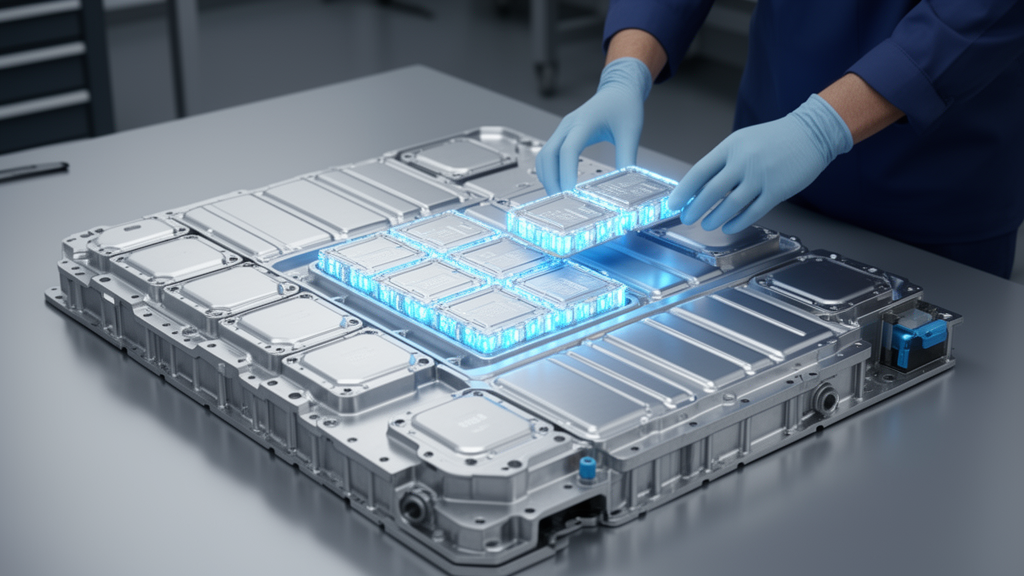
The Review traces this architectural evolution in detail. Cell-to-pack designs, popularized by cell makers and adopted across the industry, remove the module layer and mount cells directly into the pack enclosure. Cell-to-body and cell-to-chassis approaches go further, bonding cells or the entire pack into the vehicle structure so that the battery contributes to torsional stiffness and crash energy absorption. The authors caution, however, that volume utilization and specific energy alone do not capture the resulting gains and penalties. A pack that fills more of the available volume may also be harder to disassemble for recycling, more vulnerable to propagation of thermal runaway between cells, and more expensive to repair after a collision. Trade-offs, not simple metrics, define the frontier.
Four capabilities, the authors argue, set the practical limit of deeper integration: manufacturing quality, architecture-specific cell design, pack design, and sensing and control. Manufacturing quality matters because tightly integrated packs leave little tolerance for defects; a cell that swells unevenly or a seal that fails can compromise an entire structure. Architecture-specific cell design means that cells must be engineered for their integration role, not merely for standalone performance. Blade-style prismatic cells and large cylindrical cells embody different answers to the same question, as teardown analyses contrasting these formats have shown. Pack design determines how mechanical loads, thermal gradients and electrical connections are distributed. Sensing and control, finally, must compensate for the loss of physical boundaries with information: embedded sensors that monitor temperature and strain, and management systems that can detect and isolate faults before they propagate.
Safety deserves particular attention in this accounting. Thermal runaway, the cascade in which one failing cell ignites its neighbors, is governed by how cells are connected and how closely they are packed. Studies of cell-to-pack systems show that removing barriers can accelerate propagation, and research on large-format modules with different electrical connection modes demonstrates how configuration affects the spread of failure. Mitigation strategies range from interstitial heat-absorbing thermal barriers to compressible foams that prevent cascading runaway in pouch batteries. In deeply integrated designs, the safety functions once provided by module walls must be rebuilt as materials, coatings or active control, and the Review insists that this reassignment be counted honestly in any assessment of integration gains.
Beyond structure, the Review extends the integration concept to chemistry itself through multi-chemistry and multi-core packs. Instead of forcing a single cell type to serve conflicting demands, these architectures use controlled heterogeneity: pairing high-energy cells with high-power cells, or lithium-ion with sodium-ion, so that each chemistry operates in its comfort zone. Separable energy domains reduce the coupling between faults and chemistry-level compromises. Reconfigurable battery systems take this further, using switching electronics to change the electrical topology in real time, isolating degraded cells, balancing state of charge across heterogeneous groups, or adapting voltage to different charging infrastructure. The penalty is added complexity in power electronics and control, another trade-off that must be weighed at the system level.
The frontier of integration lies in platforms where every kilogram counts. Electric aircraft impose requirements far beyond those of road vehicles: batteries must deliver both high energy density for range and extraordinary power density for takeoff and climb, while meeting aviation safety standards. Analyses of vertical takeoff and landing aircraft define the performance metrics that next-generation cells must meet, and studies of battery safety for electric urban air mobility highlight the stakes of failure aloft. Structural battery composites, in which carbon fiber both carries load and stores charge, promise to make the airframe itself the energy store, though such materials remain at the laboratory stage. Humanoid robots present a complementary challenge: embodied energy concepts distribute storage throughout the robot body, trading the convenience of a single pack for endurance and balance, and soft modular power systems are being explored to compose robots from energy-storing components.
Emerging chemistries will reshape the integration calculus again. Lithium-metal and solid-state cells promise step changes in energy density, but they introduce mechanical and interfacial sensitivities that conventional lithium-ion does not. Lithium-metal anodes require controlled stack pressure to deposit and dissolve lithium uniformly; too little pressure promotes dendrites, while sustained high pressure can drive lithium creep through solid electrolytes. Solid-state batteries couple electrochemistry to external pressure in ways that pack designers must accommodate, and thermal management for these cells raises new questions. Bipolar stacking, in which each current collector carries a cathode on one side and an anode on the other, offers high voltage and energy density within a monolithic stack but demands flawless sealing to prevent ionic cross-talk between adjacent units. The Review argues that retained gains in these systems depend on mechanical and interfacial control, meaning integration decisions reach all the way into the cell.
The authors conclude that integration should be judged by a single question: does the reassignment of functions lower the total system penalty? A boundary should be removed only when its mechanical, thermal, electrical and safety roles move to fewer, lighter or more multifunctional elements without degrading performance, safety or life-cycle value. As electric vehicles, aircraft and robots converge on batteries as their defining component, this framework offers designers a common language for comparing architectures that look nothing alike, from blade cells bonded into vehicle floors to structural composites woven into aircraft wings. The measure of success, they argue, is not the structure engineers can remove, but the energy that survives the journey from active material to the moving platform it powers.
Subject of Research: Battery system integration in electric vehicles, aircraft and robots as a process of reassigning structural, thermal, electrical and safety functions
Article Title: Battery integration as function reassignment
Article References: Liang, H.-P., Wang, H., Sun, X., Long, C., Dou, X., Wu, K., & Ouyang, C. (2026). Battery integration as function reassignment. Nature Reviews Electrical Engineering. https://doi.org/10.1038/s44287-026-00342-2
Image Credits: AI Generated
DOI: 10.1038/s44287-026-00342-2
Keywords: battery integration, electric vehicles, cell-to-pack, structural batteries, thermal runaway, solid-state batteries, lithium-metal anodes, multi-chemistry packs, reconfigurable battery systems, electric aircraft, humanoid robots, energy density
Cite Scienmag News
Faith Mcneil. (October 16, 2026). Battery Integration Is Really About Reassigning Functions, Not Removing Parts. Scienmag. https://scienmag.com/battery-integration-is-really-about-reassigning-functions-not-removing-parts/
Faith Mcneil. "Battery Integration Is Really About Reassigning Functions, Not Removing Parts." Scienmag, 16 October 2026, https://scienmag.com/battery-integration-is-really-about-reassigning-functions-not-removing-parts/. Accessed 17 October 2026.
Faith Mcneil. "Battery Integration Is Really About Reassigning Functions, Not Removing Parts." Scienmag. October 16, 2026. https://scienmag.com/battery-integration-is-really-about-reassigning-functions-not-removing-parts/