

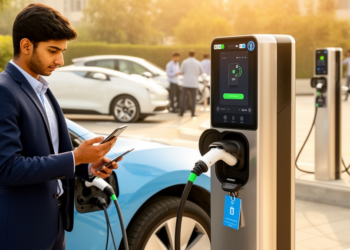
Technology readiness most strongly linked to Indian smart EV charging intention
A cross-sectional survey of 535 Indian electric-vehicle owners links technology readiness most strongly to intention to use smart charging, while ...
A cross-sectional survey of 535 Indian electric-vehicle owners links technology readiness most strongly to intention to use smart charging, while ...

A simulated menu-based charging framework combined range checks, congestion pricing and emergency preemption to cut average waiting time by 70.3% ...
A neural-network surrogate paired with differential evolution reduced model-predicted EV battery thermal risk by 94.8% across charging rates from 0.5C ...
A physics-guided digital-twin framework estimates electric vehicle battery energy minute by minute and is stress-tested across route, operating-regime, vehicle, and ...
A large-scale analysis of Indian household expenditure finds that gendered mobility disadvantage shows up not in higher transport spending but ...
Researchers in Shanghai have designed a multi-resonator acoustic metamaterial package that blocks electric motor noise below 2000 Hz, using a ...
A new hybrid GWO-PSO algorithm optimizes PID controllers to enhance frequency stability in renewable-integrated power systems, significantly reducing settling time ...
A new control framework for solar-integrated EV charging stations combines fuzzy logic, Kalman filtering, and predictive control to achieve high ...
A new MARL framework guided by MPC expert knowledge achieves coordinated frequency control across interconnected microgrids, with pass rates up ...
A new evaluation of six energy allocation strategies shows an adaptive fairness framework achieving a yearly Jain index of 0.9995 ...

Embark on a thrilling journey of discovery with Scienmag.com—your ultimate source for cutting-edge breakthroughs. Immerse yourself in a world where curiosity knows no limits and tomorrow’s possibilities become today’s reality!