

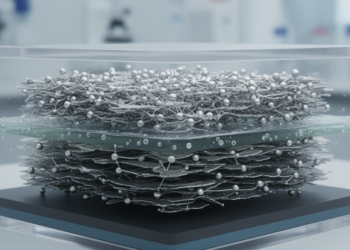
Nickel-Doped MoS2 Nanoparticles Improve Supercapacitor Electrode Performance
A laboratory study found that 6% nickel-doped MoS2 reached 1,210 F/g in a three-electrode test and 121 Wh/kg in an ...
A laboratory study found that 6% nickel-doped MoS2 reached 1,210 F/g in a three-electrode test and 121 Wh/kg in an ...

A finite-element model of a cerium dioxide–reduced graphene oxide electrode reported 2,758.7 mF cm−2 peak areal capacitance and 71% capacitance ...
A laboratory asymmetric supercapacitor using a sulfur-vacancy-engineered SnS2–Ti3C2Tx MXene cathode reached 58.33 Wh kg−1 and retained about 96% of its ...
A laboratory NiTe–MoS2/rGO supercapacitor electrode achieved 782 farads per gram and retained 87% of its initial capacity after 5,000 cycles.
Researchers in Lahore report a biphasic chromium-zirconium oxide nanocomposite wired with carbon nanotubes that achieves 748 F g⁻¹ and an ...
A new analysis argues that solid-state batteries could transform robotics, revealing that a single commercial robot consumes an EV-equivalent 60 ...
A new review argues that battery integration should be understood as function reassignment, where removed structures must transfer their mechanical, ...
Researchers have used water-soluble inorganic nitrogen precursors in a hydrothermal process to fine-tune nitrogen chemistry on graphene, producing a supercapacitor ...
KRICT researchers used porous graphitic carbon nitride as a lithium-ion guide in solvent-free thick cathodes, cutting charge-transfer energy barriers and ...
A hydrothermally synthesized CeO2/graphitic carbon nitride heterostructure delivers 675 F g−1 capacitance, 99.7% retention over 5000 cycles, and a surface-dominated ...

Embark on a thrilling journey of discovery with Scienmag.com—your ultimate source for cutting-edge breakthroughs. Immerse yourself in a world where curiosity knows no limits and tomorrow’s possibilities become today’s reality!