


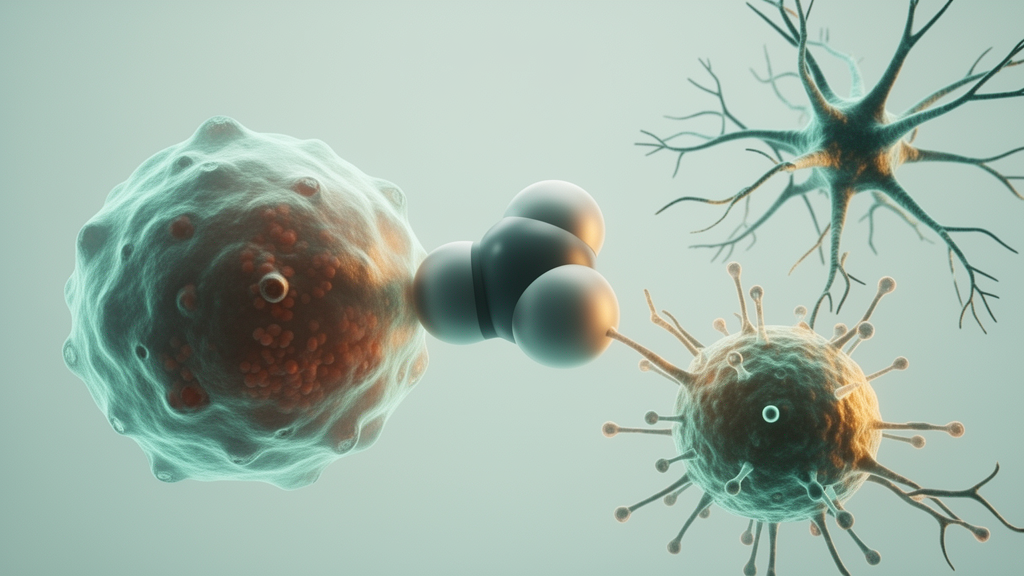
Researchers in Nanjing have combined two of the most talked-about ideas in modern cancer immunotherapy—artificial intelligence-guided protein design and immune-cell supplementation—to attack one of the hardest targets in gastrointestinal oncology. In a study published in the Journal of Translational Medicine, a team at the First Affiliated Hospital of Nanjing Medical University describes a T-cell engager molecule built with the help of the RFdiffusion protein-design system, aimed at the tight-junction protein CLDN18.2, a well-validated molecular target in gastric cancer. Their results tell a story with two halves: the engineered molecule works impressively well in the short term, but its durability depends on something the tumor microenvironment often refuses to provide—robust local immune support, particularly from dendritic cells.
T-cell engagers, often called TCEs or bispecific T-cell redirecting molecules, are designed to do exactly what their name suggests: physically bridge a T cell to a tumor cell. One arm of the molecule binds a tumor-associated antigen on the cancer cell surface, while the other binds CD3, a component of the T-cell receptor complex. When both arms engage their targets, the T cell is forced into close contact with the tumor cell, triggering activation, release of cytotoxic granules, and killing of the malignant cell. The approach has produced striking clinical successes in blood cancers, where antibodies can reach malignant cells circulating in the bloodstream. Solid tumors, however, have proven far more stubborn, and gastric cancer is a textbook example of why.
The obstacle is not usually the lack of a good target. CLDN18.2, a member of the claudin family of tight-junction proteins, is expressed on the surface of gastric cancer cells and is largely absent from most adult tissues outside the stomach mucosa, making it one of the most attractive antigens in the field. The problem is that many gastric tumors are immunologically cold—poorly infiltrated by T cells, lacking the chemokine signals that recruit them, and dominated by immunosuppressive stromal features. A T-cell engager can only redirect T cells that are actually present in or near the tumor. If the tumor bed contains few CD8-positive cytotoxic T cells, even a perfectly designed bridging molecule has little to work with.
The design of the new molecule began in silico. Rather than starting from an existing antibody, the team used an RFdiffusion-assisted workflow—a computational approach that generates novel protein structures by a diffusion-based process, effectively imagining new binding surfaces that can grip a chosen target. Candidate CLDN18.2 binders were screened computationally, and the most promising designs were incorporated into both human and murine CD3-engaging T-cell engager formats, allowing the researchers to test the concept in parallel across human-relevant and mouse-model systems. This design philosophy is part of a broader shift in protein engineering: instead of repurposing natural scaffolds, scientists can now specify a desired binding interaction and let generative models propose molecular architectures that satisfy it.
The selectivity testing focused on a critical safety concern. Claudin proteins are close relatives, and a therapeutic that binds CLDN18.1 as well as CLDN18.2 could damage healthy lung epithelium, where CLDN18.1 is found. In cell-surface binding assays, the selected engager bound CLDN18.2-positive tumor cells and CD3-positive T cells while showing limited detectable binding to cells expressing CLDN18.1. Functional testing followed in increasingly realistic settings: engineered gastric cancer cell lines, patient-derived tumor cells, and patient-derived organoids—three-dimensional cultures grown from actual patient tissue that preserve much of the cellular complexity of the original tumor. Across all of these platforms, the molecule induced CLDN18.2-dependent tumor-cell killing and activated CD8-positive T cells, confirming that the computationally designed binder could perform its biological job, not just bind its target in a test tube.
Then came the in vivo experiments, and with them the study’s central twist. In both syngeneic mouse models—immunocompetent animals with intact immune systems—and humanized models created by reconstituting mice with human peripheral blood mononuclear cells and carrying patient-derived tumor xenografts, the T-cell engager produced early tumor inhibition. But as the experiments progressed, tumor control weakened. The engager was bridging T cells to tumor cells, yet the effect was not sustaining itself. The team examined the tumors and found a consistent pattern: limited accumulation of T cells inside the tumor, increased expression of PD-1, the canonical marker of T-cell exhaustion, sparse populations of CD11c-positive dendritic cells, and weak signaling through CXCL9 and CXCL10, chemokines that normally act as beacons drawing T cells into tissue.
That molecular fingerprint pointed directly at the missing ingredient. Dendritic cells are the professional sentinels and coordinators of the immune system; they present antigen to T cells, secrete inflammatory cytokines such as interleukin-12, and produce the very chemokines—CXCL9 and CXCL10 among them—that recruit effector T cells into tumors. The researchers hypothesized that supplementing the T-cell engager treatment with additional dendritic cells might rebuild the local immune circuit that the cold tumor environment lacked. The experiment confirmed the hypothesis: adding dendritic cells improved TCE-mediated tumor-cell killing in co-culture systems and strengthened tumor control in vivo, converting a waning response into a more durable one.
To understand exactly how the dendritic cells were helping, the team ran mechanistic experiments using blocking antibodies. When they blocked MHC-II, the molecule dendritic cells use to present antigen to helper T cells, the enhancement was only modestly reduced. When they blocked interleukin-12, however, the dendritic-cell-associated boost was consistently diminished. The interpretation is significant for the field: the added dendritic cells were not primarily acting as antigen-presenting machines in this setting, but as cytokine factories, providing the inflammatory support—IL-12 and the downstream CXCL9/CXCL10 chemokine axis—that keeps redirected T cells active, recruited, and functional inside the tumor.
The implications extend well beyond gastric cancer. The study demonstrates that generative protein design tools like RFdiffusion can produce functional, selective therapeutic binders against clinically validated targets, compressing a discovery process that once took years of antibody engineering. Just as importantly, it offers a candid lesson about the limits of that technology: a beautifully designed molecule that bridges T cells to tumor cells cannot, by itself, overcome a tumor microenvironment that lacks the supporting immune infrastructure. The authors’ conclusion—that CLDN18.2-directed T-cell engagers should be tested together with strategies that rebuild local dendritic-cell–T-cell circuits—frames a design principle likely to shape the next generation of solid-tumor immunotherapy combinations.
Caveats remain, as they do in any preclinical translational study. The work rests on engineered cell lines, patient-derived cultures, organoids, and mouse models rather than human clinical trials, and the published version is an early-release, peer-reviewed accepted manuscript that may undergo further editorial refinement. The dendritic-cell supplementation strategy, while mechanistically compelling, would require substantial development before clinical application—questions of cell sourcing, manufacturing, timing, and delivery all remain open. Still, the study offers a clear and testable roadmap: pair AI-designed targeting molecules with interventions that restore the chemokine and cytokine signals cold tumors fail to produce. For patients with CLDN18.2-positive gastric cancer, a disease with limited options in advanced stages, that roadmap represents a rational path from computational design to combination therapy, one that the field will be watching closely as these strategies move toward clinical evaluation.
Subject of Research: RFdiffusion-designed CLDN18.2 T-cell engager combined with dendritic-cell supplementation for gastric cancer immunotherapy
Article Title: RFdiffusion-designed CLDN18.2 T-cell engager coupled with dendritic-cell supplementation enhances antitumor immunity in gastric cancer
Article References: RFdiffusion-designed CLDN18.2 T-cell engager coupled with dendritic-cell supplementation enhances antitumor immunity in gastric cancer. (n.d.). https://doi.org/10.1186/s12967-026-08841-4
Image Credits: AI Generated
DOI: 10.1186/s12967-026-08841-4
Keywords: RFdiffusion, T-cell engager, CLDN18.2, gastric cancer, dendritic cells, IL-12, CXCL9, CXCL10, protein design, immunotherapy, organoids, patient-derived xenografts
Cite Scienmag News
Nathaniel Bowman. (October 9, 2026). AI-Designed Protein Drug Recruits Immune Cells to Fight Gastric Cancer—With a Helping Hand from Dendritic Cells. Scienmag. https://scienmag.com/ai-designed-protein-drug-recruits-immune-cells-to-fight-gastric-cancer-with-a-helping-hand-from-dendritic-cells/
Nathaniel Bowman. "AI-Designed Protein Drug Recruits Immune Cells to Fight Gastric Cancer—With a Helping Hand from Dendritic Cells." Scienmag, 9 October 2026, https://scienmag.com/ai-designed-protein-drug-recruits-immune-cells-to-fight-gastric-cancer-with-a-helping-hand-from-dendritic-cells/. Accessed 9 October 2026.
Nathaniel Bowman. "AI-Designed Protein Drug Recruits Immune Cells to Fight Gastric Cancer—With a Helping Hand from Dendritic Cells." Scienmag. October 9, 2026. https://scienmag.com/ai-designed-protein-drug-recruits-immune-cells-to-fight-gastric-cancer-with-a-helping-hand-from-dendritic-cells/


