


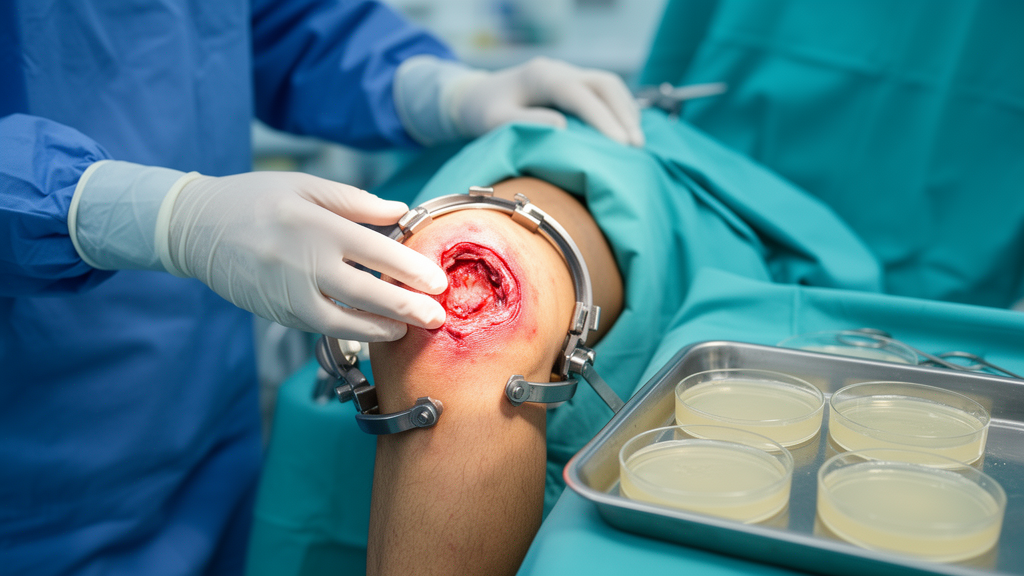
When a hip or knee replacement becomes infected, surgeons and infectious disease specialists rely on one crucial piece of information above almost all others: the identity of the microbe causing the trouble. Laboratory cultures of tissue and fluid sampled around the implant normally reveal the culprit and guide the choice of antibiotics. But in a substantial fraction of cases, those cultures stubbornly come back negative, leaving clinicians to fight an invisible enemy. A new systematic review and meta-analysis, published in the Journal of Bone and Joint Infection, has now pooled the global evidence on these culture-negative periprosthetic joint infections, and the headline finding is unexpectedly reassuring: patients with these mysterious infections can do remarkably well, particularly when treated with exchange arthroplasty rather than less aggressive approaches.
The study, led by Farzad Pourghazi and colleagues at the Mayo Clinic together with international collaborators, searched MEDLINE and Scopus through July 2025 and identified 27 cohort studies encompassing 1,399 patients with culture-negative periprosthetic joint infection. The infections spanned 584 hips, 809 knees, five shoulders, and a single elbow. Using random-effect statistical models designed to handle the considerable variability between studies, the team calculated a pooled treatment success rate of 83.6 percent, a pooled failure rate of 17.2 percent, and a pooled mortality of just 2.4 percent. For a condition in which both antibiotic selection and surgical planning are typically empirical, those numbers suggest that the absence of a named pathogen does not, by itself, doom a patient to a poor outcome.
The scale of the diagnostic problem is worth appreciating. Periprosthetic joint infection complicates roughly 2 percent of the millions of total joint replacements performed worldwide each year, and culture-negative cases account for somewhere between 5 and 42 percent of all such infections, depending on the population and the diagnostic methods used. Modern laboratories have an arsenal of tricks to coax hidden organisms into view, including prolonged incubation, sonication of the removed implant to dislodge adherent biofilm bacteria, and molecular assays such as next-generation sequencing that can detect bacterial DNA without requiring growth in culture. Yet even with these tools, a subset of infections yields no organism, and clinicians must treat blind.
Why do cultures fail in these cases? The most likely explanations, long discussed in the literature, include prior antibiotic exposure before samples were taken, slow-growing or fastidious organisms that resist standard culture conditions, and bacteria hiding within biofilms on the implant surface in forms that do not grow on routine media. Prior antimicrobial therapy has been identified as a risk factor for culture negativity, which is one reason some experts advocate holding antibiotics before surgery whenever clinically safe. Whatever the cause, the practical consequence is the same: the surgical team must choose between treatment strategies and pick an antibiotic regimen without knowing exactly what they are treating.
The surgical options fall into three broad categories. Debridement, antibiotics, and implant retention, known as DAIR, involves opening the joint, washing out infected tissue, and keeping the original prosthesis in place; it is generally reserved for acute infections with a well-fixed implant and no sinus tract. One-stage exchange arthroplasty removes and replaces the implant in a single operation, while two-stage exchange, often considered the standard of care for chronic infection, removes the prosthesis, places a temporary antibiotic-loaded spacer, and reimplants a new device only after a course of antibiotics. The new meta-analysis compared these strategies directly and found significant differences.
The numbers were striking. DAIR achieved a pooled success rate of only 73.2 percent, with failure in 29.4 percent of cases, whereas two-stage exchange reached 87.4 percent success with 14.0 percent failure, and one-stage exchange achieved 86.2 percent success with 13.8 percent failure. In other words, patients treated with exchange arthroplasty fared substantially better than those whose implants were retained. The authors are careful to note that this does not mean culture status alone should dictate surgical strategy; the choice between DAIR and exchange depends heavily on infection chronicity, implant stability, the patient’s overall health, and soft-tissue conditions. But the pattern is consistent with the broader understanding that DAIR works best in a narrow, carefully selected group of early infections.
An intriguing secondary finding emerged when the researchers split the data by joint. Hip infections showed a pooled success rate of 94.2 percent, while knee infections lagged at 75.8 percent, a statistically significant difference. The authors urge caution here, noting that this gap may reflect differences in patient selection, infection characteristics, or treatment practices between the hip and knee populations rather than any true biological effect of the joint itself. Still, the finding adds to a long-running debate in the orthopedic literature about whether knee infections are intrinsically harder to eradicate.
On the antimicrobial side, the picture was far messier. Antibiotic regimens across the 27 studies were so heterogeneous and so incompletely reported that the authors could not pool them statistically and instead summarized them descriptively. Vancomycin-based postoperative regimens were the most commonly reported, either alone or combined with other agents, reflecting the need to cover staphylococci, the most frequent causes of prosthetic joint infection, including resistant strains. Cephalosporins such as cefazolin, ceftriaxone, ceftazidime, and cefepime appeared frequently, and fluoroquinolones like ciprofloxacin and levofloxacin were common choices for oral step-down therapy after an initial intravenous phase. Treatment durations varied widely. This individualized, protocol-free approach likely reflects the thin evidence base for empirical therapy, but it also raises concerns: broad-spectrum regimens carry risks of toxicity and adverse events, and experts have called for better diagnostics and stronger antimicrobial stewardship in this space.
The study is not without caveats, and the authors are candid about them. Twenty-six of the 27 included studies were retrospective, exposing the analysis to selection bias, confounding, and incomplete reporting. Definitions of treatment success, failure, and reinfection varied from institution to institution despite repeated attempts by professional societies to standardize them, and this inconsistency fueled substantial statistical heterogeneity. More troubling, funnel plot asymmetry and Egger’s regression test suggested possible publication bias: trim-and-fill analysis, which imputes hypothetically missing studies, lowered the adjusted success estimate to 74.0 percent and raised the adjusted failure estimate to 25.6 percent. The true picture, in other words, may be somewhat less rosy than the raw pooled numbers suggest, though still consistent with a generally favorable prognosis.
What emerges from this work is a dual message. On one hand, culture-negative periprosthetic joint infection, long viewed with apprehension precisely because the pathogen is unknown, appears to carry outcomes comparable to, and in some analyses better than, culture-positive disease, particularly when managed with exchange arthroplasty guided by established surgical principles and sensible empirical antibiotics. On the other hand, the evidence remains observational, heterogeneous, and vulnerable to bias. The authors call for prospective, multi-center studies with standardized definitions of culture-negative infection and uniform reporting of outcomes, surgical selection criteria, and antimicrobial regimens. Until such studies arrive, clinicians treating an infected joint replacement with negative cultures can take some comfort: treating blind, it turns out, is not the same as treating badly.
Subject of Research: Treatment strategies and outcomes of culture-negative periprosthetic joint infection
Article Title: Management and outcomes of culture-negative periprosthetic joint infection: a systematic review and meta-analysis
Article References: Pourghazi, F., Alavi, S. M. A., Matsuo, T., Baaklini, G., Abdel, M. P., Tande, A. J., & Berbari, E. F. (2026). Management and outcomes of culture-negative periprosthetic joint infection: a systematic review and meta-analysis. Journal of Bone and Joint Infection, 11(4), 413-430. https://doi.org/10.5194/jbji-11-413-2026
Image Credits: AI Generated
Keywords: periprosthetic joint infection, culture-negative infection, total joint arthroplasty, meta-analysis, DAIR, exchange arthroplasty, antibiotic therapy, orthopedic surgery, vancomycin, treatment failure, systematic review, implant infection
Cite Scienmag News
Kristina Jarvis. (October 9, 2026). When Cultures Come Back Negative: Joint Infection Outcomes Are Better Than Feared. Scienmag. https://scienmag.com/when-cultures-come-back-negative-joint-infection-outcomes-are-better-than-feared/
Kristina Jarvis. "When Cultures Come Back Negative: Joint Infection Outcomes Are Better Than Feared." Scienmag, 9 October 2026, https://scienmag.com/when-cultures-come-back-negative-joint-infection-outcomes-are-better-than-feared/. Accessed 9 October 2026.
Kristina Jarvis. "When Cultures Come Back Negative: Joint Infection Outcomes Are Better Than Feared." Scienmag. October 9, 2026. https://scienmag.com/when-cultures-come-back-negative-joint-infection-outcomes-are-better-than-feared/


