


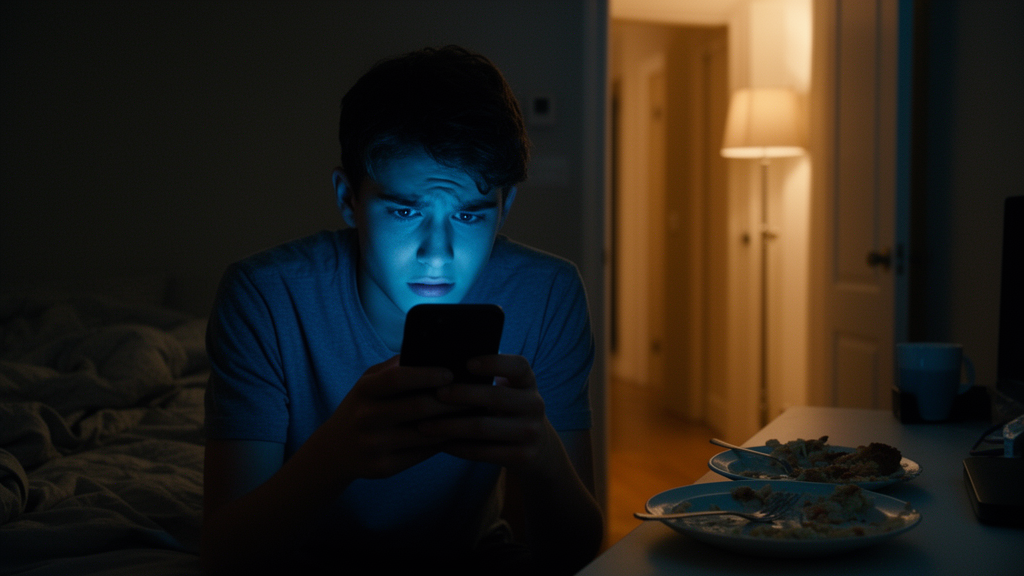
Online spaces have become inseparable from how young people experience their bodies, their food, and their sense of self. A new qualitative evidence synthesis published in PLOS Digital Health offers one of the most detailed accounts yet of how 11- to 25-year-olds with lived experience of eating disorders navigate the digital world, and the picture it paints resists easy answers. Rather than treating online content as simply harmful or simply helpful, the research reveals a landscape of contradictions, where the same platform can simultaneously provide belonging and deepen distress.
The study, conducted by Meena Khatwa, Rebecca Rees, Claire Stansfield, Vidhi Bassi, Ceri-Nicole Wilkins, and Kelly Dickson, employed thematic synthesis methods, a systematic approach to qualitative research that identifies, codes, and integrates findings across multiple studies to generate overarching themes. The team searched for studies published from 2007 onwards that captured the views of young people in OECD countries who identified as having had an eating disorder, disordered eating, or eating difficulties. From the pool of eligible research, thirteen studies met the inclusion criteria, and from these the researchers distilled three key themes that structure their findings: Comparing, Curating, and Community.
The first theme, Comparing, describes how young people used online content to evaluate both others and themselves. Social media environments are saturated with images of idealised bodies, and the synthesis found that exposure to such material became a lens through which participants measured their own appearance, eating habits, and worth. This evaluative process was not a passive experience; young people described actively scanning feeds, scrutinising the bodies of peers and influencers, and turning that scrutiny inward. The researchers note that growing attention has been paid worldwide to problematic discourse around ideal bodies and to how exposure to related content might influence disordered eating and other eating disorder symptoms, and the lived experiences captured in these studies give that concern a concrete, personal dimension.
Yet the comparison theme also carries an important nuance. Participants did not uniformly describe comparison as destructive. Some young people reported that seeing others discuss recovery, or witnessing bodies different from the narrow ideals promoted online, could interrupt harmful thought patterns. The synthesis makes clear that the direction of the effect depends heavily on context: what appears in the feed, who is posting it, and what state of mind the viewer brings to the encounter. This variability is precisely why the authors frame online eating disorder content as double-edged, capable of cutting in either direction depending on circumstances that no single content moderation rule can fully anticipate.
The second theme, Curating, captures the agency young people exerted over their digital environments. Far from being passive recipients of algorithmic output, participants described deliberate strategies for managing what they saw. These included unfollowing or muting accounts that triggered distress, actively seeking out recovery-oriented content, and shaping their feeds to reduce exposure to material that glorified disordered eating. Curation, in the accounts synthesised by the researchers, was a form of self-protection and, at times, a component of self-directed recovery. However, the theme also exposes the limits of individual effort. Curating a feed requires constant vigilance, and harmful content could resurface through recommendations, hashtags, or the behaviour of other users, meaning that the burden of safety fell largely on the very young people the content endangered.
This burden is a technically significant finding for platform design and public health policy. If harm mitigation depends on users continuously filtering their own environments, then platforms that surface triggering material through recommendation systems effectively outsource risk management to vulnerable adolescents and young adults. The synthesis suggests that young people are aware of this dynamic and often frustrated by it, describing curation as exhausting work layered on top of the psychological strain of the illness itself. Any regulatory or design response, the findings imply, should account for the reality that user-side controls are neither uniformly available nor uniformly effective.
The third theme, Community, documents the pull of online spaces where connection over shared experience becomes possible. For many participants, forums, social media groups, and comment sections offered something they could not find offline: people who understood, without explanation, what it felt like to live with an eating disorder. This sense of inclusion could be profoundly supportive, normalising help-seeking, validating difficult emotions, and providing practical encouragement toward recovery. The synthesis is careful not to dismiss these spaces, because doing so would erase a genuine source of comfort reported across the included studies.
At the same time, the Community theme carries the sharpest warning in the research. The same intimacy that made these spaces supportive could also make them harmful, since communities formed around shared illness can reinforce disordered behaviours, normalise competitive symptomatology, and keep users tethered to the identity of being ill. Participants across the studies described this ambivalence directly: the spaces offered inclusion but could also be experienced as harmful, sometimes within the same conversation or the same week. The researchers’ framing of online spaces as double-edged is not a rhetorical flourish but a structural description of how these communities function, holding both protective and corrosive potential in a single environment.
Beneath all three themes, the synthesis identified a contextual factor that the authors highlight as central: a lack of supportive, offline, mental health-promoting spaces. Young people’s heavy engagement with online eating disorder content did not occur in a vacuum. Where face-to-face services were scarce, waiting lists were long, stigma was pervasive, or everyday environments offered no safe place to discuss food, body image, and distress, the internet filled the gap. This finding reframes the popular narrative that social media causes eating disorder distress in isolation. Instead, the evidence suggests that online engagement is entangled with what offline support is missing, and that digital harm cannot be meaningfully reduced without strengthening the real-world resources young people can turn to.
For clinicians, researchers, and platform designers, the practical implications are layered. Interventions that simply remove or ban eating disorder content risk cutting young people off from the community and recovery resources they genuinely value, while approaches that rely solely on user curation leave the structural drivers of harm untouched. The synthesis points instead toward strategies that acknowledge complexity: designing recommendation systems that account for vulnerability, expanding offline and clinical support so that online spaces are not the only refuge, and involving young people with lived experience in shaping both digital and real-world interventions. As eating disorders continue to be a concern worldwide, this research demonstrates that the question is no longer whether online content is good or bad for young people, but how to tip the balance of environments that are, by their nature, both at once.
Subject of Research: Young people's experiences of online eating disorder content
Article Title: The complexities and contradictions of online eating disorder content: A qualitative evidence synthesis of young people’s views and experiences
Article References: Khatwa, M., Rees, R., Stansfield, C., Bassi, V., Wilkins, C.-N., & Dickson, K. (2026). The complexities and contradictions of online eating disorder content: A qualitative evidence synthesis of young people’s views and experiences. PLOS Digital Health, 5(10), e0001066. https://doi.org/10.1371/journal.pdig.0001066
Image Credits: AI Generated
DOI: 10.1371/journal.pdig.0001066
Keywords: eating disorders, social media, qualitative evidence synthesis, young people, mental health, online communities, body image, thematic synthesis, digital health, recovery, content curation, PLOS Digital Health
Cite Scienmag News
Denise Maddox. (October 9, 2026). Young People Reveal the Double-Edged Nature of Online Eating Disorder Content. Scienmag. https://scienmag.com/young-people-reveal-the-double-edged-nature-of-online-eating-disorder-content/
Denise Maddox. "Young People Reveal the Double-Edged Nature of Online Eating Disorder Content." Scienmag, 9 October 2026, https://scienmag.com/young-people-reveal-the-double-edged-nature-of-online-eating-disorder-content/. Accessed 9 October 2026.
Denise Maddox. "Young People Reveal the Double-Edged Nature of Online Eating Disorder Content." Scienmag. October 9, 2026. https://scienmag.com/young-people-reveal-the-double-edged-nature-of-online-eating-disorder-content/


