


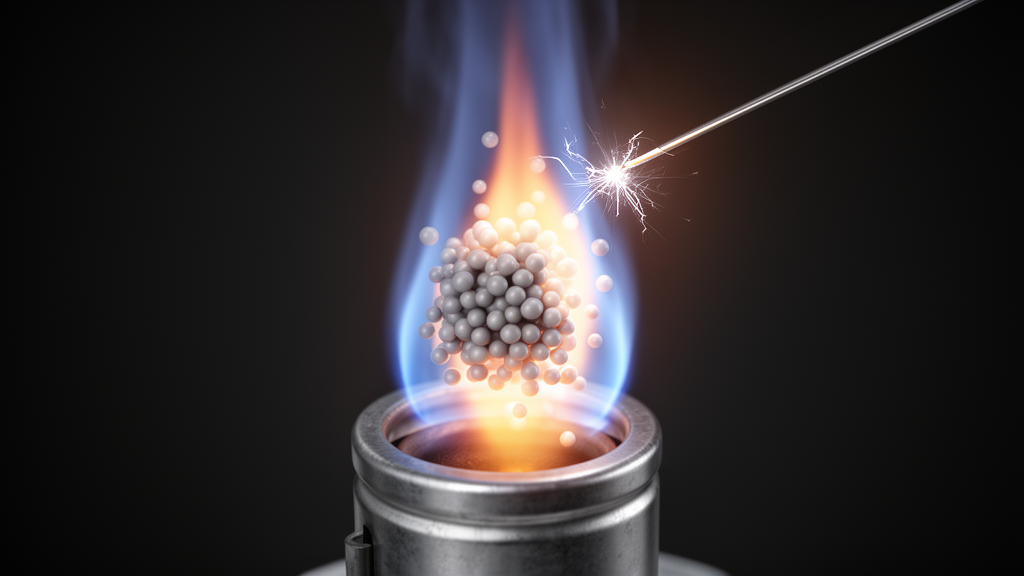
Scientists have long known that zapping a flame with plasma can make it burn more stably and cleanly. What has remained murky is what that same electrical jolt does to the tiniest particles born inside the fire. A new study published in the journal Aerosol Research by Chanakya Bagya Ramesh, Frank Daoru Han, and Yang Wang offers the first detailed look at how a corona discharge reshapes the formation of titanium- and silicon-containing nanoparticles smaller than 10 nanometers, and the answer turns out to be a surprising double-edged sword: depending on how much precursor material is flowing into the flame, the plasma can either boost particle formation or shut it down.
The research matters because combustion synthesis is one of the workhorses of the nanomaterials industry, a sector valued at roughly 16.3 billion US dollars in 2025 and projected to grow at about 15 percent annually over the next six years. Titanium dioxide and silicon dioxide, the two oxides examined in this study, are produced at enormous scale for paints, catalysts, solar cells, carbon-based products, and drug delivery systems. Because nanoparticles form within milliseconds in the coupled heat and flow fields of a flame, their quality is exquisitely sensitive to flame instability and incomplete combustion. Plasma-assisted combustion, or PAC, has been promoted as a fix for exactly those problems, injecting clouds of ions, electrons, and reactive radicals that stabilize and energize the flame while cutting emissions.
Yet, as the authors point out, almost no one had directly measured what PAC does to the very earliest stages of inorganic particle formation. Previous work had shown that plasmas suppress soot, and a 1995 study by Vemury and Pratsinis found that a DC corona discharge shrank titania particles, apparently by shortening their residence time in the hot zone through ionic wind effects. But no in situ diagnostic study had ever tracked aerosol formation during plasma-assisted combustion at the sub-10-nanometer scale where particles are truly born. That gap is what the Miami and Missouri S&T team set out to close.
The experimental setup was elegantly simple in concept. The researchers burned a stoichiometric methane-oxygen mixture above a concentric tube burner, seeding the flame with vapors of titanium isopropoxide (TTIP) or tetraethyl orthosilicate (TEOS), two common precursors for making titania and silica. Two sharpened tungsten electrodes, placed 6 millimeters apart just above the burner, generated a high-frequency alternating current corona discharge at roughly 21 kilohertz, powered at either 56 or 125 watts. Choosing high-frequency AC was deliberate: at these frequencies the ionic wind that dominates DC discharges is minimized, so charged species enter the flame mainly by diffusion, letting the team isolate the chemistry of the plasma itself.
To watch particles at their birth, the team sampled the flame through a dilution probe that instantly quenched further reactions, then measured particle sizes with a high-resolution differential mobility analyzer paired with an electrometer, covering the 1-to-10-nanometer range. A dilution ratio of 152, combining flow mixing and thermal expansion, froze the aerosol dynamics so that what was measured reflected the flame, not the sampling line. Thermocouple measurements confirmed that the precursors barely disturbed the flame chemistry; even at the highest feed rates, oxidation of TTIP or TEOS shifted the flame only about 0.7 to 1.3 percent toward fuel-rich conditions, leaving temperature essentially unchanged.
The first surprise came from the ions themselves. Without precursors, the flame alone produces positive ions peaking near 1.2 nanometers and negative ions with bimodal peaks at 0.6 and 0.8 nanometers. When the corona discharge was switched on, the positive-ion size distribution barely moved, but its concentration jumped by 45 percent at 56 watts and 62 percent at 125 watts. The negative ions told a richer story: the 0.8-nanometer peak grew, and a new peak emerged at 1.0 nanometer, suggesting the plasma promotes distinct negative-ion chemistry rather than simply amplifying what the flame already makes. In short, the discharge does not create fundamentally new ionic species so much as supercharge the existing population, with negative ions drifting toward larger sizes.
Then came the central finding. At low precursor feed rates, up to about 19.2 milligrams per hour for TTIP and 60 milligrams per hour for TEOS, the plasma promoted particle formation and growth. Positively charged titanium-containing particle concentrations rose by 86 to 150 percent under the 125-watt discharge, and negatively charged clusters surged by up to 265 percent, with mode diameters growing by as much as 42 percent. The likely explanation is that plasma-generated ions, present at concentrations comparable to or exceeding the nascent particles, coagulate with them and even trigger ion-induced nucleation, a phenomenon in which charged seeds dramatically accelerate the formation of new particles from supersaturated vapors. An electron-rich environment can also promote nuclei formation at lower supersaturation, compounding the effect.
At high precursor feed rates, above roughly 29 milligrams per hour for TTIP and 80 for TEOS, the picture flipped. Particle sizes shrank, with mobility diameters suppressed by up to 12 percent for titanium-containing particles and up to 20 percent for silicon-containing ones. To explain the reversal, the team modeled how particles accumulate charge through diffusion charging and field charging. The calculations showed that electrons, with their extraordinary mobility of about 4000 square centimeters per volt-second and vanishingly small mass, dominate diffusion charging by orders of magnitude, and field charging by electrons under the plasma’s electric field was roughly 69 times stronger than in a flame alone. Because negative charge carriers, electrons and fast, light negative ions, outpace the heavier positive ions, particles become preferentially negatively charged. Like charges repel, and that electrostatic repulsion suppresses coagulation, the main growth pathway when particle concentrations are high. The suppression effect, it turns out, simply overwhelms the nucleation promotion once enough particles crowd the flame.
The implications stretch from the factory floor to pollution control. Industrial nanoparticle synthesis operates in heavily loaded regimes with high precursor concentrations, precisely the conditions where the team found suppression. The results suggest that dialing ion concentration to match precursor loading could give operators a practical knob for tuning particle size in real time, and the same physics could help strip unwanted particulates from combustion exhausts. The authors caution that mobility analysis alone cannot fully resolve the mechanism; imaging and chemical analysis of particles below 5 nanometers remain notoriously difficult because the particles are so highly diffusive, and complementary offline characterization will be needed to complete the picture. They also note an unexpected temperature rise in the plasma-assisted flame, attributed to elongation of the reaction zone, which may itself influence downstream growth. Still, the study delivers something the field has lacked: a mechanistic, size-resolved demonstration that a flick of electrical power can flip nanoparticle formation between promotion and suppression, turning the flame into a switchable nanomaterials reactor.
Subject of Research: Plasma-assisted combustion and the formation of sub-10 nm titanium- and silicon-containing nanoparticles
Article Title: Nascent titanium-/silicon-containing particle formation in corona-discharge-assisted combustion
Article References: Bagya Ramesh, C., Han, F. D., & Wang, Y. (2026). Nascent titanium-/silicon-containing particle formation in corona-discharge-assisted combustion. Aerosol Research, 4(1), 265-277. https://doi.org/10.5194/ar-4-265-2026
Image Credits: AI Generated
Keywords: plasma-assisted combustion, corona discharge, nanoparticle synthesis, combustion synthesis, titanium dioxide, silicon dioxide, ion-induced nucleation, aerosol science, differential mobility analyzer, electrostatic repulsion, particle charging, flame chemistry
Cite Scienmag News
Bethany Barker. (October 9, 2026). Electric Sparks in Flames Can Switch Nanoparticle Growth On or Off. Scienmag. https://scienmag.com/electric-sparks-in-flames-can-switch-nanoparticle-growth-on-or-off/
Bethany Barker. "Electric Sparks in Flames Can Switch Nanoparticle Growth On or Off." Scienmag, 9 October 2026, https://scienmag.com/electric-sparks-in-flames-can-switch-nanoparticle-growth-on-or-off/. Accessed 9 October 2026.
Bethany Barker. "Electric Sparks in Flames Can Switch Nanoparticle Growth On or Off." Scienmag. October 9, 2026. https://scienmag.com/electric-sparks-in-flames-can-switch-nanoparticle-growth-on-or-off/


