


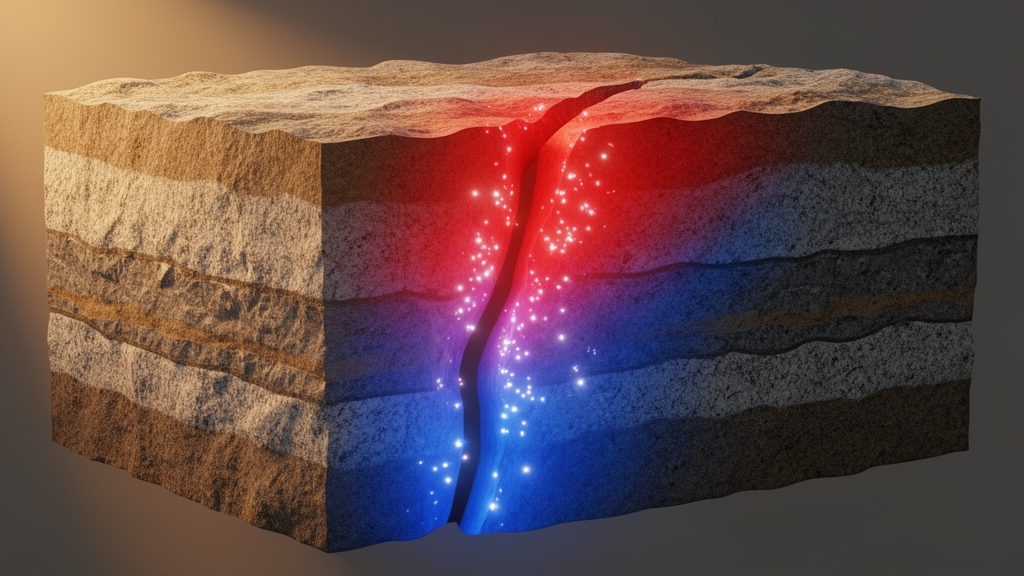
When a major earthquake strikes, the danger is far from over. Smaller shocks can continue for days, months, or even years, compounding the destruction and hampering rescue efforts. Yet predicting precisely where these aftershocks will strike remains one of seismology’s most stubborn challenges. A new study published in Nonlinear Processes in Geophysics offers a strikingly different answer to this problem, one that could reshape how emergency managers think about the hours and weeks following a devastating mainshock. The research, conducted by Boi-Yee Liao of Krirk University in Thailand, introduces a dynamic framework for tracking how underground stress evolves after a large earthquake, and it arrives at a conclusion that challenges conventional practice: in many circumstances, the spatial gradient of stress, rather than the magnitude of stress itself, is the more reliable signal of where aftershocks will occur.
The foundation of aftershock forecasting has long rested on the Coulomb stress change model, a tool that quantifies how a mainshock redistributes shear and normal stresses on surrounding faults. Where the calculated stress change is positive, faults are pushed closer to failure, and aftershocks are statistically more likely; where it is negative, so-called stress shadows suppress seismicity. This approach has illuminated fault interactions in settings from subduction zones to continental strike-slip systems, and studies of events such as the 1999 Chi-Chi earthquake in Taiwan and the 2008 Wenchuan earthquake in China have demonstrated its explanatory power. But the model has a fundamental limitation: it typically treats stress transfer as a static snapshot, computed at a single moment or for an isolated event. Real fault systems are anything but static. Stress diffuses, frictional surfaces heal, and the crust relaxes through viscous flow and afterslip, all of which alter the landscape of triggering potential as time passes.
Liao’s framework addresses this shortcoming by fusing three mathematical ingredients into a single, self-consistent model. The first is the rate-and-state friction law, originally formulated by James Dieterich in 1994, which describes how frictional strength on a fault depends on slip rate and the contact time of asperities, capturing the slow healing of fault surfaces over time. The second is a Kolmogorov-Petrovsky-Piskunov type reaction-diffusion equation, borrowed from the mathematics of spreading populations and chemical waves, which allows stress to propagate spatially while undergoing nonlinear local reactions such as stress saturation at high levels. The third ingredient is the Banach fixed-point theorem, a pillar of functional analysis that guarantees the iterative numerical scheme converges to a unique, stable solution. By recasting the stress evolution equation as a contraction mapping, the theorem ensures that each update of the stress field moves it closer to equilibrium, preventing the numerical divergence that has plagued nonlinear friction models in heterogeneous tectonic environments.
Two time-dependent parameters sit at the heart of the framework. The first, alpha, governs the memory of historical stress, controlling how much of the previous stress state is retained at each iteration. The second, beta, scales the strength of diffusion and reaction updates, acting as an effective step size for stress redistribution. Crucially, both are made functions of time: alpha decays in a manner consistent with Omori’s law, the celebrated empirical observation that aftershock rates fall off roughly as the inverse of elapsed time, while beta grows reciprocally, reflecting the increasing dominance of diffusion and relaxation as the sequence matures. Early in the sequence, the crust retains a strong memory of the mainshock and aftershocks cluster near residual high-stress zones; later, the stress field smooths out and triggering shifts to different mechanisms. The parameters are not tuned to fit the data, the author emphasizes, but constrained within an admissible domain defined by convergence conditions and the CFL stability criterion, keeping the model physically interpretable rather than a black-box curve fit.
To test the framework, Liao turned to the magnitude 6.4 Hualien earthquake that struck northeastern Taiwan on 6 February 2018. Taiwan sits at the active collision boundary between the Eurasian and Philippine Sea plates, making it one of the most seismically active and tectonically complex regions on Earth. The Hualien event, likely involving multiple faults and triggering rupture of the shallow Milun Fault, killed 17 people, injured more than 300, and collapsed four buildings. Its productivity was extraordinary: over 2,100 aftershocks were recorded in the first 12 days alone. Using a coseismic slip model derived from GPS data and genetic algorithm inversion, the study computed Coulomb stress changes at depths from 6 to 30 kilometers, then evolved those stress fields dynamically on a fine numerical grid, comparing the results against an aftershock catalog relocated with double-difference methods from Taiwan’s Central Weather Administration.
The results reveal a pronounced depth-dependent structure in how stress controls aftershocks. In shallow layers between 6 and 12 kilometers, where stress gradients are steep and heterogeneity is strongest, the model required more than 20 iterations to converge, mirroring the prolonged aftershock activity observed in the brittle mid-crust. Deeper layers, with smoother initial stress fields, stabilized in fewer than 10 iterations. The aftershock distribution itself told a consistent story: most events clustered between roughly 5 and 15 kilometers depth, the primary seismogenic zone of strong brittle rock, while seismicity dropped off sharply below about 15 kilometers, where elevated temperatures and pressures drive more aseismic deformation. This vertical stratification motivated the depth-resolved modeling strategy, with frictional parameters allowed to vary exponentially with depth to reflect changing rock properties.
The headline finding concerns the comparison between stress magnitudes and stress gradients as predictors. Within the first 50 days after the mainshock, and at depths shallower than about 12 kilometers, regions of high stress gradient, exceeding roughly 0.2 bar per kilometer, correlated far more tightly with aftershock locations than regions of high absolute stress. In fact, two high-stress zones northwest and southeast of the epicenter, where the stress field was nearly uniform, hosted almost no aftershocks, while the gradient field correctly excluded them. The gradient, in effect, measures the differential slip potential between adjacent patches of fault, making it a more refined indicator of instability than amplitude alone. Validation using the Area Under the ROC Curve and the Molchan error diagram confirmed the model’s skill: at 6 kilometers depth, both metrics showed robust performance, with AUC values consistently above 0.7 and Molchan Areas below 0.3 during the first 180 days, and the gradient-based predictor often outperforming the stress-change predictor in both magnitude and temporal stability.
The picture changes with depth and time. At 18 kilometers, stress changes rather than gradients proved the better predictor during the second through fourth years after the mainshock, as diffusion homogenized the stress field and gradients decayed toward zero. Beyond about 50 days at shallow depths, and beyond the early postseismic phase at greater depths, the predictive power of gradients diminished substantially, with AUC values drifting toward the random-guess threshold of 0.5. A statistical comparison using paired t-tests and Cohen’s d effect sizes found a significant advantage for gradients at 6 kilometers depth, with a small but systematic effect size of 0.36, which the author argues is operationally meaningful in a threshold-sensitive triggering system where even modest gains in discrimination can sharpen alert zones and reduce missed hazards. The framework also proved sensitive to its initial scaling parameter, with forecast skill peaking when that parameter fell between 18 and 22, a range consistent with the theoretical convergence constraints.
The practical implications extend well beyond academic seismology. Because the framework is modular and adaptive, its authors envision integration into probabilistic seismic hazard assessment workflows, complementing the smoothed-seismicity approaches that dominate current practice with a physics-based, depth-resolved view of transient hazard escalation. In the immediate aftermath of a large earthquake, such a model could help emergency responders prioritize inspections of vulnerable infrastructure, position relief resources, and communicate risk to affected communities with greater spatial precision. Over longer horizons, the identification of persistent high-gradient zones could inform the retrofitting of seismic-resistant buildings and lifelines. The study is careful to note that its stress maps are not deterministic, cell-by-cell predictions of individual events, but statistical representations of evolving stress architecture, best interpreted at scales comparable to or larger than hypocentral location uncertainty. Even with that caveat, the message is compelling: after the ground stops shaking the first time, the sharpest clues about where it will shake again may lie not in how much stress the mainshock delivered, but in how sharply that stress changes from one patch of fault to the next.
Subject of Research: Dynamic Coulomb stress gradient modeling for aftershock prediction
Article Title: Beyond static forecasts: a dynamic stress gradient framework for high-resolution aftershock prediction and mitigation
Article References: Liao, B.-Y. (2026). Beyond static forecasts: a dynamic stress gradient framework for high-resolution aftershock prediction and mitigation. Nonlinear Processes in Geophysics, 33(1), 123-155. https://doi.org/10.5194/npg-33-123-2026
Image Credits: AI Generated
Keywords: aftershocks, Coulomb stress, earthquake forecasting, stress gradients, rate-and-state friction, reaction-diffusion, Banach fixed-point theorem, Hualien earthquake, Taiwan, seismic hazard assessment, Omori's law, nonlinear geophysics
Cite Scienmag News
Violet Maxwell. (October 9, 2026). Stress Gradients, Not Just Stress Magnitudes, Could Transform Aftershock Forecasting. Scienmag. https://scienmag.com/stress-gradients-not-just-stress-magnitudes-could-transform-aftershock-forecasting/
Violet Maxwell. "Stress Gradients, Not Just Stress Magnitudes, Could Transform Aftershock Forecasting." Scienmag, 9 October 2026, https://scienmag.com/stress-gradients-not-just-stress-magnitudes-could-transform-aftershock-forecasting/. Accessed 9 October 2026.
Violet Maxwell. "Stress Gradients, Not Just Stress Magnitudes, Could Transform Aftershock Forecasting." Scienmag. October 9, 2026. https://scienmag.com/stress-gradients-not-just-stress-magnitudes-could-transform-aftershock-forecasting/


