


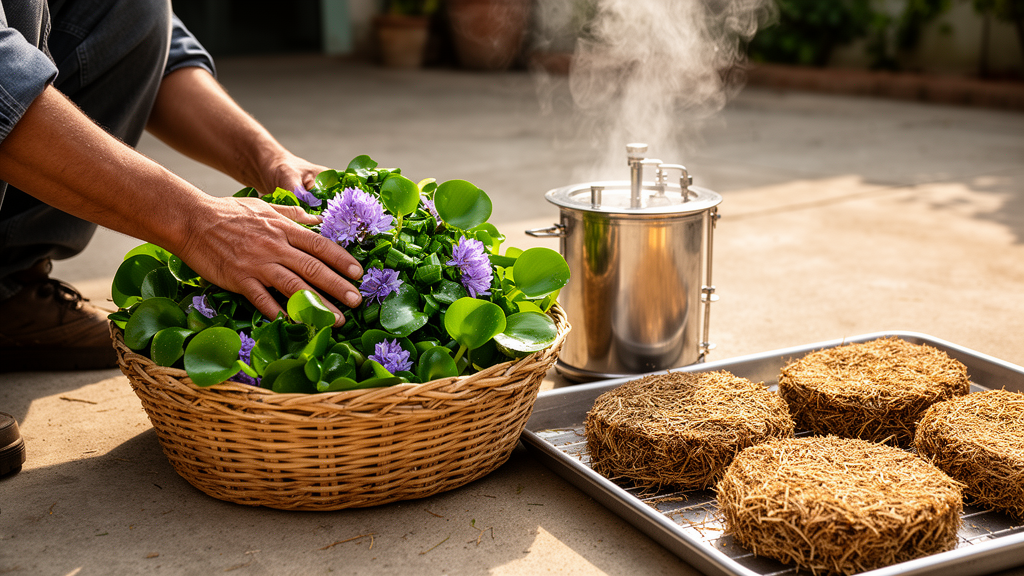
Water hyacinth is one of the world’s most notorious aquatic invaders, choking freshwater bodies across Asia, Africa and beyond with astonishing speed. A new study published in Environmental Science and Pollution Research by Gunjan Singh, Yogita Jain and Radhika Singh of Dayalbagh Educational Institute in Agra, India, suggests that this ecological nuisance could become a valuable feedstock for liquid biofuels, provided the plant’s tough lignocellulosic armor is cracked open in the right way. The researchers report that relatively gentle thermal pretreatments, combined with a green alkaline reagent recovered from food-industry wastewater, substantially boosted the conversion of water hyacinth stems into bioethanol and biomethanol through anaerobic digestion.
The central challenge the team confronted is familiar to anyone working with second-generation biofuels. Water hyacinth, like straw, bagasse and other lignocellulosic materials, embeds its fermentable sugars within a dense matrix of cellulose, hemicellulose and lignin. This recalcitrant structure resists microbial and enzymatic attack, which means untreated biomass yields disappointingly little fuel. Pretreatment is the crucial step that disrupts the matrix, increasing the accessibility of the polysaccharides to the microorganisms that carry out anaerobic digestion. The Indian team’s twist was to pair thermal disruption with an unconventional, waste-derived alkaline agent rather than a costly commercial chemical.
That agent is petha wastewater, the highly alkaline effluent generated by petha sweet manufacturers in Agra, a city famous for the translucent sugar delicacy. Instead of viewing this industrial stream purely as a disposal problem, the researchers exploited its extreme alkalinity, which sits between pH 12 and 14, as a pretreatment reagent for biomass. A 15 percent weight-per-volume solution of the wastewater served as the green chemical component of the pretreatment. This dual-purpose strategy addresses two environmental burdens simultaneously: the spread of an invasive aquatic plant and the responsible management of an aggressive industrial effluent, both of which are significant waste-disposal challenges in the region.
The experimental design compared two thermal approaches layered on top of the alkaline soak. In the first, biomass samples were autoclaved at 100 degrees Celsius for just five minutes. In the second, samples were exposed to microwave irradiation at 80 watts for 25 minutes. After pretreatment, the processed water hyacinth stems were subjected to anaerobic digestion using cow dung as the mixed microbial inoculum, with the substrate and inoculum combined at an 80:20 ratio. Cow dung, a readily available and inexpensive source of diverse anaerobic microbes, provides the enzymatic machinery needed to hydrolyze the opened-up biomass and convert released sugars into alcohols.
The results favored the autoclave route. Autoclave-pretreated water hyacinth delivered 6.7 percent more bioethanol and 13.8 percent more biomethanol than microwave-pretreated material, establishing pressurized steam as the superior partner for the alkaline petha wastewater in this system. Both thermal routes outperformed untreated biomass, confirming that the pretreatment step meaningfully improved the degradability of the stems. The magnitude of the methanol improvement in particular suggests that the combination of alkali and steam was especially effective at liberating the substrates that anaerobic communities funnel toward methanol formation.
To understand why the pretreatments worked, the team turned to advanced imaging and elemental analysis. Field emission scanning electron microscopy, or FESEM, revealed pronounced changes in the surface morphology of the pretreated stems, showing the structural damage inflicted on the lignocellulosic matrix. Energy-dispersive X-ray spectroscopy, or EDX, documented corresponding shifts in the elemental composition of the biomass. Together, these techniques painted a consistent picture: the pretreated material presented a far more accessible surface to microbes and enzymes, explaining the gains in fuel yield. Such characterization is critical in biofuel research because it links a process parameter directly to the physical mechanism that drives improved conversion.
An equally important outcome concerned the petha wastewater itself. The pretreatment process drew down the effluent’s punishingly high alkaline pH to nearly neutral levels, making the spent liquid far more suitable for subsequent biological processing or disposal. In conventional biofuel schemes, alkaline pretreatment consumes fresh chemicals and generates a new waste stream that must be neutralized. Here, the chemistry runs in the opposite direction: the waste stream does the chemical work, and the biomass does the neutralizing. The authors argue that this co-pretreatment approach enhances overall resource recovery and embodies the principles of a circular bioeconomy, in which one industry’s effluent becomes another process’s reagent.
The choice of feedstock carries its own strategic weight. Water hyacinth grows prolifically, requires no land, fertilizer or irrigation, and its removal from lakes and rivers actively benefits aquatic ecosystems by restoring oxygen exchange and water flow. Its extensive presence, low cost and ecological harm make biofuel generation from the plant economically and environmentally attractive, transforming a waste biomass problem into an energy asset. Previous studies, including work by some of the same authors on rice straw pretreated with petha wastewater, had hinted at the promise of this green chemistry approach; the new findings extend it to a notoriously stubborn aquatic feedstock and quantify the thermal options available.
Looking forward, the study positions water hyacinth as part of a broader waste-to-energy portfolio that also spans biodiesel, biogas and solid biofuels. Biomethanol is drawing growing attention as a renewable fuel for internal combustion engines and as a chemical platform molecule, while bioethanol remains the most widely deployed liquid biofuel worldwide. A process that simultaneously harvests an invasive plant, cleans up an alkaline industrial effluent and produces two marketable fuels is precisely the kind of integrated solution that circular-economy advocates call for. The authors note that the approach enhances resource recovery while tackling both problems with a single environmentally conscious pretreatment method, a framing likely to resonate with policymakers seeking cost-effective biomass valorization in regions where water hyacinth infestations and small-scale food processing coexist.
The research, received in August 2025 and published in September 2026, was conducted at the Biohydrogen Lab of Dayalbagh Educational Institute, with all experimental work carried out by Gunjan Singh and the concept designed by Radhika Singh and Yogita Jain. While scaling from laboratory digesters to industrial biorefineries will require further optimization of costs, energy inputs and process reliability, the study offers a technically grounded demonstration that the barrier standing between an invasive weed and a tank of fuel can be dismantled with steam, microwaves and, remarkably, sweet-shop wastewater.
Subject of Research: Thermal and green alkaline pretreatment of water hyacinth biomass for enhanced bioethanol and biomethanol production via anaerobic digestion
Article Title: Thermal pretreatment of water hyacinth: a sustainable route for bioethanol and biomethanol production
Article References: Singh, G., Jain, Y., & Singh, R. (2026). Thermal pretreatment of water hyacinth: a sustainable route for bioethanol and biomethanol production. Environmental Science and Pollution Research, 33(29), 14854-14866. https://doi.org/10.1007/s11356-026-38186-w
Image Credits: AI Generated
DOI: 10.1007/s11356-026-38186-w
Keywords: water hyacinth, bioethanol, biomethanol, anaerobic digestion, pretreatment, lignocellulosic biomass, petha wastewater, circular bioeconomy, cow dung inoculum, FESEM, autoclave, microwave irradiation
Cite Scienmag News
Violet Maxwell. (October 9, 2026). Invasive Water Hyacinth Turned Into Biofuel With a Simple Thermal Pretreatment Twist. Scienmag. https://scienmag.com/invasive-water-hyacinth-turned-into-biofuel-with-a-simple-thermal-pretreatment-twist/
Violet Maxwell. "Invasive Water Hyacinth Turned Into Biofuel With a Simple Thermal Pretreatment Twist." Scienmag, 9 October 2026, https://scienmag.com/invasive-water-hyacinth-turned-into-biofuel-with-a-simple-thermal-pretreatment-twist/. Accessed 9 October 2026.
Violet Maxwell. "Invasive Water Hyacinth Turned Into Biofuel With a Simple Thermal Pretreatment Twist." Scienmag. October 9, 2026. https://scienmag.com/invasive-water-hyacinth-turned-into-biofuel-with-a-simple-thermal-pretreatment-twist/


