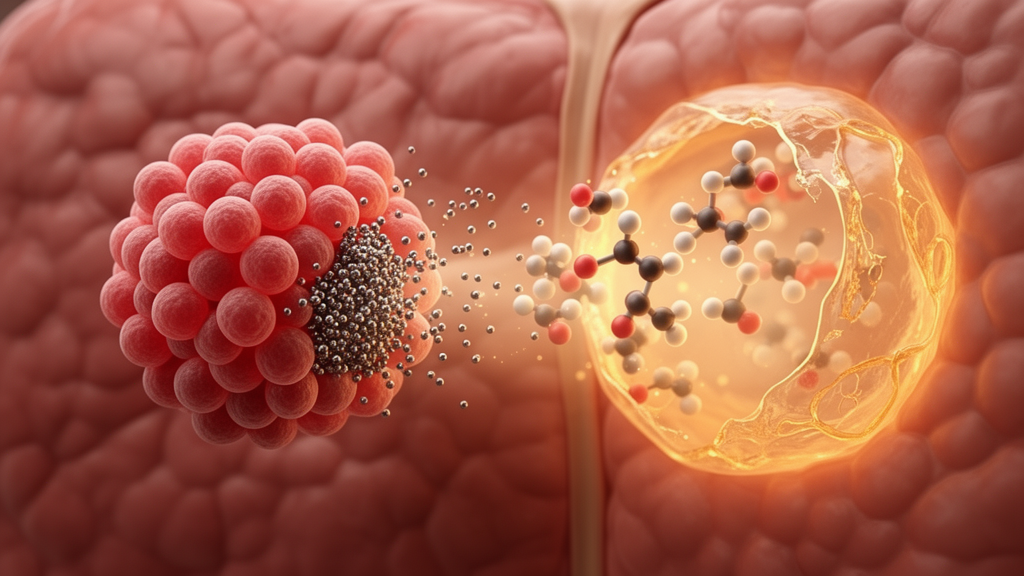
A focused review of preclinical studies concludes that several natural products can restore ferroptotic sensitivity in hepatocellular carcinoma by weakening the NRF2-SLC7A11-GPX4 antioxidant program, while other compounds activate the same pathway to protect injured, non-malignant liver tissue. The central finding is that nuclear factor erythroid 2-related factor 2, or NRF2, has context-dependent effects: transient activity can protect healthy hepatocytes from oxidative injury, whereas sustained activity can become a survival dependency in malignant cells. The analysis also identifies parallel defense systems that may allow tumors to survive when the principal glutathione-dependent pathway is disrupted. Nearly all supporting evidence comes from cells and animal models, leaving the compounds as pharmacological probes and potential leads rather than established treatments.
Systemic treatment for hepatocellular carcinoma, or HCC, is increasingly organized around immune checkpoint inhibitors. Atezolizumab plus bevacizumab and durvalumab plus tremelimumab are established first-line combinations for advanced disease, while nivolumab plus ipilimumab has also entered practice. Sorafenib and lenvatinib remain important when immunotherapy is unsuitable, and several kinase inhibitors are used after progression. Primary and acquired resistance frequently limit the usefulness of these options. Ferroptosis, an iron-dependent form of regulated cell death driven by unchecked phospholipid peroxidation, offers a possible way to attack resistant tumors. It is also mechanistically relevant to immunotherapy because CD8-positive T cells can suppress SLC7A11 and promote ferroptotic sensitivity in tumor cells, linking a redox defense program with conditions that shape responses to checkpoint blockade.
NRF2 coordinates the liver’s response to oxidative and electrophilic stress. Under basal conditions, Kelch-like ECH-associated protein 1, or KEAP1, recruits NRF2 to a Cullin 3 ubiquitin-ligase complex, allowing proteasomal degradation. When reactive cysteines in KEAP1 are modified by stress, NRF2 escapes turnover, enters the nucleus and induces genes including HMOX1, NQO1, SLC7A11 and GPX4. In non-transformed liver, a transient and appropriately scaled response can preserve hepatocytes. Maresin 1 reduced ferroptotic liver injury in preclinical work through NRF2, heme oxygenase 1 and GPX4 signaling. Ginsenoside Rg1 promoted KEAP1 degradation and NRF2 nuclear translocation in a chronic lipopolysaccharide injury model, while Gardeniae Fructus extract attenuated thioacetamide-induced fibrosis through AMPK/SIRT1 and NRF2-related signaling. These observations establish a physiological rationale for retaining protective NRF2 activity outside malignant tissue.
In HCC, persistent NRF2 activity can support a different program. Increased SLC7A11-mediated cystine uptake supports glutathione production, while GPX4 uses glutathione to remove phospholipid hydroperoxides. NRF2 can also influence drug transport and other metabolic adaptations associated with resistance. Several upstream alterations converge on this pathway: KEAP1 loss can prevent normal NRF2 degradation, phosphorylated p62 can occupy KEAP1 and reduce NRF2 turnover, mitochondrial TSPO can promote p62 accumulation by disrupting autophagic flux, and IGF2BP3 can stabilize modified NFE2L2 messenger RNA. Immune consequences extend beyond redox regulation. In HCC models, TSPO-driven NRF2 activity increased PD-L1 expression, while PP1A-dependent KEAP1 dephosphorylation was associated with NRF2 activation, T-cell exhaustion and reduced efficacy of lenvatinib combined with checkpoint blockade. Constitutive activity can therefore form part of a broader tumor-survival network.
A diverse group of natural compounds has been reported to suppress NRF2 signaling and lower the threshold for ferroptosis in malignant models. Polyphyllin I reduced NRF2, heme oxygenase 1 and GPX4 signaling, accompanied by iron accumulation, glutathione depletion and mitochondrial injury. Tiliroside inhibited TBK1, reduced p62 phosphorylation at Ser349 and weakened the p62-KEAP1 interaction, restoring KEAP1-dependent NRF2 turnover and sensitizing HCC cells to sorafenib. Ponicidin stabilized the KEAP1-NRF2 complex and blocked nuclear translocation in lenvatinib-resistant cells. Picropodophyllin inhibited IGF1R/PI3K/AKT signaling, promoted NRF2 degradation and reduced SLC7A11 and SLC40A1 expression. Curcumin shifted p62-KEAP1-NRF2 signaling toward ferroptosis, while decursin attenuated the NRF2-GPX4 program, inhibited tumor growth in xenografts and retained activity in sorafenib-resistant cells. A computational analysis linked decursin to SLC11A2 in iron handling, but that proposed interaction still requires direct validation.
Other compounds converge on the same ferroptotic endpoint through SLC7A11, GPX4 or iron availability. Esculetin inhibited the NRF2-xCT-GPX4 pathway and increased ferrous iron, reactive oxygen species and lipid peroxidation. Sappanone A produced a similar response through NRF2/xCT/GPX4 signaling. Caryophyllene oxide approached the endpoint from the iron side by inducing NCOA4/FTH1/LC3-dependent ferritinophagy and expanding the labile iron pool. Withaferin A linked NRF2-regulated epithelial-mesenchymal transition with ferroptosis and drug resistance. These findings show that chemically unrelated products need not share one molecular target to affect the same functional threshold. Yet pathway effects are often better established than direct binding, and increased reactive oxygen species or reduced viability alone is insufficient to identify ferroptosis. Stronger evidence requires lipid-peroxidation measurements, evidence of iron dependence, characteristic biochemical or ultrastructural changes and rescue by a ferroptosis inhibitor.
GPX4 is not the only defense against phospholipid peroxidation. Ferroptosis suppressor protein 1, or FSP1, is myristoylated at the plasma membrane, where it reduces ubiquinone to ubiquinol and regenerates a lipophilic radical-trapping antioxidant independently of glutathione and GPX4. Dihydroorotate dehydrogenase, or DHODH, performs an analogous reduction of coenzyme Q in the inner mitochondrial membrane and restrains mitochondrial lipid peroxidation, particularly when GPX4 is inhibited. Constitutive NRF2 activity can also raise FSP1 expression, meaning that suppressing NRF2 may reduce this parallel defense without eliminating it. Natural-product research has begun to address these arms directly: ginsenoside (20)S-APPT induced ferroptosis by targeting FSP1, and a semisynthetic oridonin derivative modulated G6PD and PGD to overcome FSP1- and DHODH-mediated defenses in liver-cancer models. Combination strategies may therefore need to cover both glutathione-dependent and ubiquinol-dependent protection.
Multi-component herbal formulations and delivery platforms attempt to address efficacy and selectivity. Hua Zheng San Ji Fang increased KEAP1 and suppressed NRF2/HO-1 signaling, while the Thai formulation Benja-ummarit reduced CD98, NRF2 and GPX4 and induced an iron- and oxidation-dependent death phenotype. Such mixtures broaden pathway coverage but complicate constituent attribution, chemical standardization, pharmacokinetics and interaction analysis. Exosome-like nanovesicles derived from Salvia chinensis and Scutellaria barbata promoted ferroptosis through AMPK/NRF2/xCT and NRF2/SLC7A11/GPX4 signaling, respectively. A self-assembled platinum(IV)-18beta-glycyrrhetinic-acid platform combined NRF2 inhibition with apoptosis and ferroptosis. Synthetic comparators included co-delivery of NRF2 small interfering RNA with sorafenib and lactobionic-acid-targeted lipid nanoparticles carrying p53 messenger RNA and NRF2 small interfering RNA. These systems remain preclinical, but they illustrate how spatial delivery might separate tumor inhibition from systemic redox toxicity.
The opposite strategy is rational in non-malignant liver injury. Ginsenoside Rg1 promoted NRF2 activation while suppressing NLRP3, NLRP1 and AIM2 inflammasome activation. Thymoquinone inhibited KEAP1 and increased NRF2 expression and nuclear translocation in injury models, while hinokitiol activated NRF2/GPX4 and reduced hepatocyte ferroptosis in metabolic dysfunction-associated steatohepatitis. These findings do not support unselected systemic NRF2 activation in people with established HCC; they define the normal-tissue function that a tumor-directed inhibitor would need to preserve. Two preclinical approaches illustrate possible ways to widen the therapeutic window: a biased inhibitor that preferentially disrupts the KEAP1-p62 interaction in p62-aberrant HCC while largely preserving basal KEAP1-NRF2 regulation, and tumor-targeted carriers that localize NRF2-directed nucleic acids or combination drugs. Neither has established clinical feasibility.
Translation requires a more demanding pharmacological evidence base. Most natural-product studies remain cell-based, and relatively few integrate bioavailability, metabolism, exposure-response relationships, direct target engagement and normal-liver toxicity. Molecular docking and network pharmacology should generate hypotheses rather than replace biophysical binding assays, genetic epistasis or target-rescue experiments. Multi-herb preparations also require chemical fingerprinting, batch consistency and constituent-level interaction analysis. Patient stratification may depend on biomarkers such as KEAP1 alteration, p62 abundance and modification patterns, while tumor and adjacent liver should be assessed together to quantify selectivity. Future studies should also measure FSP1, DHODH and the ACSL4-LPCAT3-dependent supply of phospholipid substrates and include immune endpoints when checkpoint therapy is involved. The review’s conclusion is cautious: natural products reveal converging mechanisms that may be useful for lead selection, but no compound discussed has been validated as an NRF2-directed clinical therapy for HCC.
Subject of Research: Preclinical natural-product modulation of the NRF2-ferroptosis axis in hepatocellular carcinoma
Article Title: Natural products target the NRF2-ferroptosis axis in hepatocellular carcinoma: tumor sensitization versus hepatoprotection
Article References: Cheng, Z., & Rong, P. (2026). Natural products target the NRF2-ferroptosis axis in hepatocellular carcinoma: tumor sensitization versus hepatoprotection. Frontiers in Pharmacology, 17, Article 1968548. https://doi.org/10.3389/fphar.2026.1968548
Image Credits: AI Generated
DOI: 10.3389/fphar.2026.1968548
Keywords: hepatocellular carcinoma, ferroptosis, NRF2, KEAP1, GPX4, SLC7A11, natural products, drug resistance, liver protection, FSP1, DHODH, Natural
Cite Scienmag News
Nathaniel Bowman. (October 25, 2026). Preclinical natural products target ferroptosis defenses in liver cancer. Scienmag. https://scienmag.com/preclinical-natural-products-target-ferroptosis-defenses-in-liver-cancer/
Nathaniel Bowman. "Preclinical natural products target ferroptosis defenses in liver cancer." Scienmag, 25 October 2026, https://scienmag.com/preclinical-natural-products-target-ferroptosis-defenses-in-liver-cancer/. Accessed 25 October 2026.
Nathaniel Bowman. "Preclinical natural products target ferroptosis defenses in liver cancer." Scienmag. October 25, 2026. https://scienmag.com/preclinical-natural-products-target-ferroptosis-defenses-in-liver-cancer/