


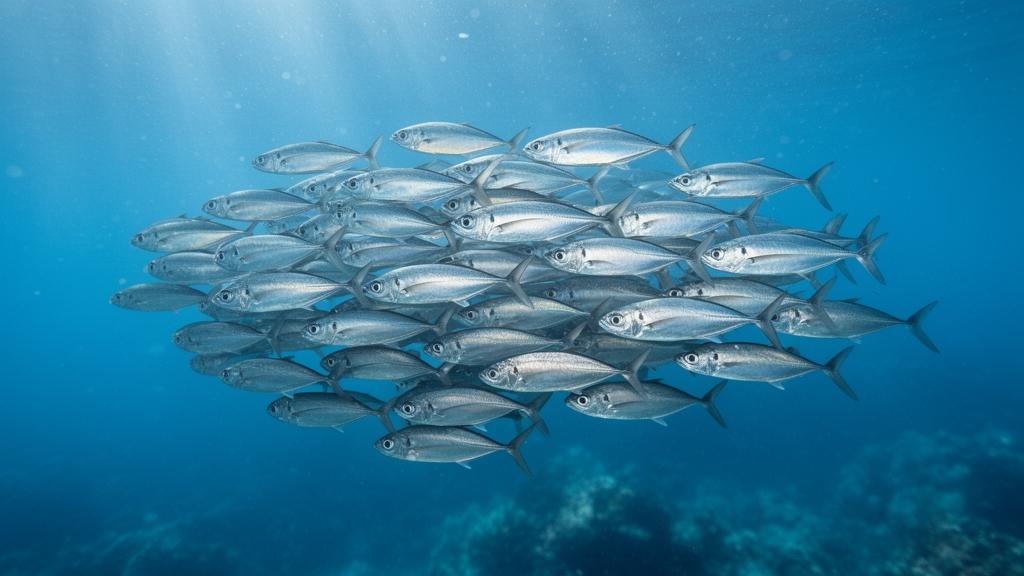
Micro glassfish form schools through a rule simpler than the classic idea that a group moves in the same direction: each fish copies the movement of one randomly chosen nearby neighbor. A peer-reviewed study by physicists and neurobiologists at the University of California San Diego reports that this pairwise copying rule can explain how schooling behavior develops and produces highly dynamic group movement. The researchers also identified discrete moments when mature glassfish respond rapidly to neighboring fish, linking computational descriptions of collective motion with the sensory and motor processes of individual animals.
The study, published in Physical Review Letters and led by Palka Puri, a recent graduate of UC San Diego’s Physics PhD program, focused on micro glassfish, Danionella cerebrum. The researchers examined the fish across a range of developmental stages and developed a turn-by-turn account of their schooling behavior. Their computational model is based on observations of how individual animals respond to the movements of nearby fish and can predict the dynamics of schools forming and breaking. The work is an animal behavioral and computational modeling study, not evidence that the same mechanism has been established in other species or that it directly explains human social behavior.
The model addresses a difficulty in collective-behavior research: physicists have often studied animal groups as active matter, but connecting abstract models to the large-scale movement patterns of animals in nature has been challenging. By examining micro glassfish at different group sizes and developmental stages, the researchers found support for a pairwise interaction in which an individual copies the direction of a randomly selected neighbor rather than aligning with the average direction of all nearby fish. The distinction is important. Pairwise copying leads to highly dynamic group behavior, while the classical averaging model produces different predictions. The copying model also accounts for how schooling can emerge during development, building on the authors’ previous work.
The team tested the model in a virtual-reality environment containing real glassfish and computer-generated virtual fish. When virtual fish changed direction, the real glassfish behaved according to the predictions of the pairwise copying model. This provided a behavioral test of the model rather than only a retrospective fit to recorded swimming patterns. The results support the idea that information can pass between animals through locally selected social partners. The evidence does not establish that every movement in every glassfish school is governed by the same rule, nor does it identify the complete neural circuitry responsible for copying.
The study also identified the timing of the interactions embedded in the model. At the end of one fish’s turn, a brief “window of opportunity” opens for a neighbor to align with it. Mature glassfish generated copying turns with fast reaction times, revealing a give-and-take structure in which fish alternately act and respond. The researchers said these precisely timed exchanges will support future investigations of how attention and social copying are processed in the brain. Because Danionella are transparent, they are also suited to brain-wide neural imaging, which the investigators hope will make it possible to examine how individual neurons contribute to the computations underlying collective movement.
The work presents a mechanistic account of schooling that links individual action, sensory response and group organization. Its central result is not merely that glassfish coordinate, but that the coordination can arise through repeated copying between nearby individuals at discrete moments. The virtual-reality results show that real fish respond to controlled changes in a partner’s movement in the manner predicted by the model, while the developmental analysis indicates that the interaction can help explain the emergence of schooling over maturation. The study does not yet resolve how the fish’s brains select neighbors, integrate sensory information or convert it into fast motor responses. It instead identifies a measurable behavioral framework for asking those questions and for investigating how complex group behavior is assembled from many simpler interactions.
Subject of Research: Neural and computational mechanisms of collective schooling behavior in micro glassfish
Article Title: Rules of the school
Article References: Rules of the school. Original publication (Bibliographic details unavailable.)
Image Credits: AI Generated
DOI: Not provided
Keywords: collective behavior, micro glassfish, Danionella cerebrum, schooling, pairwise copying, computational modeling, virtual reality, social interaction, animal movement, Rules, school, scientific research
Cite Scienmag News
Courtney Benton. (October 25, 2026). Fish Schools Emerge from Precisely Timed Copying Interactions. Scienmag. https://scienmag.com/fish-schools-emerge-from-precisely-timed-copying-interactions/
Courtney Benton. "Fish Schools Emerge from Precisely Timed Copying Interactions." Scienmag, 25 October 2026, https://scienmag.com/fish-schools-emerge-from-precisely-timed-copying-interactions/. Accessed 25 October 2026.
Courtney Benton. "Fish Schools Emerge from Precisely Timed Copying Interactions." Scienmag. October 25, 2026. https://scienmag.com/fish-schools-emerge-from-precisely-timed-copying-interactions/


