


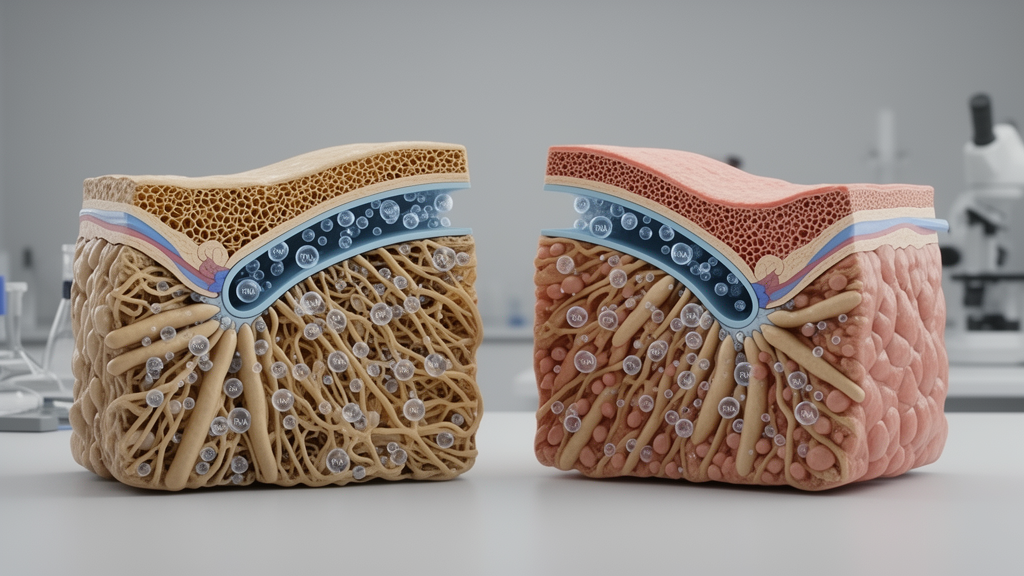
A donor-tissue study identified 34 differentially expressed miRNAs between the two regions, then validated selected changes by quantitative real-time PCR. The results point to candidate regulators of the adult stem cells found in the non-filtering region, although the research did not establish causal roles or clinical applications. The investigators used the nanoString nCounter platform to profile microRNAs in filtering and non-filtering regions of human donor trabecular meshwork.
Thirty-one miRNAs were significantly upregulated in the non-filtering region and three were significantly downregulated relative to the filtering region, applying a fold-change threshold of at least 1.2. Selected regional differences were then assessed in donor tissues grouped into three age strata: 0–30 years, 30–60 years and over 60 years. Formalin-fixed, paraffin-embedded sections from primary open angle glaucoma donors were also examined by quantitative real-time PCR.
Validation confirmed that miR-24-3p, miR-107, miR-34a-5p and miR-184 had higher expression in the non-filtering region, while miR-376a-3p, miR-145-5p and miR-22-3p had lower expression there than in the filtering region. These seven miRNAs were among the 34 identified in the broader regional comparison; they were not the complete set of differentially expressed miRNAs. The study also found that miR-145-5p, miR-22-3p and miR-376a-3p were upregulated in the trabecular meshwork of glaucomatous donor tissues, opposite to their lower expression in the non-filtering region in the regional analysis.
Age-stratified analysis revealed an age-related decline in miR-107, miR-184 and miR-34a-5p specifically within the non-filtering region. Those three miRNAs had also been validated as more highly expressed in that region than in the filtering region. Their decline therefore occurred alongside an established difference in the tissue’s adult stem-cell population, which the study background reports decreases with ageing and is significantly reduced in primary open angle glaucoma.
The supplied findings do not show that the microRNA changes cause either the age-related or glaucoma-associated differences in stem-cell numbers. For functional interpretation, the researchers used miRTarBase to identify potential targets of the validated miRNAs and Shiny GO 0.82 for enrichment analysis. These computational analyses associated the selected miRNAs with stem-cell-related pathways, including Wnt, hypoxia-inducible factor, PI3K-AKT and MAPK signalling.
The findings nominate candidate molecular regulators, but database-predicted targets and enriched pathways do not by themselves demonstrate direct regulation of stem cells or prove that a particular pathway underlies the observed expression patterns. The study was based on human donor tissue and regional comparisons rather than an intervention in living participants. It included age-stratified donor samples and glaucomatous sections, but the available report does not provide the number of donors, detailed statistical estimates or uncertainty measures.
The investigators concluded that further miRNA transfection studies are essential for determining the specific roles of the candidate regulators in trabecular meshwork stem cells. Until those functional relationships are established, the results define an expression profile associated with tissue region, donor age and glaucoma status rather than demonstrating a clinical diagnostic marker or therapeutic target.
Subject of Research: MicroRNA expression associated with ageing and glaucoma in human trabecular meshwork donor tissue
Article Title: MicroRNA profiling of filtering and non-filtering regions of human trabecular meshwork: changes with ageing and in glaucoma
Article References: Nair, S., Devarajan, B., Vanniarajan, A., Ravichandran, N., Ramaswamy, G., Bhat, V., Ramsamy, K. S., & Chidambaranathan, G. P. (2026). MicroRNA profiling of filtering and non-filtering regions of human trabecular meshwork: changes with ageing and in glaucoma. Molecular Biology Reports, 53(1), Article 1472. https://doi.org/10.1007/s11033-026-12667-0
Image Credits: AI Generated
DOI: 10.1007/s11033-026-12667-0
Keywords: microRNA, trabecular meshwork, primary open angle glaucoma, ageing, stem cells, gene expression, donor tissue, RNA profiling, Wnt signalling, PI3K-AKT, profiling, filtering
Cite Scienmag News
Beatrice Stafford. (October 25, 2026). Research report: MicroRNA profiling of filtering and non-filtering regions of human trabecular meshwork: changes with ageing and in glaucoma. Scienmag. https://scienmag.com/research-report-microrna-profiling-of-filtering-and-non-filtering-regions-of-human-trabecular-meshwork-changes-with-ageing-and-in-glaucoma/
Beatrice Stafford. "Research report: MicroRNA profiling of filtering and non-filtering regions of human trabecular meshwork: changes with ageing and in glaucoma." Scienmag, 25 October 2026, https://scienmag.com/research-report-microrna-profiling-of-filtering-and-non-filtering-regions-of-human-trabecular-meshwork-changes-with-ageing-and-in-glaucoma/. Accessed 25 October 2026.
Beatrice Stafford. "Research report: MicroRNA profiling of filtering and non-filtering regions of human trabecular meshwork: changes with ageing and in glaucoma." Scienmag. October 25, 2026. https://scienmag.com/research-report-microrna-profiling-of-filtering-and-non-filtering-regions-of-human-trabecular-meshwork-changes-with-ageing-and-in-glaucoma/


