


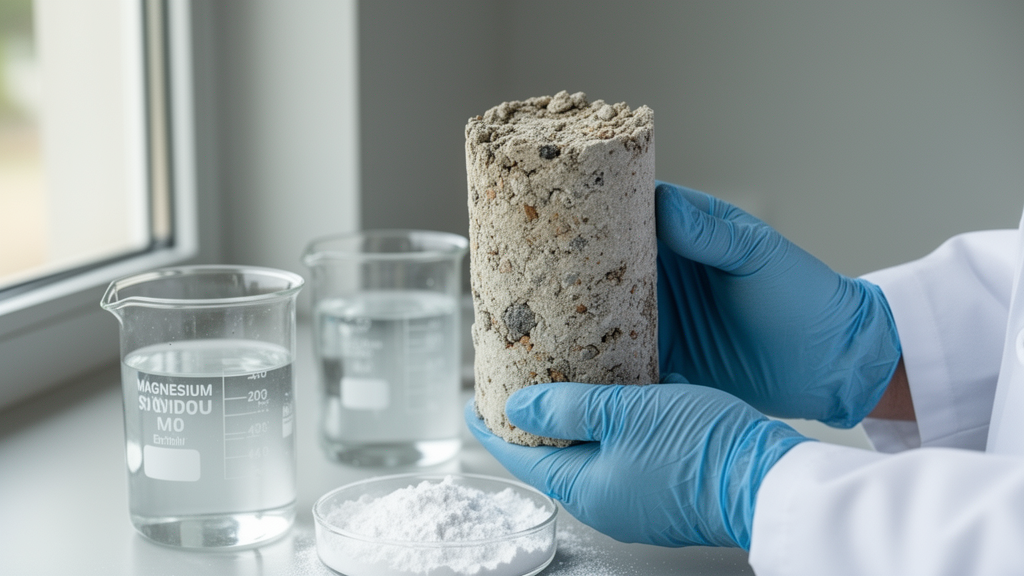
Enzyme-induced phosphate precipitation, or EIPP, is emerging as a quieter alternative to cement-based solidification of mine tailings, and new laboratory results show that a seemingly small formulation choice, the magnesium salt used to build the cement, can determine how well the treated material holds up in the real world. In the study, lead-zinc tailings from Panzhihua, China, were solidified with an EIPP solution in which the enzyme phytase breaks down sodium glycerophosphate, releasing inorganic phosphate that reacts with magnesium ions to form cementing precipitates. Two magnesium sources were compared: magnesium chloride, an inorganic salt, and magnesium acetate, an organic salt. The treated tailings were then pushed through up to twelve cycles of soaking and oven-drying, and separately soaked in acid solutions, to see how each cement weathered.
The appeal of the enzyme route lies in what it avoids. Conventional solidification and stabilization technologies rely on cement or alkali activation, which typically demand extensive mechanical mixing, disturb the site, and bind poorly with heavy metals over the long term. Biomineralization techniques instead inject a reactive liquid at low or no pressure, letting mineral precipitation happen in place. The better-known carbonate-based versions, microbial and enzyme-induced carbonate precipitation, have proven effective for concrete crack repair and soil strengthening, and have even been used to trap heavy metals inside mineral precipitates. But those systems release ammonium ions and ammonia gas during treatment, and metal carbonates can be unstable in acidic environments. EIPP sidesteps urea hydrolysis entirely, generating no ammonium, and phosphate minerals generally immobilize heavy metals more effectively than carbonates.
The two magnesium salts produced strikingly different cements. With magnesium chloride, the precipitate formed as large phosphate crystals. With magnesium acetate, the precipitate came out amorphous and non-crystalline, wrapped in impurities. The researchers traced this to the organic byproducts of the reaction: the hydroxyl and carboxyl groups of glycerol and acetate form a dense hydrogen-bond network that makes the solution viscous, slows ion transport, and hinders crystal growth. The result is a bulkier, stickier, wax-like sediment. These differences translated directly into different solidification mechanisms. The crystalline chloride-based cement, Cl-EIPP, held the tailings together mainly by bridging between particles with its large crystals, while the acetate-based cement, Ac-EIPP, worked through filling and cohesion. The acetate-treated tailings reached 1.56 times the strength of the chloride-treated ones.
Dry-wet cycling, referenced to the ASTM D559/D559M standard, then revealed how each cement fails. In each cycle, specimens were soaked in deionized water for twenty-four hours and dried at forty degrees Celsius, a temperature chosen to reflect summer surface conditions in Panzhihua, for forty-eight hours. For the chloride-treated tailings, the first cycle was by far the most damaging: strength fell from 1.46 megapascals to 1.11 megapascals, a loss of nearly 24 percent, because abundant pore channels let soluble byproducts such as sodium chloride and glycerol dissolve and wash out, weakening inter-crystal connections. Strengths after the first and third cycles were similar, indicating that most early strength loss happened immediately, as loose and weakly bound precipitates dropped into suspension during the first immersion.
From the sixth cycle onward, a second degradation mechanism took over in the chloride-treated samples. The precipitate crystals, which had shown few cleavages in the first three cycles, developed significant cracks, and the tailings surface began to shed visibly. Scanning electron microscopy of specimens after nine cycles showed fractures both inside the precipitates and between precipitates and tailings particles, driven by drying shrinkage and dissolution. Because the tailings grains and the phosphate cement deform differently, repeated strain incompatibility extended interfacial cracks. Meanwhile, a cyclic dissolution-reprecipitation process roughened the crystal surfaces, with flaky products appearing from the dissolution and recrystallization of surface phosphates. The progressive loss of bonded area transferred stress from a continuous cemented skeleton to a frictional, interlocking particle skeleton, which explains why the samples became less brittle and reached higher peak strains even as their peak stress declined.
The acetate-treated tailings degraded differently but lost strength faster overall. As soaking dissolved the molecules providing hydrogen bonding, the precipitate lost viscosity, grew more brittle, and shrank markedly on drying, so that fracture within the filling zone became the primary cause of strength loss. Over one to twelve cycles, the strength of acetate-treated specimens declined by 27.4 to 52.7 percent, compared with 24.0 to 38.4 percent for the chloride-treated ones. Yet the acetate samples retained higher absolute strength throughout, because their bulkier precipitates occupied more of the interparticle space, keeping the two-dimensional pore area ratio lower. Surface spalling was actually more severe in the acetate samples between the sixth and ninth cycles, reflecting the compromised bridging function, but the better filling and lower permeability of the internal structure preserved their mechanical advantage. The authors suggest that reducing severe drying could benefit acetate-based treatment in service.
Acid exposure posed a separate threat, tested only on the chloride-treated tailings through semi-dynamic leaching adapted from ASTM C1308-08. Cylindrical samples were immersed for thirteen days in solutions of sulfuric and nitric acid mixed at a mass ratio of 2:1, with initial pH values of 5.5, 4.5, 3.5, and 2.5, the lowest included as a deliberately severe condition rather than a representation of typical rainfall. Strength fell by 25, 27.3, 29.5, and 41.0 percent at the four acidity levels respectively. The tailings’ dolomite content and the precipitates themselves buffered the acid: solutions starting at pH 3.5 to 5.5 ended near pH 6.12 to 7.81, so the internal chemical environments and the resulting strength losses stayed similar across that range. At pH 2.5, however, the final solution only rose to about 3.5, showing that buffering capacity was overwhelmed, and pore sizes increased visibly.
The microscopy told the acid story in detail. The mean two-dimensional pore area ratio of the soaked specimens climbed from 7.81 to 17.83 percent as acidity increased, and at pH 2.5 the tailings surfaces were noticeably smoother, with markedly less precipitate adhering to particle surfaces and junctions. What remained had transformed into clearer elliptical flakes bearing obvious holes as traces of erosion. Acid, in short, dissolved the cementing precipitates, enlarged the pore space, and weakened cementation, with damage intensifying once buffering failed. The practical warning is specific: particular care should be taken to avoid inorganic acid environments with a pH below 2.5, while resistance within the pH 3.5 to 5.5 range was relatively uniform.
The broader lesson from the study is that precipitate volume filling is key to maintaining strength under dry-wet erosion, and that magnesium acetate is the optimized selection for EIPP-based tailings remediation, despite its faster relative strength loss. The finding echoes earlier work on carbonate systems, where calcium salt choice changed crystal morphology, precipitation yield, and mechanical performance in ways that did not always track together. It also aligns with rock-weathering research, since EIPP-treated soils share with cemented sandstone a granular skeleton reinforced by mineral cementation, and degrade through the same combination of cement dissolution, porosity increase, and microcracking. For engineers weighing biomineralization against cement, the message is that the binder’s chemistry, not just its quantity, sets the durability envelope, and that matching the magnesium source to the expected moisture and acidity conditions at a site may matter as much as the treatment dose itself.
Subject of Research: Enzyme-induced phosphate precipitation of mine tailings
Article Title: Dry–wet and acidic durability of tailings solidified by enzyme-induced phosphate precipitation: Effects of magnesium sources and precipitate characteristics
Article References: Han, L., Chen, Y., Guo, H., Jiang, X., Wang, P., & Li, J. (2026). Dry–wet and acidic durability of tailings solidified by enzyme-induced phosphate precipitation: Effects of magnesium sources and precipitate characteristics. Results in Engineering, 32, Article 113622. https://doi.org/10.1016/j.rineng.2026.113622
Image Credits: AI Generated
DOI: 10.1016/j.rineng.2026.113622
Keywords: enzyme-induced phosphate precipitation, mine tailings, biomineralization, dry-wet cycling, acid erosion, magnesium acetate, magnesium chloride, geotechnical engineering, heavy metal stabilization, solidification and stabilization, acidic, durability
Cite Scienmag News
Denise Maddox. (October 25, 2026). Magnesium Source Choice Governs Durability of Enzyme-Solidified Mine Tailings. Scienmag. https://scienmag.com/magnesium-source-choice-governs-durability-of-enzyme-solidified-mine-tailings/
Denise Maddox. "Magnesium Source Choice Governs Durability of Enzyme-Solidified Mine Tailings." Scienmag, 25 October 2026, https://scienmag.com/magnesium-source-choice-governs-durability-of-enzyme-solidified-mine-tailings/. Accessed 25 October 2026.
Denise Maddox. "Magnesium Source Choice Governs Durability of Enzyme-Solidified Mine Tailings." Scienmag. October 25, 2026. https://scienmag.com/magnesium-source-choice-governs-durability-of-enzyme-solidified-mine-tailings/


