


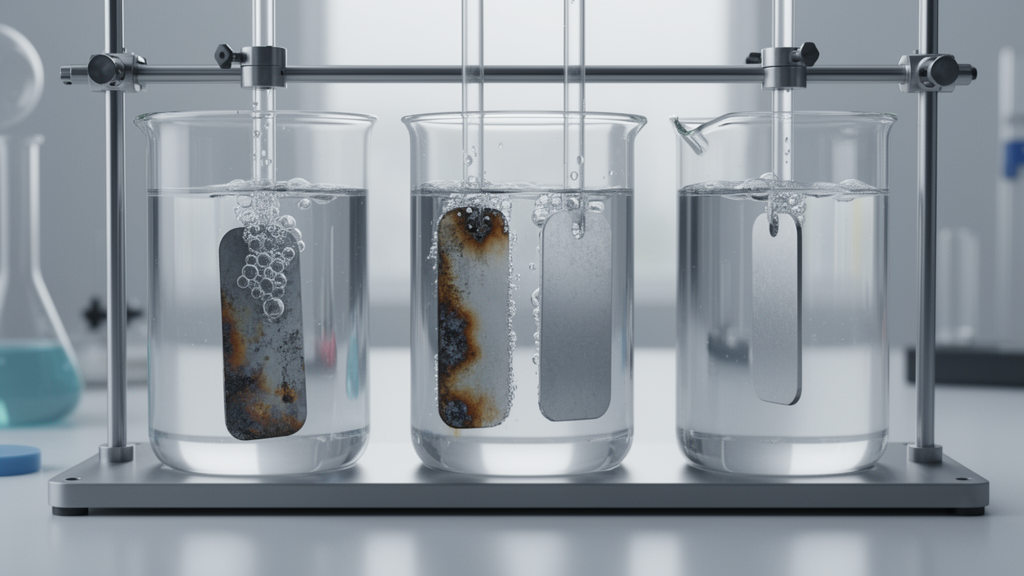
A laboratory study found that Q235 steel and T2 copper developed different corrosion patterns in hydrochloric acid mixed with formic, acetic or propionic acid. Among the tested mixtures, hydrochloric acid with propionic acid was least corrosive, followed by the formic-acid mixture, while hydrochloric acid with acetic acid was the most corrosive. Weight-loss tests also showed that steel’s corrosion rate fell rapidly during the first 72 hours and then stabilized, whereas copper’s rate rose gradually over six days before leveling off.
The research examined steel and copper in hydrochloric acid alone and in mixed acid systems. In tests of the individual acids, corrosivity followed the order hydrochloric acid, formic acid, acetic acid and propionic acid, a sequence consistent with their pKa values. Mixing organic acids with hydrochloric acid changed that pattern: the mixed systems ranked from least to most corrosive as hydrochloric acid/propionic acid, hydrochloric acid/formic acid and hydrochloric acid/acetic acid. The results therefore show that the relative corrosivity of a mixture could not be inferred from the separate ordering of its component acids under the tested conditions.
The researchers used theoretical calculations and molecular-dynamics simulations to examine molecular behavior at the metal surfaces. Carboxyl groups acted as the principal adsorption sites, and the hydrochloric-acid/acetic-acid mixture showed the strongest adsorption and highest corrosivity among the mixed systems studied. Further electrochemical measurements of steel and copper in that mixture showed charge-transfer resistance decreasing and corrosion-current density increasing with immersion time. These observations indicated that electrochemical charge transfer became easier as exposure continued, but the study reported no change in the underlying corrosion mechanism during the observation period.
Surface and deposit analyses revealed chemical differences associated with the attack on the two metals, with more severe corrosion observed on steel than on copper. Atomic-force microscopy and scanning electron microscopy with energy-dispersive spectroscopy were used to examine the surfaces, while X-ray photoelectron spectroscopy identified metal oxides, chlorides and carboxylate complexes. Fourier-transform infrared spectroscopy and X-ray diffraction analysis of material precipitated at the bottom of the test solutions detected metal oxides, metal chlorides and acetate-containing products of different valences, together with basic copper acetate. The abstract reports these complementary characterization results but does not explicitly state that the surface analyses independently corroborated the electrochemical measurements.
The study provides a laboratory basis for understanding how Q235 steel and T2 copper respond to hydrochloric acid combined with selected organic acids. Its measured behavior was both material- and time-dependent, and adding an organic acid altered the comparative corrosivity of the mixed media. However, the available report does not specify acid concentrations, exposure temperatures, specimen dimensions, numerical corrosion rates, replicate counts or uncertainty estimates. Its conclusions are therefore limited to the tested materials, acid combinations and experimental conditions, rather than demonstrating a universal performance advantage for mixed-acid cleaning formulations or establishing how the results would translate to every industrial application.
Subject of Research: Corrosion behavior of Q235 steel and T2 copper in hydrochloric acid and organic-acid mixtures
Article Title: Study on corrosion mechanism of steel and copper in hydrochloric acid/organic acid mixed media
Article References: Chen, K., Yuan, R., Liu, Y., Liu, J., Ren, X., & Zhou, S. (2026). Study on corrosion mechanism of steel and copper in hydrochloric acid/organic acid mixed media. Journal of Materials Science, 61(41), 32159-32179. https://doi.org/10.1007/s10853-026-13680-1
Image Credits: AI Generated
DOI: 10.1007/s10853-026-13680-1
Keywords: Q235 steel, T2 copper, mixed-acid corrosion, hydrochloric acid, organic acids, acetic acid, formic acid, propionic acid, electrochemistry, surface characterization, corrosion, mechanism
Cite Scienmag News
Denise Maddox. (October 25, 2026). Lab study finds mixed-acid corrosion varies by metal and organic acid. Scienmag. https://scienmag.com/lab-study-finds-mixed-acid-corrosion-varies-by-metal-and-organic-acid/
Denise Maddox. "Lab study finds mixed-acid corrosion varies by metal and organic acid." Scienmag, 25 October 2026, https://scienmag.com/lab-study-finds-mixed-acid-corrosion-varies-by-metal-and-organic-acid/. Accessed 25 October 2026.
Denise Maddox. "Lab study finds mixed-acid corrosion varies by metal and organic acid." Scienmag. October 25, 2026. https://scienmag.com/lab-study-finds-mixed-acid-corrosion-varies-by-metal-and-organic-acid/


