


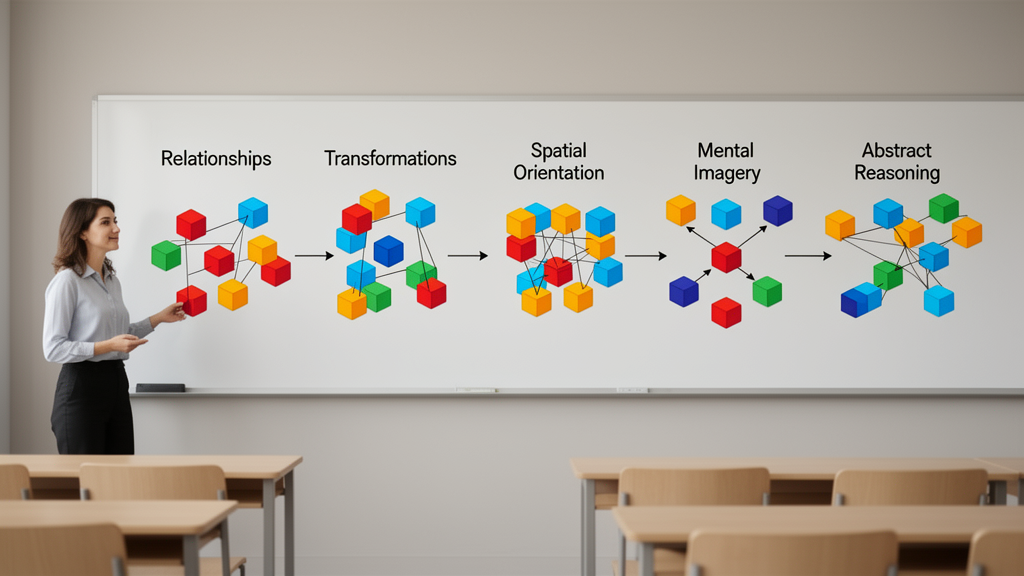
A 31-item questionnaire developed and tested with 566 primary and secondary school teachers in western China found support for a five-dimensional model of teachers’ competence in using artificial intelligence to create, interpret and apply visual instructional material. The AI-Empowered Teacher Visualization Teaching Competency Scale, or AI-VTCS, measures Design and Creation, Awareness and Interpretation, Decision-Making and Collaboration, Ethics and Safety, and Professional Development. The cross-sectional validation study found high internal consistency, acceptable factor-model fit, and strict measurement invariance across gender, school type and teaching stage.
The scale was designed to capture a teaching role that extends beyond operating artificial intelligence tools. Generative systems can produce text, images, charts, animations and other instructional resources from prompts, shifting teachers toward work that includes designing prompts, selecting tools, judging output and deciding how visual material should enter a lesson. Researchers based the instrument on the AI extension of the Technological Pedagogical Content Knowledge framework, supplemented with theories of visual literacy, data literacy, multimedia learning, cognitive load and teacher self-efficacy. Together, these perspectives frame AI-empowered visualization teaching as a coordinated blend of technological, pedagogical and subject-matter judgment rather than technical familiarity alone.
The researchers defined AI-empowered visualization teaching competency as an integrated capacity in AI-supported contexts. The construct combines AI knowledge, the ability to transform instructional content into visual representations, and the critical evaluation needed to judge whether generated material is accurate, suitable and pedagogically useful. This definition separates visualization teaching competency from visual instructional design, which focuses on selecting and organizing visual representations according to knowledge type, instructional objectives and learner characteristics, and from AI knowledge, which includes understanding generative logic, tool limits, prompt design and output evaluation. Teacher self-efficacy was included as a theoretical mechanism for sustained reflection, professional planning and collaborative exchange.
Initial items were based on the theoretical model and semi-structured interviews with 12 teachers in Xi’an, six men and six women. Five educational-technology experts and experienced teachers then reviewed the relevance and clarity of a 36-item pool. Five items were removed, producing the 31-item pre-test questionnaire. Participants responded on a five-point Likert scale ranging from strong disagreement to strong agreement, with higher scores representing stronger self-reported competency. The researchers then used item analysis, exploratory factor analysis, confirmatory factor analysis, reliability tests, measurement-invariance analysis and criterion-related validity tests to evaluate the instrument.
Exploratory factor analysis of 283 randomly selected teachers’ responses extracted five factors that closely matched the proposed structure. The Kaiser-Meyer-Olkin value was 0.945, Bartlett’s test of sphericity was significant, and the five factors together explained 71.074% of the variance. All 31 items met the study’s thresholds for factor loading, item specificity and sampling adequacy, so none was removed. Confirmatory factor analysis on the other 283 teachers supported both a first-order model with five separate factors and a second-order model organized under a broader competency. The first-order model produced a comparative fit index of 0.918, Tucker-Lewis index of 0.910, root mean square error of approximation of 0.072 and standardized root mean square residual of 0.045; the second-order model produced corresponding values of 0.910, 0.902, 0.075 and 0.060.
The five dimensions describe distinct but interconnected parts of teachers’ work. Design and Creation concerns using generative AI to transform abstract content into suitable visual resources, then pedagogically refining, sequencing and differentiating those outputs. Awareness and Interpretation covers the technical reading of AI-generated graphics and data, scrutiny of possible biases or misleading presentation, and translation of visual evidence into instructional understanding. Decision-Making and Collaboration concerns independent classroom decisions based on learning analytics, clear boundaries between human and AI authority, and differentiated interventions. Ethics and Safety includes privacy awareness, recognition of algorithmic bias and educational ethical judgment, while Professional Development captures reflection, goal planning and exchange with colleagues.
Reliability was high throughout the instrument. Cronbach’s alpha values ranged from 0.911 to 0.934 for the five subscales and reached 0.967 for the complete scale. A Spearman-Brown coefficient of 0.860 was obtained for split-half reliability. Convergent validity was supported by composite reliability values of 0.915 to 0.951 and average variance extracted values of 0.576 to 0.829 in the first-order model. In the second-order model, the square root of the average variance extracted for each factor exceeded its correlations with the other factors, satisfying the study’s discriminant-validity criterion. This higher-order solution was important because Design and Creation and Awareness and Interpretation were highly correlated in the first-order model, at 0.812.
The researchers also examined whether the scale could be compared meaningfully among different groups. Multigroup analyses supported configural, metric, scalar and strict invariance across male and female teachers, public and private schools, and primary, middle and high school teaching stages. The nested-model results met the investigators’ prespecified change thresholds for the comparative fit and RMSEA indices, providing evidence that the scale operated comparably in the groups examined. The results apply to the sampled teachers and do not establish equivalence in every country, educational system or AI-supported classroom.
Criterion-related validity was assessed by comparing AI-VTCS dimensions with all seven components of the established TPACK scale: pedagogical knowledge, content knowledge, technological knowledge, pedagogical content knowledge, technological pedagogical knowledge, technological content knowledge and technological pedagogical content knowledge. All 35 relationships between the five AI-VTCS dimensions and the seven TPACK components were positive and statistically significant, with coefficients ranging from 0.560 to 0.737. Awareness and Interpretation and Decision-Making and Collaboration showed the strongest associations with TPACK, while Professional Development had the weakest. The authors interpret this pattern as evidence that AI-empowered visualization teaching is related to, but distinguishable from, established technology-integration knowledge.
The findings position the new instrument as a domain-specific companion to broader measures of teacher AI competence rather than a replacement for them. Its potential uses include diagnostic assessment in pre-service and in-service teacher education and identification of particular training needs. A teacher with lower Design and Creation scores, for example, could be directed toward work on prompt design and visual-resource creation, whereas lower Ethics and Safety scores could indicate a need for instruction on privacy and bias. These are proposed applications supported by the validated structure, not interventions tested in the study, and the researchers did not measure whether using the scale improves teaching or student outcomes.
Several limitations constrain how the results should be interpreted. Participants were recruited by convenience sampling from five western Chinese provinces and regions: Shaanxi, Inner Mongolia, Hebei, Shanxi and Anhui. Of the 566 valid responses, 70.0% came from women, 82.7% from public schools, and most respondents taught in primary or middle school. Cultural context, unequal educational resources and differences in access to AI could affect responses, so validation is still needed in eastern China and other national settings. The instrument was also self-reported and may be affected by social desirability, while Harman’s single-factor test cannot eliminate common-method bias. Test–retest reliability was not assessed. Future work could therefore combine survey responses with classroom observation, teaching artifacts and multi-source ratings, examine temporal stability, and test whether higher competency scores predict student achievement, motivation or critical thinking.
Subject of Research: Psychometric validation of a scale for teachers’ AI-empowered visualization teaching competency
Article Title: Development and validation of the AI-empowered visualization teaching competency scale
Article References: Chen, L., Qiao, S., Luo, X., Chen, G., & Zhang, Y. (2026). Development and validation of the AI-empowered visualization teaching competency scale. Frontiers in Psychology, 17, Article 1994352. https://doi.org/10.3389/fpsyg.2026.1994352
Image Credits: AI Generated
DOI: 10.3389/fpsyg.2026.1994352
Keywords: AI education, teacher competency, visualization teaching, generative AI, scale validation, TPACK, visual literacy, data literacy, AI ethics, instructional technology, Development, validation
Cite Scienmag News
Courtney Benton. (October 25, 2026). AI Scale Measures Teachers’ Visualization Competence in Five Dimensions. Scienmag. https://scienmag.com/ai-scale-measures-teachers-visualization-competence-in-five-dimensions/
Courtney Benton. "AI Scale Measures Teachers’ Visualization Competence in Five Dimensions." Scienmag, 25 October 2026, https://scienmag.com/ai-scale-measures-teachers-visualization-competence-in-five-dimensions/. Accessed 25 October 2026.
Courtney Benton. "AI Scale Measures Teachers’ Visualization Competence in Five Dimensions." Scienmag. October 25, 2026. https://scienmag.com/ai-scale-measures-teachers-visualization-competence-in-five-dimensions/


