


Colorectal cancer remains one of the deadliest malignancies on the planet, and the numbers are sobering. It is the third most common cancer worldwide, affecting nearly two million people in 2020 and claiming roughly one million lives each year. By 2040, new cases are projected to climb to 3.2 million annually, with deaths reaching 1.6 million. Even as immunotherapy has transformed treatment for some patients, the five-year survival rate for metastatic colorectal cancer still hovers around 14 percent. Now, a team of researchers from Poland, Finland, China, and Sweden has produced one of the most detailed spatial maps yet of why these tumors so often outmaneuver the immune system, and their findings reveal immunosuppressive players that had never before been described in cancer.
The study, published in the British Journal of Cancer, combined two of the most powerful tools in modern genomics: spatial transcriptomics, which records gene activity while preserving the physical architecture of tissue, and single-cell RNA sequencing, which profiles gene expression in thousands of individual cells. The researchers applied spatial transcriptomics to colorectal tumor tissue and matched normal tissue from a patient with early-stage colon cancer, then validated their discoveries across 41 publicly available spatial transcriptomics slides, single-cell datasets representing 472 colorectal cancer patients, and bulk transcriptomic data from 617 more. This layered approach allowed them to see not just which cells were present in the tumor microenvironment, but exactly where they sat, whom they were talking to, and what molecular messages they were exchanging.
The first major insight concerned the geography of invasion. Using computational deconvolution methods such as SpaCET and RCTD, the team estimated the proportions of different cell types within each microscopic spot of tissue. They found that tumor clusters, defined by markers like CD44, EPCAM, and CDH1, extended beyond the boundaries visible under the microscope, infiltrating the surrounding stroma. A complementary reference-free analysis with STdeconvolve revealed even greater spatial complexity, showing tumor-like gene signatures pushing further into normal tissue than standard spot-based resolution could detect. Along this invasive trajectory, the researchers observed a coordinated upregulation of genes driving epithelial-to-mesenchymal transition, matrix metalloproteinases such as MMP2, MMP9, and MMP11, and inflammatory chemokines, while genes maintaining intestinal integrity were switched off.
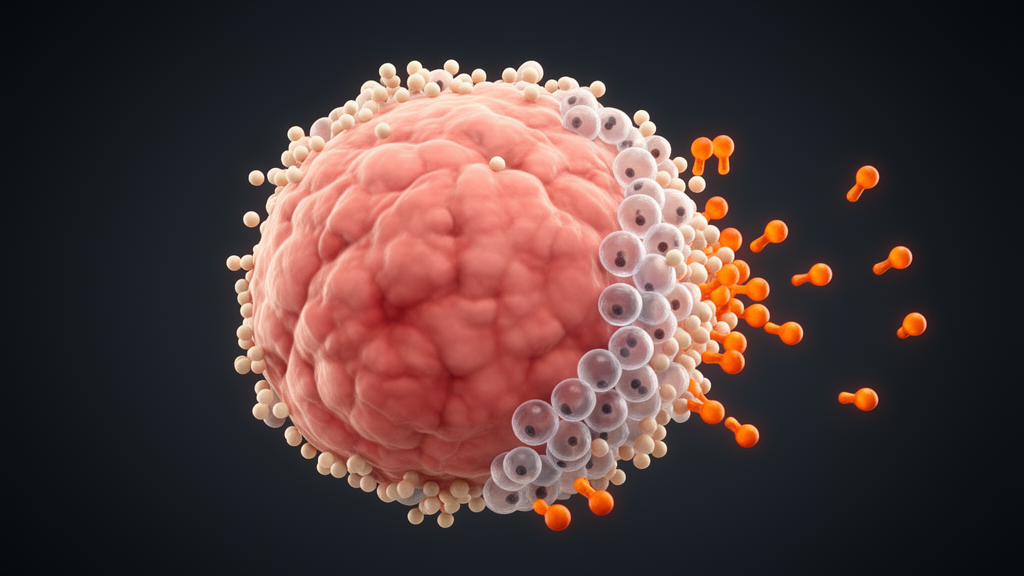
Perhaps the most striking structural discovery was a ring of SPP1-positive macrophages encircling the tumor, a barrier-like arrangement invisible in routine hematoxylin and eosin staining. These macrophages displayed a classic M2-like, immunosuppressive phenotype, expressing high levels of CCL18, CCL22, CD276, and metalloproteinases that remodel the extracellular matrix in ways that support cancer invasion. Crucially, the spatial data showed that regulatory T cells, or Tregs, the immune cells whose job is normally to restrain immune responses, were concentrated within the tumor core, nestled inside this macrophage ring. Ligand-receptor interaction analysis revealed the communication channels at work: CCL18 signaling through CCR8, and CCL22 through CCR4, both acting as chemical beacons drawing Tregs into the tumor. In publicly available spatial datasets, these SPP1 macrophage and Treg neighborhoods were predominantly localized at the invasive margins of tumors, suggesting a conserved architectural principle of immune evasion.
The tumor cells themselves were far from passive. All tumor clusters showed elevated expression of TGFB1, a potent immunosuppressive cytokine, along with the inhibitory checkpoint molecule CD276. The researchers also documented a metabolic form of immune suppression: tumor clusters exhibited heightened KYNU-AHR signaling, a pathway tied to tryptophan deprivation, which is known to starve anti-tumor T cells of an essential amino acid. This same axis appeared to induce CXCL5, a macrophage attractant, reinforcing the recruitment of M2-like macrophages, particularly in late-stage disease. Tumor clusters also activated the CD24-SIGLEC10 interaction, a so-called don’t-eat-me signal that prevents macrophages from engulfing cancer cells, and upregulated CD47 in the tumor core, another molecular shield against phagocytosis that has previously been linked to poor responses to PD1 and PD-L1 checkpoint inhibitors.
Not all immune structures in the tumor microenvironment are hostile. The team identified immune cell aggregates resembling tertiary lymphoid structures, organized clusters of immune cells that form in non-lymphoid tissue and are generally associated with favorable prognosis. Interaction analysis confirmed active T cell homing through CXCL13-CXCR5, CCL19-CCR7, and CCL21-CCR7 signaling, robust antigen presentation via MHC molecules, and T cell receptor signaling. Yet even within these seemingly protective structures, the researchers detected immunosuppressive undertones: enhanced PVR-TIGIT and PVR-CD96 inhibitory signaling, chemokine interactions capable of recruiting CCR4-positive Tregs, and elevated CD276. The picture that emerged was one of a battleground where anti-tumor immunity and immune suppression coexist in uneasy proximity.
To trace how these immune aggregates change as normal tissue becomes cancerous, the researchers applied pseudotime trajectory analysis, a computational method that orders cells or tissue spots along a developmental path based on gene expression. Two lineages emerged: a normal lineage and a tumor lineage. The tumor lineage showed heightened antibacterial and cytotoxic gene expression, active antigen presentation, and markers of ongoing angiogenesis, including MMP2-PECAM1 and TIMP3-CD44 interactions. But it also displayed a troubling signature: decreased co-stimulatory CD28 and increased expression of SIT1 and SIRT2, both negative regulators of T cell receptor signaling. SIT1, a transmembrane adaptor protein previously shown in mouse models to inhibit TCR-mediated signaling, had never been implicated in colorectal cancer immune suppression. Its elevated expression in tumor-associated immune aggregates, confirmed in public spatial datasets, suggests a previously unrecognized mechanism by which tertiary lymphoid structures might be functionally disarmed even as they form.
The study’s most novel discovery, however, was an entirely new subpopulation of regulatory T cells. Within FOXP3-positive spots, the hallmark of Tregs, in a specific tumor cluster, the researchers found high expression of IFI6, an interferon-induced gene, alongside ISG15 and a suite of other interferon-related genes including IFIT1, IFIT3, IFI44, and the IFITM family. Validation in single-cell data from 472 patients confirmed that IFI6-positive Tregs were significantly enriched in tumors and metastases compared with peripheral blood, healthy tissue, adjacent normal tissue, and lymph nodes, and were present across all stages of disease progression. Bulk transcriptomic analysis of 617 patients independently confirmed the elevation of this signature in primary tumors. These cells also expressed high levels of LGALS9, or galectin-9, an immune checkpoint molecule that has shown promise as a therapeutic target in early clinical trials.
The clinical implications of the IFI6-positive Treg population are considerable. The proportion of these cells was significantly increased in patients who did not respond to therapy, and a signature score combining Treg fraction with IFI6 and LGALS9 expression was associated with significantly reduced survival in The Cancer Genome Atlas colorectal cohort. Interaction analysis suggested that these Tregs are recruited to the tumor through multiple channels, including TFF3-CXCR4 signaling from cancer cells, CXCL16-CXCR6 from dendritic cells and SPP1 macrophages, and CXCL13 and CXCL14 from other immune and stromal cells. Once inside, they appear to suppress immunity through MHCII-mediated interactions with antigen-presenting cells, CD86-CTLA4 engagement with dendritic cells, and inhibition of NK cells via the HLA-E-KLRD1 checkpoint axis. IFI6 itself, an apoptosis suppressor, has been linked to colorectal cancer proliferation and, in esophageal carcinoma, to a mesenchymal and immunosuppressive microenvironment, reinforcing the plausibility of its role here.
The authors are careful to note the limitations of their work. The spatial transcriptomics data derive from a limited number of patient samples, and the computational discoveries await functional validation in laboratory and animal models. Protein-level confirmation in larger independent cohorts will be needed before these findings reach the clinic. Nevertheless, the study establishes a compelling framework: colorectal tumors construct layered immunosuppressive niches, with SPP1-positive macrophages forming a physical and chemical barrier that recruits Tregs via CCL18 and CCL22, tumor cells deploying tryptophan metabolism and don’t-eat-me signals, tertiary lymphoid structures being quietly undermined by SIT1, and a newly identified interferon-primed Treg population associated with treatment failure and poor survival. Each of these molecular players, from CCR8 and CCR4 to LGALS9 and HLA-E, represents a potential point of therapeutic intervention, offering a roadmap for the next generation of personalized immunotherapies against one of the world’s most formidable cancers.
Subject of Research: Spatial and single-cell transcriptomic characterization of immunosuppressive niches in colorectal cancer
Article Title: Integrated spatial and single-cell transcriptomics uncover IFI6⁺ regulatory T-cells and SPP1⁺ macrophages immunosuppressive niches in colorectal cancer
Article References: Miroszewska, D., Song, S., Urbiola-Salvador, V., Cázares Olivera, M., Jabłońska, A., Bolcewicz, M., Kalinowski, L., Duzowska, K., Drężek-Chyła, K., Zdrenka, M., Śrutek, E., Szylberg, Ł., Jankowski, M., Bała, D., Zegarski, W., Nowikiewicz, T., Filipowicz, N., Piotrowski, A., Dumanski, J. P., … Chen, Z. (2026). Integrated spatial and single-cell transcriptomics uncover IFI6⁺ regulatory T-cells and SPP1⁺ macrophages immunosuppressive niches in colorectal cancer. British Journal of Cancer. https://doi.org/10.1038/s41416-026-03637-1
Image Credits: AI Generated
DOI: 10.1038/s41416-026-03637-1
Keywords: colorectal cancer, spatial transcriptomics, single-cell RNA sequencing, regulatory T cells, SPP1 macrophages, IFI6, tumor microenvironment, immune evasion, LGALS9, tertiary lymphoid structures, immunotherapy, CCL18-CCR8 signaling
Cite Scienmag News
Nathaniel Bowman. (October 9, 2026). Hidden Immune Saboteurs: Scientists Map the Cells That Shield Colorectal Tumors. Scienmag. https://scienmag.com/hidden-immune-saboteurs-scientists-map-the-cells-that-shield-colorectal-tumors/
Nathaniel Bowman. "Hidden Immune Saboteurs: Scientists Map the Cells That Shield Colorectal Tumors." Scienmag, 9 October 2026, https://scienmag.com/hidden-immune-saboteurs-scientists-map-the-cells-that-shield-colorectal-tumors/. Accessed 9 October 2026.
Nathaniel Bowman. "Hidden Immune Saboteurs: Scientists Map the Cells That Shield Colorectal Tumors." Scienmag. October 9, 2026. https://scienmag.com/hidden-immune-saboteurs-scientists-map-the-cells-that-shield-colorectal-tumors/


