


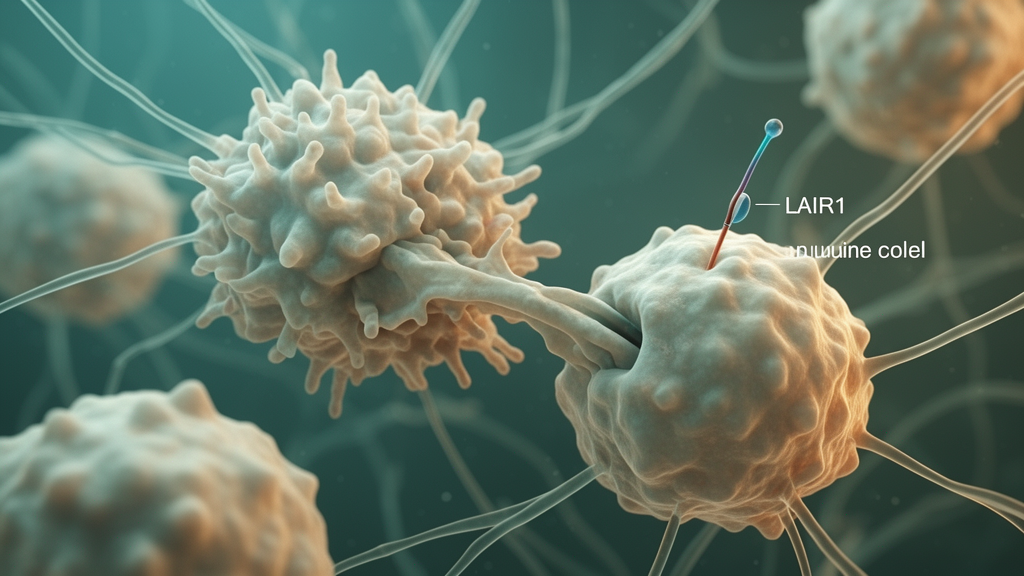
Glioblastoma and other malignant gliomas remain among the most stubborn challenges in oncology, and one of the central reasons is that the brain’s own immune defences are turned against the tumour. A study published in the British Journal of Cancer now reveals a molecular mechanism through which glioma-associated microglia and macrophages, the dominant immune population inside these tumours, are prevented from devouring cancer cells. The work identifies the inhibitory receptor LAIR1 as a critical brake on phagocytosis and maps, in unusual molecular detail, the signalling chain that links this receptor to the collapse of anti-tumour activity within the glioma microenvironment.
The research team, led by investigators at Capital Medical University in Beijing, combined bioinformatics, flow cytometry and multiplex immunohistochemical staining to chart where LAIR1 is expressed in human gliomas. The answer was unambiguous: LAIR1 is found predominantly on glioma-associated microglia and macrophages, collectively known as GAMs. Patients whose tumours harboured high numbers of LAIR1-expressing GAMs survived significantly less long than those with lower infiltration, establishing the receptor as a marker, and potentially a driver, of aggressive disease.
To test whether LAIR1 merely accompanies poor outcomes or actively causes them, the researchers turned to genetically engineered mice lacking the Lair1 gene. In orthotopic glioma models, in which tumours are implanted within the brain itself, LAIR1 deficiency substantially reduced tumour burden. The effect was traced to the behaviour of the immune cells rather than the tumour cells: when LAIR1 was absent, GAMs displayed enhanced tumoricidal activity in laboratory assays, engulfing tumour cells more readily and mounting stronger anti-tumour responses.
Single-cell and bulk RNA sequencing of LAIR1-high GAMs revealed a strongly immunosuppressive phenotype. These cells expressed molecular programmes associated with dampened T-cell responses, a hallmark of the glioma microenvironment that has repeatedly frustrated immunotherapy efforts. Notably, the team found that LAIR1-high GAMs were linked to the CD47-SIRPα axis, a well-known ‘don’t eat me’ signalling pair in which tumour cells display CD47 on their surface to engage SIRPα on macrophages and shut down engulfment. In mouse models, tumours rich in LAIR1-high GAMs were resistant to anti-PD-1 checkpoint blockade, connecting this receptor to the clinical failure of immunotherapy in brain cancer.
The mechanistic heart of the study concerns a protein called MYH9, the heavy chain of non-muscle myosin IIA. Myosin II motors are well established as physical enablers of phagocytosis: they generate the contractile force needed for a macrophage to extend its membrane around a target and pull it inside. Previous work has shown that myosin II activity must be precisely regulated at the phagocytic synapse, and the new findings place MYH9 at the centre of LAIR1’s suppressive circuit in GAMs.
Using co-immunoprecipitation, PCR arrays, molecular dynamics analysis and CRISPR/Cas9 gene editing, the researchers pieced together the pathway step by step. Collagen I, an abundant component of the glioma extracellular matrix, activates LAIR1 on the surface of GAMs. Once engaged, LAIR1 recruits and activates the phosphatase SHP2, which removes a phosphate group from MYH9 at the amino acid serine 1943. This dephosphorylation event has far-reaching consequences: it prevents the recruitment of USP22, a deubiquitylating enzyme that would otherwise stabilise MYH9 by stripping off ubiquitin tags that mark proteins for destruction.
With USP22 blocked from acting on MYH9, the myosin protein loses its protective deubiquitylation and is degraded. The same logic applies to HIF1α, a transcription factor that USP22 also stabilises and that supports the pro-tumour behaviour of macrophages. The net result is that the phagocytic machinery of the GAM is dismantled: the cell can no longer build the contractile apparatus needed to engulf glioma cells, and the immunosuppressive character of the microenvironment deepens. In this way, a collagen-rich tumour matrix actively disarms the very immune cells that patrol it.
The study’s experimental design was unusually comprehensive. Beyond Lair1-deficient mice, the team used engineered BV2 microglial cell lines, bone marrow-derived macrophages and GAMs isolated directly from patients treated at Beijing Tiantan Hospital. RNA sequencing and targeted PCR arrays defined the transcriptional landscape, while molecular dynamics simulations supported the structural basis of the SHP2-MYH9 interaction. Raw sequencing data were deposited in the NCBI Sequence Read Archive, and the work was approved by the Ethics Committee of Beijing Tiantan Hospital, adding translational weight to the preclinical findings.
The therapeutic implications are considerable. LAIR1 belongs to the LILRB family of inhibitory immune receptors, several of which are being pursued as ‘ innate immune checkpoints’ in cancer. LAIR1 itself has attracted attention because it binds collagen domains and has been implicated in T-cell exhaustion in collagen-dense tumours, in acute myeloid leukaemia development, and in resistance to T-cell attack in hepatocellular carcinoma. Antibody blockade of LAIR1 and LAIR1-directed CAR T cells have already shown enhanced anti-tumour responses in preclinical models, suggesting that a pharmacological toolkit for targeting this receptor is beginning to take shape.
What distinguishes the new work is that it defines a complete, testable signalling axis, from extracellular collagen through LAIR1 and SHP2 to USP22, MYH9 and HIF1α, and ties each link to the functional outcome of phagocytosis in glioma-associated immune cells. If LAIR1 can be safely blocked in patients, the brake on GAM engulfment could be released, potentially converting the largest immune population in glioma from a tumour ally into an attacker. Such a strategy might also sensitise tumours to existing checkpoint inhibitors, addressing the anti-PD-1 resistance that the study directly documents. For a disease in which median survival has barely moved in decades, a molecular switch that reprograms the tumour’s own microenvironment offers a genuinely new line of attack, and one that researchers can now pursue with a clear mechanistic map in hand.
Subject of Research: LAIR1-mediated suppression of phagocytosis in glioma-associated microglia and macrophages
Article Title: LAIR1 suppresses phagocytosis via SHP2/USP22-mediated MYH9 degradation in glioma-associated microglia/macrophages to drive immunosuppression
Article References: Wang, Z., Sun, Q., Li, C., Sun, T., He, Z., Wang, Y., Li, R., Lin, X., Jasiulionis, M. G., Ji, N., Zhang, Y., & Xu, H. (2026). LAIR1 suppresses phagocytosis via SHP2/USP22-mediated MYH9 degradation in glioma-associated microglia/macrophages to drive immunosuppression. British Journal of Cancer. https://doi.org/10.1038/s41416-026-03617-5
Image Credits: AI Generated
DOI: 10.1038/s41416-026-03617-5
Keywords: glioma, LAIR1, phagocytosis, microglia, macrophages, SHP2, USP22, MYH9, CD47-SIRPalpha, immunosuppression, immunotherapy resistance, tumour microenvironment
Cite Scienmag News
Nathaniel Bowman. (October 8, 2026). Immune Receptor LAIR1 Blocks Cancer Cell Engulfment in Brain Tumours. Scienmag. https://scienmag.com/immune-receptor-lair1-blocks-cancer-cell-engulfment-in-brain-tumours/
Nathaniel Bowman. "Immune Receptor LAIR1 Blocks Cancer Cell Engulfment in Brain Tumours." Scienmag, 8 October 2026, https://scienmag.com/immune-receptor-lair1-blocks-cancer-cell-engulfment-in-brain-tumours/. Accessed 8 October 2026.
Nathaniel Bowman. "Immune Receptor LAIR1 Blocks Cancer Cell Engulfment in Brain Tumours." Scienmag. October 8, 2026. https://scienmag.com/immune-receptor-lair1-blocks-cancer-cell-engulfment-in-brain-tumours/


