


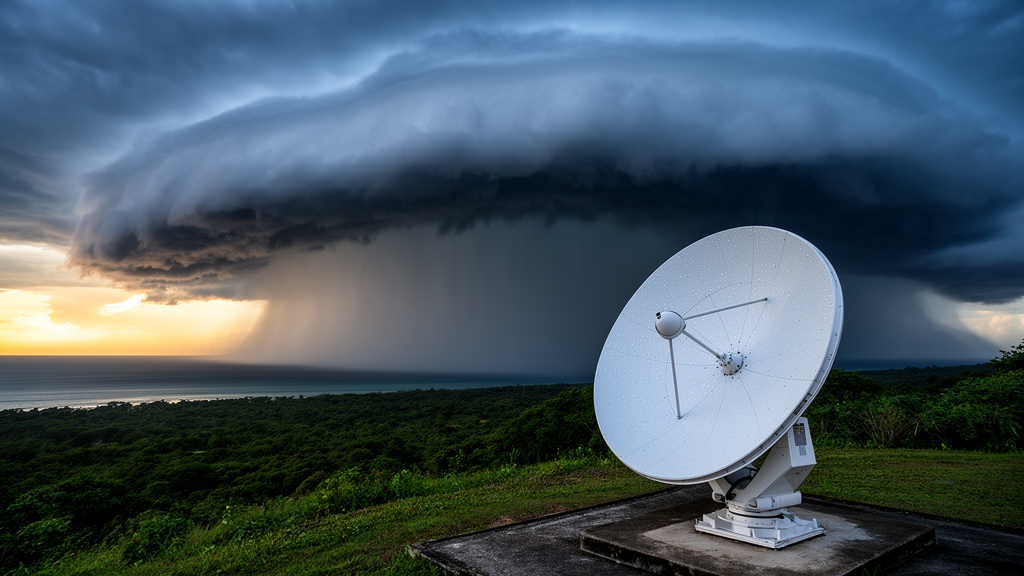
Deep inside towering tropical thunderstorms, ice particles, graupel, and partially melted snow plummet toward the ground at speeds that determine how much water reaches the surface, how much moisture gets lofted into high cirrus clouds, and ultimately how these storms feed back on the climate system. Yet the fall speeds of these hydrometeors — the collective term for raindrops, snowflakes, graupel, and hail — remain among the most poorly constrained quantities in atmospheric science, particularly in the violent cores of deep convective clouds where aircraft cannot safely fly. A new study published in Atmospheric Measurement Techniques by Scott Giangrande of Brookhaven National Laboratory, Christopher Williams of the University of Colorado Boulder, and Alain Protat of the Australian Bureau of Meteorology now offers one of the most detailed observational pictures yet of how fast precipitation particles actually fall inside tropical deep convection, and the findings challenge assumptions embedded in both radar retrieval algorithms and climate models.
The research draws on a uniquely capable instrument: a dual-frequency radar wind profiler operated near Darwin, Australia, during the 2005–2006 monsoon season. The system pairs a 50-MHz profiler with a 920-MHz profiler, and the combination exploits a subtle physical distinction. The 50-MHz radar detects not only Rayleigh scattering from hydrometeors but also Bragg scattering from turbulent fluctuations in the refractive index of clear air. Because those turbulent irregularities move with the air itself, the 50-MHz Doppler spectrum contains two peaks: one tracking the vertical air motion and another tracking the falling particles. The 920-MHz radar, sensitive only to the hydrometeor signal at these heights, is used to mask out the particle peak in the 50-MHz spectra, isolating the vertical air motion. The bulk reflectivity-weighted particle fall speed then emerges as a simple residual — the difference between the measured mean Doppler velocity and the retrieved air motion, adjusted to sea level pressure using the classic Foote and du Toit approximation.
This residual approach carries a crucial advantage over conventional techniques. Most radar retrievals of vertical air motion must first assume an empirical relationship between radar reflectivity factor Z and particle fall speed Vt, then subtract that assumed fall speed from the observed Doppler velocity. Any error in the assumed relationship propagates directly into the estimated updraft or downdraft, and such assumptions are widely recognized as the dominant source of error in profiler-based air motion retrievals. By retrieving air motion without any fall speed assumption and then solving for Vt as the leftover, the Darwin team sidesteps that circularity. The result is a bulk, power-weighted fall speed for each radar volume, biased toward the largest and densest particles that dominate the radar return — precisely the quantities that matter for interpreting scanning radar observations and for testing the fall speed prescriptions used in cloud models.
Before venturing into the uncharted territory of storm cores, the authors validated the technique against conditions with well-established reference behavior. Using roughly 16,000 one-minute samples of convective rain and 38,000 samples of stratiform rain below the melting layer, they fitted power-law relationships of the form Vt = aZ^b. The convective fit yielded a coefficient of 2.59 for a fixed exponent of 0.1, closely matching an independent reference derived from more than 4,000 drop size distributions recorded by a collocated two-dimensional video disdrometer, which gave a matched coefficient of 2.7. The stratiform fit produced a coefficient of 3.3, slightly higher than the disdrometer’s 3.1, but the discrepancy proved physically meaningful rather than erroneous: the team had deliberately restricted stratiform samples to columns with pronounced bright-band signatures, where aggregation and breakup below the melting layer favor fewer, larger drops for a given reflectivity. When all stratiform echoes were included, the coefficient settled to 3.0, essentially identical to the surface instrument. Residual standard deviations were about 1 meter per second for rain.
Snow presented a similar consistency check. Above the bright band, the profilers collected more than 44,000 samples between 4.5 and 6.5 kilometers altitude and over 16,000 samples between 6.5 and 8.5 kilometers. The retrieved fall speeds exceeded 1 meter per second for reflectivity above 20 dBZ and 1.4 meters per second at 30 dBZ, with residual standard deviations of roughly 0.3 to 0.4 meters per second — comparable to the error bars reported in earlier Darwin profiler work by Protat and Williams in 2011. The best-fitting relationships favored a lower exponent than some prior studies, and the team noted that shifts in the coefficients with altitude make physical sense: near the melting layer, aggregation produces large, slowly falling aggregates that inflate reflectivity relative to fall speed, while higher aloft, smaller and denser unaggregated ice falls faster for its reflectivity.
With confidence established, the study turned to its centerpiece: fall speeds within deep convective cores above the melting level, between 5.5 and 7.5 kilometers altitude, drawing on about 31,000 one-minute samples from 43 storm events. These volumes contain complicated mixtures of lofted rain, frozen drops, graupel, and small hail, and no direct observational reference existed for them before. The Darwin observations landed between two previously published graupel relationships — one derived for the Amazon, which implies faster-falling particles for a given reflectivity, and one for Oklahoma, which implies slower-falling particles. But the most striking result emerged at the lower end of the reflectivity range: for Z below 35 dBZ, the tropical particles fell faster than prior relationships predicted by more than 1 to 2 meters per second. Because these moderate-reflectivity samples typically come from the peripheries of convective cores rather than their most intense centers, the finding suggests that existing retrieval treatments systematically underestimate fall speeds in these flank regions.
To probe the physical controls behind this behavior, the team separated events by monsoon regime using established radiosonde-based classifications. Active monsoon conditions, associated with the deepest moist westerly flow and the highest rainfall accumulations, contributed 11 events, while Break monsoon conditions — drier midlevels, higher convective available potential energy, and more intense daytime convection — contributed 23 events. Both regimes produced similar fall speed behavior in the strongest core regions with reflectivity above 35 dBZ, but Break events showed markedly greater variability and a propensity for faster fall speeds at lower reflectivities. Some Break samples even exceeded the fall speeds expected of rain at the same reflectivity, with values above 6 meters per second for Z below 35 dBZ. The authors interpret these outliers as evidence of partially melted graupel coupled with size sorting, in which stronger updrafts loft liquid and rimed ice above the melting level and winds sort the fastest particles toward core peripheries.
The regime comparison also carries a provocative implication for modelers. Prior arguments, rooted in midlatitude Oklahoma simulations, held that stronger updrafts favor larger but lower-density graupel that falls more slowly. The Darwin observations only partially support that picture. While the strongest cores did show relatively slow-falling, presumably lower-density graupel consistent across both regimes, the Break monsoon’s more vigorous storms clearly produced faster and more diverse mixed-phase media aloft than the weaker Active monsoon storms. Notably, the profilers rarely observed reflectivity above 45 dBZ at these altitudes, indicating that even the most intense tropical Break storms did not sustain large hail aloft the way continental storms can. The authors suggest that in humid tropical environments, graupel and frozen drops melt and shrink more readily, pushing bulk fall speeds toward rain-like values — a picture consistent with recent modeling by Vagasky and colleagues showing that warmer environments accelerate hail melting.
The practical consequences extend well beyond radar meteorology. Fall speeds govern how much condensate rains out versus detrains into anvil clouds, and recent Earth system model analyses have shown that convective fall speeds control shortwave radiation and convective precipitation in simulations, while stratiform fall speeds influence outgoing longwave radiation and global-scale thermodynamics. Many convective parameterizations hard-wire fall speed assumptions for graupel and mixed-phase media, often tuned to midlatitude conditions. If substituting the older Oklahoma-style curves for the Darwin observations, retrieved updraft intensities in the strongest tropical cores could shift by 1 to 5 meters per second — a substantial error in the quantities used to evaluate some of the most uncertain processes in climate projection. Encouragingly, the finding that core-region graupel fall speeds appear relatively invariant across a modest range of tropical thermodynamic environments hints that a single, simpler tropical relationship might suffice, potentially simplifying both retrievals and parameterizations. As longer profiler records accumulate and forward radar operators improve, the Darwin dataset stands as a rare observational anchor for one of the stormiest, least sampleable corners of Earth’s atmosphere.
Subject of Research: Hydrometeor fall speed retrieval in tropical deep convection using dual-frequency radar wind profilers
Article Title: Dual-frequency profiler study of hydrometeor fall speeds in tropical deep convection
Article References: Giangrande, S. E., Williams, C. R., & Protat, A. (2026). Dual-frequency profiler study of hydrometeor fall speeds in tropical deep convection. Atmospheric Measurement Techniques, 19(19), 6251-6265. https://doi.org/10.5194/amt-19-6251-2026
Image Credits: AI Generated
Keywords: tropical convection, hydrometeor fall speed, dual-frequency radar, wind profiler, graupel, radar retrievals, Darwin Australia, monsoon, cloud microphysics, vertical air motion, deep convective cores, Atmospheric Measurement Techniques
Cite Scienmag News
Russell Cooper. (October 9, 2026). Tropical Thunderstorm Particles Fall Faster Than Models Predict, Radar Study Reveals. Scienmag. https://scienmag.com/tropical-thunderstorm-particles-fall-faster-than-models-predict-radar-study-reveals/
Russell Cooper. "Tropical Thunderstorm Particles Fall Faster Than Models Predict, Radar Study Reveals." Scienmag, 9 October 2026, https://scienmag.com/tropical-thunderstorm-particles-fall-faster-than-models-predict-radar-study-reveals/. Accessed 9 October 2026.
Russell Cooper. "Tropical Thunderstorm Particles Fall Faster Than Models Predict, Radar Study Reveals." Scienmag. October 9, 2026. https://scienmag.com/tropical-thunderstorm-particles-fall-faster-than-models-predict-radar-study-reveals/


