


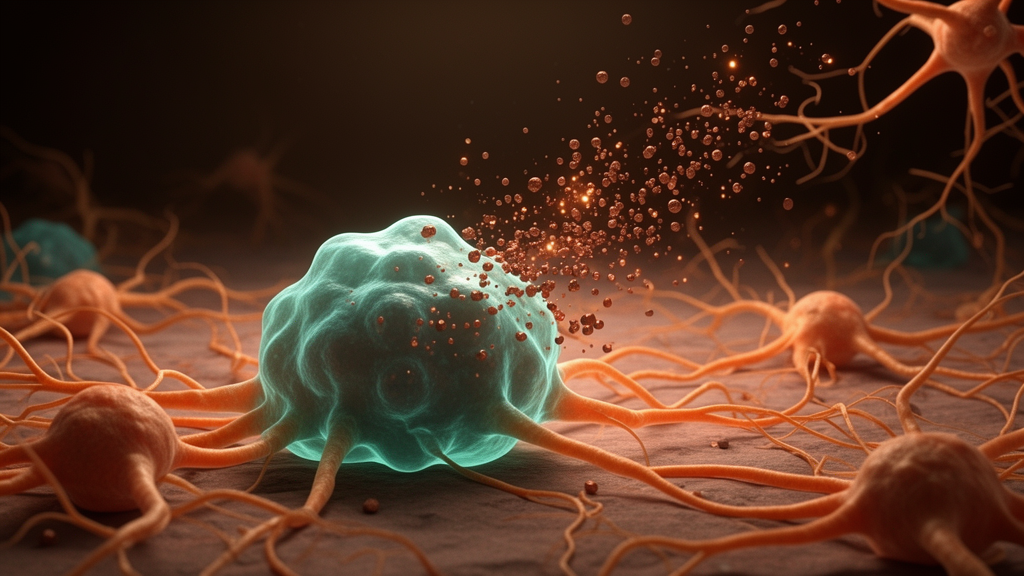
A study published in Nature Neuroscience on 26 October 2026 reports that a Parkinson’s disease risk protein called NgBR, encoded by the NUS1 gene, is highly expressed in microglia, the brain’s resident immune cells, and that its loss there sets off a chain reaction that kills dopaminergic neurons in mouse models. According to the research team led by Lele Liu, Guanghui Wang and Haigang Ren, microglia lacking NgBR do not primarily attack neurons with inflammatory cytokines, as classical microglial toxicity models would predict. Instead, they export iron. The iron leaves the microglia bound to a carrier protein, lipocalin-2 (LCN2), travels across the extracellular space, and is taken up by dopaminergic neurons through a receptor called SLC22A17. The resulting iron overload inside the neurons triggers ferroptosis, an iron-dependent form of cell death driven by lipid peroxidation, and produces progressive Parkinson’s-like motor deficits in the animals.
The mechanistic details emerge from a series of experiments outlined in the paper’s figures. When the researchers deleted NgBR in mouse and human microglia, the cells mounted an endoplasmic reticulum stress response that activated the PERK–ATF4–NUPR1 signaling pathway. This pathway preferentially induced LCN2 expression and secretion rather than the release of classical pro-inflammatory cytokines, a finding the authors describe as preferential induction of iron efflux over cytokine release. LCN2 exists in two functional states: an iron-free form called Apo-LCN2 and an iron-loaded form called Holo-LCN2. The study found that only the iron-loaded Holo-LCN2 secreted by NgBR-deficient microglia was internalized by dopaminergic neurons via SLC22A17, a receptor the paper identifies as highly expressed in those neurons. Once inside, the delivered iron accumulated to levels that promoted neuronal lipid peroxidation and ferroptotic death.
The in vivo evidence centers on a conditional knockout mouse line, referred to in the study as Nus1cKO, in which NgBR is deleted specifically in microglia. These animals developed progressive Parkinson’s-like motor deficits alongside the selective loss of dopaminergic neurons in the substantia nigra pars compacta, the brain region whose degeneration defines Parkinson’s disease. Pharmacological inhibition of the LCN2–SLC22A17 transport axis, or pharmacological inhibition of ferroptosis itself, alleviated both the dopaminergic neuron loss and the Parkinson’s-like symptoms caused by microglial NgBR deficiency in the in vitro and in vivo models, according to the paper’s results.
The authors frame these findings as identifying disrupted intercellular iron homeostasis, iron moving between cells rather than being mismanaged within a single cell type, as a pathological driver of Parkinson’s disease, and they highlight the LCN2–SLC22A17 axis as a potential therapeutic target. NUS1, which encodes the neurite outgrowth inhibitor-B receptor NgBR, was recently identified as a Parkinson’s disease risk gene, and the new work assigns that risk function to microglia rather than to neurons. The study’s abstract states that the selective loss of dopaminergic neurons in the substantia nigra pars compacta is a defining feature of Parkinson’s disease, yet its underlying mechanisms remain unclear, and the new results propose one mechanism rooted in iron logistics between immune cells and vulnerable neurons.
Several caveats bound the conclusions. The evidence comes from mouse models and from microglia and neurons studied in vitro, including mouse and human microglia; the paper does not report direct measurements of the LCN2–SLC22A17 axis in human Parkinson’s disease tissue, and the abstract does not describe clinical testing of LCN2 or ferroptosis inhibitors in patients. The pharmacological rescues demonstrate proof of principle in the models rather than established treatments. Even so, the study connects a genetic risk factor, a stress-responsive transcriptional pathway, an iron-carrier protein, a neuronal receptor and a specific cell death program into one coherent pathway, and it suggests that blocking iron transport from microglia to dopaminergic neurons, or blocking ferroptosis downstream of that transport, could slow the neurodegeneration that produces Parkinson’s motor symptoms in these experimental systems.
Subject of Research: Microglial NgBR deficiency, intercellular iron dysregulation and dopaminergic neurodegeneration in Parkinson's disease models
Article Title: Microglial NUS1 deficiency drives dopaminergic neurodegeneration through intercellular iron dysregulation in Parkinson’s disease models
Article References: Liu, L., Hong, Y., Wang, X., Huang, X., Ma, Y., Wang, R., Sun, Q., Sun, H., Hao, Z., Mu, C., Lu, X., Hu, L., Guo, J., Tang, B., Wang, G., & Ren, H. (2026). Microglial NUS1 deficiency drives dopaminergic neurodegeneration through intercellular iron dysregulation in Parkinson’s disease models. Nature Neuroscience. https://doi.org/10.1038/s41593-026-02499-3
Image Credits: AI Generated
DOI: 10.1038/s41593-026-02499-3
Keywords: Parkinson's disease, microglia, NgBR, NUS1, LCN2, SLC22A17, iron dysregulation, ferroptosis, dopaminergic neurons, substantia nigra, PERK–ATF4–NUPR1 signaling, neurodegeneration
Cite Scienmag News
Cassandra Pierce. (October 26, 2026). Microglial iron transport failure drives dopaminergic neuron loss in Parkinson’s models. Scienmag. https://scienmag.com/microglial-iron-transport-failure-drives-dopaminergic-neuron-loss-in-parkinsons-models/
Cassandra Pierce. "Microglial iron transport failure drives dopaminergic neuron loss in Parkinson’s models." Scienmag, 26 October 2026, https://scienmag.com/microglial-iron-transport-failure-drives-dopaminergic-neuron-loss-in-parkinsons-models/. Accessed 26 October 2026.
Cassandra Pierce. "Microglial iron transport failure drives dopaminergic neuron loss in Parkinson’s models." Scienmag. October 26, 2026. https://scienmag.com/microglial-iron-transport-failure-drives-dopaminergic-neuron-loss-in-parkinsons-models/


