


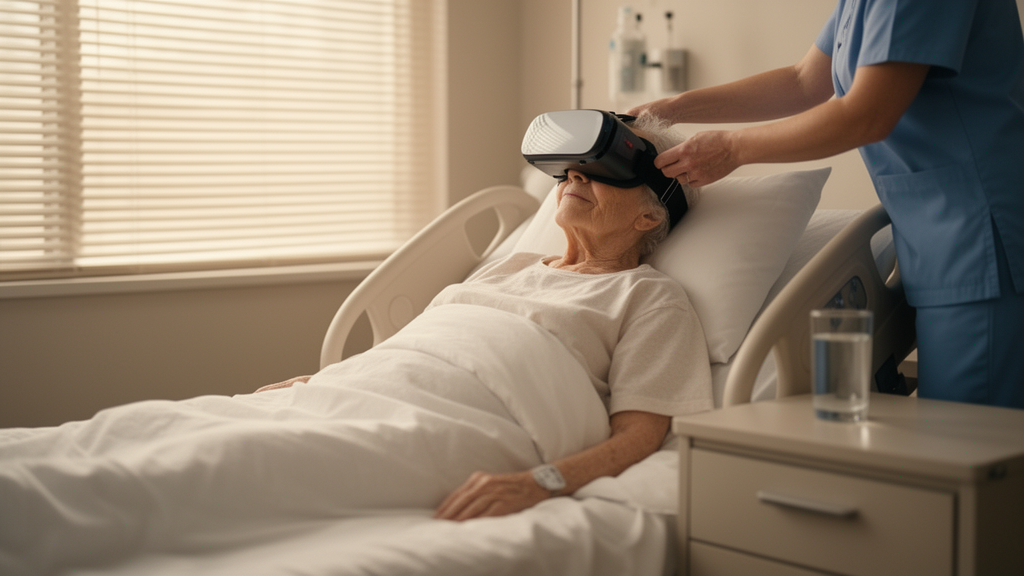
Hospitalized older adults in Hungary are set to take part in a carefully designed experiment that asks a deceptively simple question: does it matter whether you can act inside a virtual world, or merely look at it? A research team led by Pál Tamás Szabó of the Future Care Lab at Moholy-Nagy University of Art and Design, working with clinicians from Semmelweis University, the University of Szeged and Uzsoki Hospital, has published the full study protocol for a multicenter randomized controlled trial of Zenctuary VR+, a nature-based immersive virtual reality intervention built specifically for older inpatients. The protocol appeared in Frontiers in Medical Technology on 26 October 2026, and the trial is registered at ClinicalTrials.gov under identifier NCT07712549.
The trial’s central premise is mechanistic rather than decorative. Prolonged hospitalization can restrict autonomy, reduce opportunities for self-directed activity and place patients in a passive role, with daily routines, mobility and treatment decisions largely regulated by others. The authors are careful to note that hospitalization does not automatically produce learned helplessness, the psychological state in which repeated experiences of uncontrollability breed passivity, motivational decline and depressive responses. Instead, they argue that the hospital environment may create conditions that increase vulnerability to helplessness-related processes in some patients, particularly when the visible link between a person’s own action and its outcome disappears from daily life.
Zenctuary VR+ was engineered to counter exactly that. The system runs standalone on a Meta Quest 3 head-mounted display, developed in Unity with a separate operator-facing application that communicates over a local wireless network for real-time monitoring and support. Participants remain seated throughout and choose among six distinct nature-based virtual environments: a lookout, a lakeside, a riverside, a meadow, a forest and a garden with a pavilion. Each scene contains five or six predefined stations combining observation, navigation and optional low-cognitive-load interactions such as fruit picking, feeding virtual animals, watering plants and collecting objects. Movement between stations uses a simplified gaze-assisted teleportation system, and no minimum number of interactions is required.
The theoretical target of these design choices is what the team calls action–outcome contingency: the experience of acting on an environment and seeing a result. Repeated, low-demand opportunities for self-initiated action are hypothesized to support perceived control, agency-related experience and mastery-like experiences that strengthen self-efficacy. Crucially, the protocol states plainly that these mappings are theoretical design assumptions, not evidence that any individual component causes a specific psychological mechanism. Agency and perceived control will be explored qualitatively through post-session interviews rather than measured with dedicated quantitative instruments, and mechanism-related quantitative analyses will remain exploratory.
The study design isolates the interactive ingredient with unusual precision. One hundred hospitalized adults aged 60 or older will be randomly assigned in a 1:1 ratio to either the active Zenctuary VR+ intervention or a passive control condition. Both groups will use the same headset, the same six virtual environments, the same schedule of six sessions over three weeks delivered twice weekly, and the same standardized onboarding and operator supervision. In the control condition, a dedicated “Bench mode” disables all interactive elements, navigation and goal-directed tasks; participants simply sit on a virtual bench and observe the scenery. Any difference between the groups can therefore be attributed to the interactive feature package as a whole, not to immersion in pleasant virtual nature alone.
The primary outcome is psychological distress measured by the total score of the Hospital Anxiety and Depression Scale, a 14-item self-report instrument widely used in medical populations, chosen because the intervention aims to reduce overall distress rather than anxiety or depression separately. Secondary outcomes include self-esteem on the Rosenberg Self-Esteem Scale, general self-efficacy on the General Self-Efficacy Scale, hopelessness on the Beck Hopelessness Scale, depressive symptoms on the Geriatric Depression Scale, and learned helplessness on the Learned Helplessness Scale. Assessments occur at baseline, immediately after the intervention period and at a four-week follow-up, with questionnaire burden deliberately spread across sessions when needed for frail participants.
The statistical plan reflects both rigor and candor about uncertainty. The primary analysis will use a linear mixed model testing the group-by-time interaction across the three assessment occasions, with study site included as a fixed effect to match the site-stratified randomization and participant as a random effect. The prespecified principal contrast compares between-group change from baseline to post-intervention, with a follow-up contrast assessing persistence at four weeks. The sample size calculation, based on a conservative small-to-moderate effect size of f = 0.15 at 80 percent power, yielded a minimum of 86 participants, increased to 100 to allow roughly 14 percent attrition. Secondary and mediation analyses are explicitly exploratory and will not be interpreted as establishing causal mediation, partly because potential mediators and the distress measure are assessed over the same intervals.
Eligibility rules reveal the practical challenges of bringing immersive technology to a medically vulnerable population. Participants must expect to remain hospitalized at least four weeks after enrollment, tolerate seated headset use, and score at least 18 on the Montreal Cognitive Assessment after standard education adjustment, a pragmatic threshold to ensure informed participation rather than a diagnostic cutoff. Exclusions include acute delirium, impaired consciousness, psychotic disorder diagnoses, current antipsychotic treatment, untreated epilepsy and severe vestibular dysfunction. The authors stress that these conservative psychiatric criteria, set a priori by a multidisciplinary team, do not imply that VR is generally contraindicated in people with psychotic disorders; they were chosen to support safety and a more homogeneous initial study population.
Safety procedures are extensive. Every session begins with a brief check that the participant is fit to take part that day, and sessions can be postponed for acute illness, severe fatigue, pain, dizziness or reduced alertness. Participants are told they may pause or stop at any time without consequence, and operators will immediately remove the headset if significant discomfort, severe cybersickness, acute emotional distress, pain or fall risk emerges. Rather than adding a standardized cybersickness questionnaire, which would burden this population, tolerability is monitored through direct observation, participant self-report and a standardized session log, with all interruptions, adverse events and early terminations documented and summarized descriptively.
The team is transparent about the trial’s limits. Participants and operators cannot be blinded, only the outcome assessors can; the clinically heterogeneous sample recruited across geriatric, rehabilitation and neurosurgical wards may introduce variability; and because eligibility does not require elevated baseline distress, floor effects may limit detectable improvement. Self-report outcomes carry expectancy effects when participants know which condition they received. The Learned Helplessness Scale lacks a fully validated Hungarian version, so its scores will be treated as exploratory, with formal psychometric evaluation reported separately. No independent data monitoring committee is planned given the low-risk, non-drug nature of the intervention, and no interim efficacy analysis will be run. Recruitment is planned from November 2026 through December 2027, and the trial remains in its preparation phase, meaning no efficacy results yet exist. If the interactive condition outperforms passive immersion, the authors caution that further research will be needed before such systems could be scaled in routine hospital care; the trial is designed to test comparative effectiveness against passive VR, not superiority over usual care.
Subject of Research: A study protocol for a multicenter randomized controlled trial of an interactive nature-based immersive VR intervention targeting psychological distress and helplessness-related processes in hospitalized older adults.
Article Title: A mechanism-oriented immersive virtual reality intervention for psychological distress and helplessness-related processes in hospitalized older adults: study protocol for a multicenter randomized controlled trial
Article References: Szabó, P. T., Vásárhelyi, B. R., Lajkó, P., Stankovic, M., Fekete, M., Pintérné Sosity, B., Chovanec, S., & Bakk, Á. K. (2026). A mechanism-oriented immersive virtual reality intervention for psychological distress and helplessness-related processes in hospitalized older adults: study protocol for a multicenter randomized controlled trial. Frontiers in Medical Technology, 8, Article 1940940. https://doi.org/10.3389/fmedt.2026.1940940
Image Credits: AI Generated
DOI: 10.3389/fmedt.2026.1940940
Keywords: virtual reality, hospitalized older adults, psychological distress, learned helplessness, randomized controlled trial, study protocol, self-efficacy, perceived control, nature-based intervention, digital health, geriatrics, Zenctuary VR+
Cite Scienmag News
Ophelia Keating. (October 26, 2026). Virtual Reality Trial Will Test Whether Interactive Nature Scenes Ease Distress in Hospitalized Older Adults. Scienmag. https://scienmag.com/virtual-reality-trial-will-test-whether-interactive-nature-scenes-ease-distress-in-hospitalized-older-adults/
Ophelia Keating. "Virtual Reality Trial Will Test Whether Interactive Nature Scenes Ease Distress in Hospitalized Older Adults." Scienmag, 26 October 2026, https://scienmag.com/virtual-reality-trial-will-test-whether-interactive-nature-scenes-ease-distress-in-hospitalized-older-adults/. Accessed 26 October 2026.
Ophelia Keating. "Virtual Reality Trial Will Test Whether Interactive Nature Scenes Ease Distress in Hospitalized Older Adults." Scienmag. October 26, 2026. https://scienmag.com/virtual-reality-trial-will-test-whether-interactive-nature-scenes-ease-distress-in-hospitalized-older-adults/


