


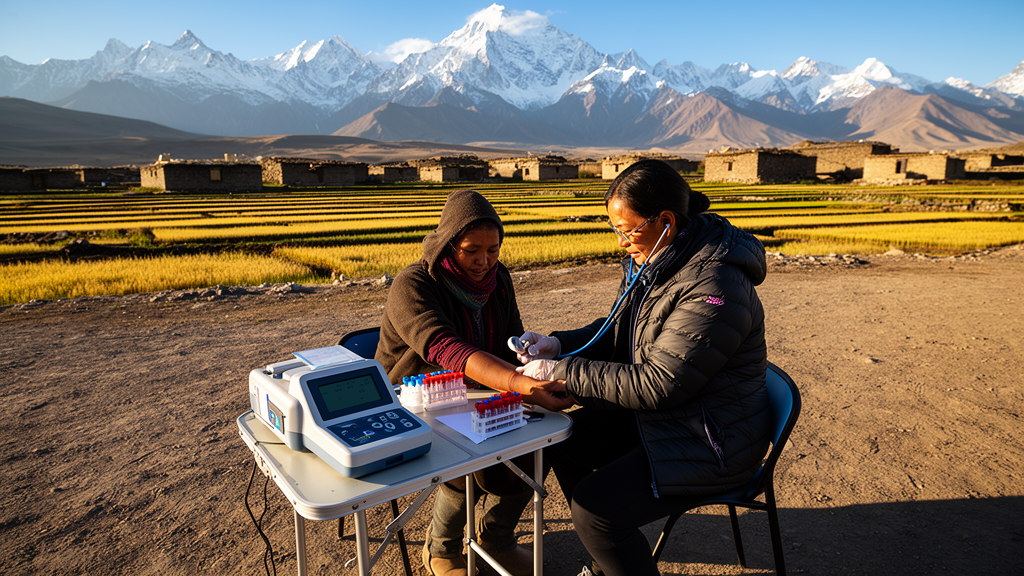
More than one in five Tibetan residents living at high altitude shows elevated serum uric acid, according to a multicenter cross-sectional survey published in BMC Endocrine Disorders. The study, which examined 1264 Tibetan residents across three distinct elevation zones of the Tibetan Plateau, reports an overall crude prevalence of hyperuricemia of 22.6 percent, with a striking sex imbalance: 45.8 percent among males compared with just 5.4 percent among females.
The research team, led by Yicong Yin, Jianwei Ren and Tingting You with colleagues from multiple institutions, recruited participants from three altitudinal gradients: Nyingchi at roughly 2900 meters, Lhasa and Shigatse at approximately 3700 meters, and Ngari at about 4300 meters. This design allowed the investigators to compare how the burden of hyperuricemia is distributed across communities with long-term exposure to progressively thinner air.
Prevalence did not rise in a simple straight line with elevation. Instead, the spatial distribution was non-linear, peaking in Ngari, the highest-altitude region included in the survey. The authors conclude that hyperuricemia prevalence in this population is associated with regional effects and metabolic factors, although the cross-sectional nature of the study means these associations cannot be read as causal effects of altitude itself.
To identify independent risk factors, the researchers applied logistic regression models, and to probe how risk changes across continuous measurements they used restricted cubic spline (RCS) models, a statistical technique capable of capturing non-linear risk trajectories. Multivariate analysis singled out male sex, hypertension, a body mass index of 24 kg/m² or higher, dyslipidemia, high-altitude polycythemia and elevated serum creatinine as independent risk factors for hyperuricemia.
The restricted cubic spline analysis added technical nuance to these findings. Rather than revealing a threshold effect, the RCS models showed significant non-linear continuous increases in hyperuricemia risk as BMI and serum creatinine levels rose. In practical terms, risk climbed progressively across the observed range of both measurements, with the shape of the increase deviating from a simple straight-line relationship.
High-altitude polycythemia, a condition associated with prolonged residence at elevation, emerged as an independent risk factor in its own right. Its inclusion among the identified risk factors links hyperuricemia in this population to the hematological characteristics of long-term high-altitude living, as captured by the survey’s multivariate model.
The authors propose that public health strategies incorporating weight management and routine metabolic monitoring may be beneficial for this population. This suggestion follows directly from the risk factors identified in the analysis, which span both metabolic measurements and altitude-related conditions.
As a cross-sectional survey, the study captures a snapshot of prevalence and associated factors at a single point in time, so it identifies correlations rather than demonstrating that any factor causes hyperuricemia. The authors note that systematic epidemiological data on hyperuricemia across different high-altitude gradients had remained limited, and they frame their multicenter design as an attempt to fill that gap. The findings position the Tibetan population of the plateau, with its long-term altitude exposure, as a distinctive setting for studying how regional effects and metabolic factors shape the distribution of hyperuricemia.
Subject of Research: Epidemiology of hyperuricemia in high-altitude Tibetan populations
Article Title: Prevalence and associated factors of hyperuricemia among the Tibetan population with long-term exposure to high-altitude environments: a multicenter cross-sectional study
Article References: Yin, Y., Ren, J., You, T., Liu, Z., Liu, X., Puchi, Z., Tian, L., Wang, D., Li, H., Yu, S., Hou, L., Cheng, Q., Guo, X., Cheng, X., Xia, L., & Qiu, L. (2026). Prevalence and associated factors of hyperuricemia among the Tibetan population with long-term exposure to high-altitude environments: a multicenter cross-sectional study. BMC Endocrine Disorders. https://doi.org/10.1186/s12902-026-02660-w
Image Credits: AI Generated
DOI: 10.1186/s12902-026-02660-w
Keywords: hyperuricemia, Tibetan population, high altitude, cross-sectional study, BMI, serum creatinine, polycythemia, metabolic health, prevalence, risk factors, associated, factors
Cite Scienmag News
Ophelia Keating. (October 26, 2026). High-Altitude Tibetan Study Maps Hyperuricemia Risk Across Elevation Gradients. Scienmag. https://scienmag.com/high-altitude-tibetan-study-maps-hyperuricemia-risk-across-elevation-gradients/
Ophelia Keating. "High-Altitude Tibetan Study Maps Hyperuricemia Risk Across Elevation Gradients." Scienmag, 26 October 2026, https://scienmag.com/high-altitude-tibetan-study-maps-hyperuricemia-risk-across-elevation-gradients/. Accessed 26 October 2026.
Ophelia Keating. "High-Altitude Tibetan Study Maps Hyperuricemia Risk Across Elevation Gradients." Scienmag. October 26, 2026. https://scienmag.com/high-altitude-tibetan-study-maps-hyperuricemia-risk-across-elevation-gradients/


