


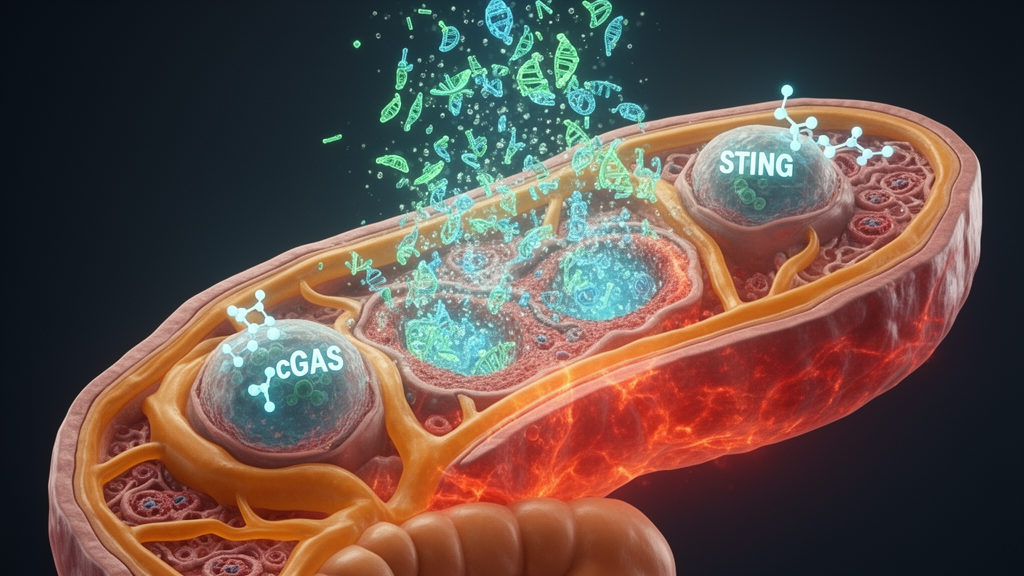
A sweeping review published in Frontiers in Physiology argues that the cGAS-STING innate immune pathway, best known for detecting viral and bacterial DNA, plays a central and double-edged role in acute pancreatitis, a disease in which the pancreas literally digests itself. The authors, emergency medicine researchers at Shenzhen Traditional Chinese Medicine Hospital, systematically synthesize evidence that the pathway senses DNA spilling from dying pancreatic acinar cells and converts that molecular distress signal into the inflammatory cascade that determines whether a patient recovers or slides into necrosis and organ failure.
Acute pancreatitis is far from rare, and its stakes are considerable. The review notes an overall mortality rate of roughly 1 to 5 percent, with deaths concentrated among patients who develop pancreatic necrosis, low blood volume, or systemic inflammatory response syndrome. Standard care remains supportive: fluid resuscitation, suppression of pancreatic secretion, pain control, and early enteral nutrition, escalating to intensive care and antibiotics in severe cases. Survivors face long-term risks as well, including exocrine or endocrine pancreatic insufficiency, recurrent episodes, progression to chronic pancreatitis, and an elevated risk of pancreatic cancer attributed to repeated tissue injury.
The initiating event is well established: premature activation of trypsinogen inside the pancreas triggers autodigestion of acinar cells. What follows is an immune drama. Because the uninflamed pancreas is microbe-free, early injury occurs in a sterile environment, and the immune response is ignited by damage-associated molecular patterns, or DAMPs, released from necrotic acinar cells, including HMGB1, ATP, and self-DNA. These molecules activate pattern recognition receptors on infiltrating macrophages, neutrophils, dendritic cells, mast cells, and natural killer cells, which pour out additional inflammatory mediators and recruit adaptive immune cells. When the initial insult is not rapidly resolved, this response can persist, intensify, and spread beyond the pancreas into systemic inflammation and, in the worst cases, multiple organ dysfunction syndrome.
The cGAS-STING pathway is the cell’s principal alarm system for misplaced DNA. cGAS, a horseshoe-shaped cytosolic protein, binds double-stranded DNA through two cooperative sites to form a 2:2 complex, using a zinc thumb motif to recognize B-form DNA in a sequence-independent manner. At high DNA concentrations, cGAS oligomerizes and undergoes liquid-liquid phase separation, amplifying its catalytic activity. Once activated, it synthesizes the second messenger 2′3′-cGAMP from GTP and ATP. cGAMP then activates STING on the endoplasmic reticulum, which translocates to the Golgi apparatus and recruits TANK-binding kinase 1, phosphorylating IRF3 to drive type I interferon genes while also activating NF-κB to induce the pro-inflammatory cytokines IL-6 and TNF-α. STING can additionally activate STAT6 through TBK1-mediated phosphorylation at Ser407, independent of the canonical JAK pathway.
In experimental pancreatitis, this machinery appears to act as an amplifier of injury. In murine models, STING senses acinar cell death and activates pro-inflammatory signaling, with macrophages expressing STING and participating in both the initiation and amplification of pancreatic inflammation. Genetic ablation of STING consistently attenuates disease severity across cerulein- and diet-induced models, reducing pancreatic edema, serum lipase, and neutrophil infiltration, and bone marrow chimera experiments localize the pathogenic function to infiltrating leukocytes rather than resident acinar cells. Clinical evidence further suggests that leaked mitochondrial DNA exacerbates acinar injury through a cGAS-STING-NF-κB axis, and that cytokines induced by the pathway act back on acinar cells to provoke more mitochondrial stress and more mtDNA leakage, forming a self-reinforcing feedback loop.
The pathway’s reach extends to the extrapancreatic complications that kill patients. In a rat model of severe acute pancreatitis, STING-related genes were upregulated in both pancreas and intestine, and inhibiting STING signaling alleviated intestinal epithelial damage. In models of severe pancreatitis with acute lung injury, the mtDNA-cGAS-STING axis promoted NLRP3 inflammasome-mediated pyroptosis of macrophages by enhancing phosphorylated IRF3 nuclear translocation and increasing IRF7 expression, while mitochondrial DNA also drove inflammatory monocyte infiltration through a STING/TLR9-NF-κB-JMJD3-TNF-α route. Intriguingly, the pathway’s role flips in chronic pancreatitis, where STING activation appears protective by regulating Th17 cell infiltration, possibly because different immune cell subsets dominate in different inflammatory environments.
The review’s most detailed analysis concerns crosstalk with programmed cell death. Apoptosis and cGAS-STING regulate each other in both directions: STING activation promotes apoptosis by upregulating the pro-apoptotic protein NOXA and downregulating Bcl-xL, and phosphorylated IRF3 can bind and inhibit Bcl-xL to trigger mitochondrial outer membrane permeabilization. Conversely, caspase-3 and caspase-7, activated during apoptosis, cleave cGAS and IRF3, suppressing the mtDNA-cGAS-STING circuit in both human and murine cells. Autophagy provides a second regulatory layer: cGAS initiates autophagy by interacting with LC3 and Beclin-1, promoting the degradation of cytosolic DNA and of cGAS itself, while STING can be routed to lysosomal destruction via TBK1-mediated phosphorylation of p62, preventing overactivation of innate immune signaling.
Ferroptosis and pyroptosis add further complexity. Ferroptosis, driven by iron-dependent lipid peroxidation, is governed by the GPX4 enzyme and the system Xc- cystine importer; the relationship with STING is bidirectional and context-dependent, since GPX4 deficiency promotes STING carbonylation that impairs signaling, while sustained STING activation can interact with NCOA4 to promote ferritinophagy and amplify lipid peroxidation. Pyroptosis, the caspase-1-dependent, gasdermin D-mediated form of inflammatory cell death, also cuts both ways: GSDMD pore formation depletes intracellular potassium, which restrains cGAS-dependent interferon responses, yet the cGAS-STING pathway upregulates NLRP3 expression in an IRF3-dependent manner and STING directly stabilizes NLRP3, enhancing inflammasome activation. The authors caution that much of the ferroptosis evidence comes from pancreatic cancer models and cannot be straightforwardly extrapolated to acute injury.
On therapeutics, the review surveys natural plant-derived compounds with suggestive but immature evidence. Saikosaponin D, a triterpene saponin from Bupleurum chinense, protects acinar cells in cerulein-induced models by reducing mitochondrial damage, suppressing mtDNA release, and inhibiting NLRP3/caspase-1 pyroptosis and MAPK signaling. Artemisinin induces protective caspase-3-mediated apoptosis in acinar cells, and its derivative artesunate has inhibited cGAS-STING-mediated inflammation in other systems. Kaempferol suppresses cGAS-STING activation in lung injury models, and bufalin activates Keap1-Nrf2/HO-1 while inhibiting NF-κB in experimental severe pancreatitis. But the authors are blunt about the gaps: none of these compounds has demonstrated target engagement with cGAS or STING in pancreatic cells, confirmed therapeutic concentrations in pancreatic tissue, selectivity against other innate immune sensors, or formal safety evaluation in relevant models. Saikosaponin D’s oral bioavailability falls below 15 percent, rosavin’s is just 4.7 percent, and bufalin’s narrow therapeutic window as a cardiotonic steroid raises safety concerns.
The review closes with an integrative model and a candid admission of what remains unknown. It proposes a four-phase architecture: initiation through acinar mitochondrial injury and mtDNA release, amplification when extracellular DNA activates cGAS-STING in infiltrating macrophages, feedback as cytokines drive further mitochondrial stress, and a final fork in which autophagy-mediated DNA clearance permits repair or persistent activation drives ferroptosis, pyroptosis, and multi-organ injury. The pivotal unresolved question is whether cGAS-STING activation is a sufficient driver of disease progression or merely a consequence of acinar cell death, a distinction that will require genetic epistasis experiments comparing acinar-specific with myeloid-specific STING deletion. The authors also flag that most mechanistic evidence derives from cerulein models of mild, edema-predominant disease, potentially underrepresenting the pathway’s role in necrotizing severe pancreatitis. As a review, the work reports no new experimental data, but it maps a research agenda in which a DNA-sensing pathway once studied mainly in antiviral immunity may hold the keys to taming one of medicine’s most unpredictable inflammatory diseases.
Subject of Research: The role of cGAS-STING innate immune signaling in inflammation and programmed cell death during acute pancreatitis
Article Title: The role and therapeutic potential of cGAS-STING signaling in acute pancreatitis: from the perspectives of inflammation and cell death
Article References: Wang, H., Wen, L., Wang, H., Liu, Y., & Mo, Z. (2026). The role and therapeutic potential of cGAS-STING signaling in acute pancreatitis: from the perspectives of inflammation and cell death. Frontiers in Physiology, 17, Article 1976652. https://doi.org/10.3389/fphys.2026.1976652
Image Credits: AI Generated
DOI: 10.3389/fphys.2026.1976652
Keywords: acute pancreatitis, cGAS-STING, innate immunity, inflammation, apoptosis, autophagy, ferroptosis, pyroptosis, mitochondrial DNA, NLRP3 inflammasome, natural compounds, cell death
Cite Scienmag News
Kristina Jarvis. (October 27, 2026). DNA Sensor cGAS-STING Emerges as Double-Edged Driver of Acute Pancreatitis. Scienmag. https://scienmag.com/dna-sensor-cgas-sting-emerges-as-double-edged-driver-of-acute-pancreatitis/
Kristina Jarvis. "DNA Sensor cGAS-STING Emerges as Double-Edged Driver of Acute Pancreatitis." Scienmag, 27 October 2026, https://scienmag.com/dna-sensor-cgas-sting-emerges-as-double-edged-driver-of-acute-pancreatitis/. Accessed 27 October 2026.
Kristina Jarvis. "DNA Sensor cGAS-STING Emerges as Double-Edged Driver of Acute Pancreatitis." Scienmag. October 27, 2026. https://scienmag.com/dna-sensor-cgas-sting-emerges-as-double-edged-driver-of-acute-pancreatitis/


