


A new species of pygmy grasshopper has been described from the temperate hills of Bajung in Nepal’s Parbat District, extending the known range of the endemic genus Skejotettix from the country’s subtropical lowlands into cool mountain forests nearly 2,000 meters above sea level. The species, named Skejotettix kasalo in honor of Croatian tetrigidologist Niko Kasalo, brings the number of species in this Nepal-endemic genus to three and raises the country’s tally of pygmy grasshoppers, the family Tetrigidae, to 69 species. The discovery began on 28 September 2022, when researcher Madhav Subedi was photographing another pygmy grasshopper, Criotettix cf. bispinosus, on a lichen-covered stone amid Crofton weed bushes beside the freshwater stream of Panikhola.
A single female of the unfamiliar species was spotted at that site. Later the same day, an adult male and a nymph turned up on the clifftop of Basnee Gaun, and two days after that an entire population was found at Kafleko Pakho, roughly 500 meters north of Basnee Gaun. Because a full population was present there, Kafleko Pakho was designated the type locality. The species has also been given the common name Bajung’s cliffhopper, combining the name of the village where it was discovered with a reference to its habitat.
Kafleko Pakho sits at approximately 1,920 meters elevation within the Dhiku-Maidan community forest, on sloping terrain of grassland and forest at the top of the hill above Bajung village, which has a cool temperate climate. The ground vegetation includes Ageratina adenophora, Anaphilis sp., the fern Nephrolepis cordifolia, Gnaphalium affine, and Rubus ellipticus beneath a canopy of Symplocos theifolia, Daphniphyllum himalayense, Rhododendron arboreum, Schima wallichii, Prunus cerasoides, Eurya acuminata, and other temperate tree species. A dirt road constructed in 2019 cuts through the locality, and its mud walls, thick with moss and algal growth, proved to be a favored haunt of the new grasshopper: the holotype and several paratypes were collected and photographed on these walls. From the type locality, the Annapurna and Mansiri Himal ranges are visible in the distance.
The type series consists of a female holotype and four paratypes, two males and two females, collected by hand between 28 September and 11 October 2022 and deposited in the insect collection of the Agriculture Science Center in Ghyalchok, Gorkha. Specimens were killed in an ethyl acetate killing jar and pinned with stainless steel pins for storage, with additional adults and nymphs photographed in the wild. The localities were visited regularly over a month, from September into October 2022, to observe life stages and ecology. Vegetation at the sites was first identified by vernacular names with the help of local people and then checked against binomial names and internet images.
Morphologically, Skejotettix kasalo conforms to the generic diagnosis: a small grasshopper whose antennae insert between or below the ventral margins of the compound eyes, whose scapus bears a large notch in lateral view, whose frontal costa is visible in front of the compound eyes in lateral view, and whose vertex is narrower than the width of an eye. The antennae are filiform with 16 antennomeres, the apical one consisting of fused segments. It can be distinguished from its two congeners by a suite of characters, including antennal grooves placed below the lower margin of the compound eyes, a bluntly rounded pronotal apex, a distinctly undulated median carina, larger claws, an infrascapular area intermediate in width, and a scutellum wider than the scapus. Compared with the type species of the related genus Ergatettix, E. dorsiferus, it has a wider vertex with parallel lateral borders, a convex vertex without horns, and robust rather than slender middle femora, while sharing features such as the notched antennal scapus and antennal grooves distinctly below the ventral margins of the eyes.
Measurements of the type series show body lengths ranging from 9.70 to 13.27 millimeters, with females averaging 11.83 millimeters and males 9.78. The hind femora are robust, about 2.41 times as long as wide, with a serrate dorsal margin and arc-shaped, pointed antegenicular teeth, while the fore and mid femora are about 3.36 times as long as wide. Pronotum length varies strikingly among individuals, from 6.74 to 14.19 millimeters, reflecting a pronounced dimorphism within the species. No sexual dimorphism was observed apart from body size and terminalia; females have widened, serrated ovipositor valves with pointed apices, and males have a widened subgenital plate curving upwards with a blunt apex.
Until now, Skejotettix was known only as a brachypronotal, short-winged genus, with reduced wings in S. netrajyoti and wings hidden or absent in S. muglingi. In S. kasalo, however, a macropronotal, long-winged form coexists alongside the typical brachypronotal, short-winged form, a phenomenon also documented in some other Tetriginae such as species of Paratettix. The undulation of the median carina is more distinct and higher in the brachypronotal form than in the macropronotal form. The author suggests this variability may indicate that S. kasalo is a basal species in the genus’s evolutionary tree, from which the morphologies of the other species could have been derived, and that apterousness may have appeared several times independently within Skejotettix. These ideas are presented explicitly as hypotheses to direct future studies, to be explored through detailed morphological and molecular work beyond the scope of the paper.
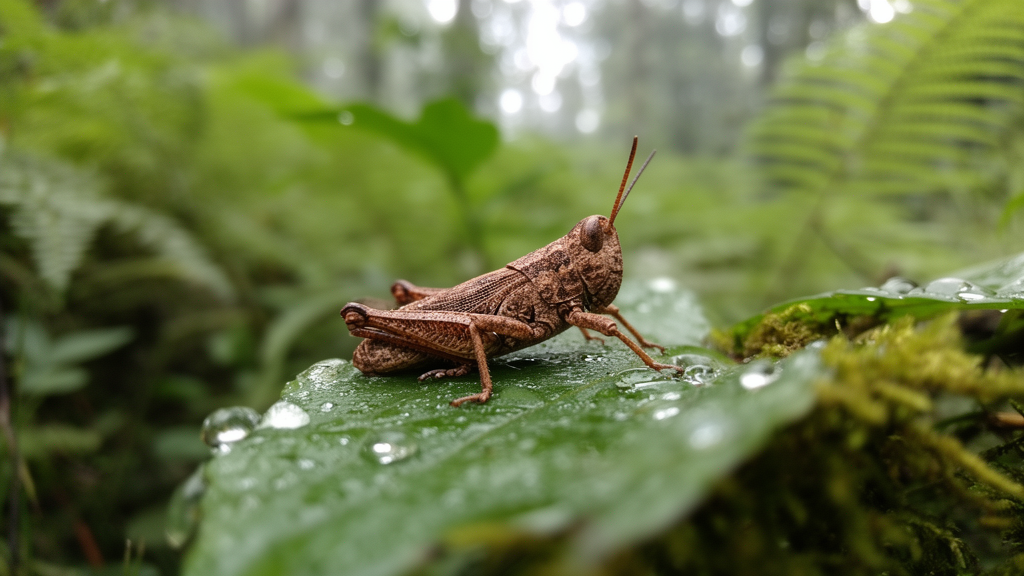
The species’ coloration is cryptic, enabling individuals to blend in with their surroundings. Those found on stones with lichen growths are entirely or partially blue-green, matching their substrate, while those on muddy road walls are light to rusty brown. Coloration can be uniform throughout the body, mottled, or different in the anterior and posterior halves of the body. Individuals were observed feeding on detritus, moss, lichens, and algae, with both a nymph and an adult recorded feeding on video in the wild.
Nymphs resemble adults in coloration and most traits but differ in having a shorter pronotum, no wings, no antegenicular teeth on the hind femora, poorly developed external genitalia, and comparatively more distinctly expressed carinae. They develop from one instar to the next by molting, casting off exuviae that typically split dorsally from the tip of the vertex to the tip of the pronotum while the rest of the exoskeleton remains intact, a feature that may make the shed skins useful for some morphological studies. Only two other tetrigid species, Criotettix cf. bispinosus and Hedotettix sp., were found alongside the new species at the investigated localities.
The discovery expands the genus Skejotettix along both altitudinal and climatic gradients, from subtropical sites between 155 and 460 meters elevation to temperate habitats between 1,665 and 1,920 meters. The new species has a forest-type habitat similar to that of S. netrajyoti, but the flora composition and climatic conditions of the forests are entirely different. Observations of nymphs being the most abundant life stage in the last weeks of September, coinciding with the onset of winter, hint that nymphs may be the overwintering stage in S. kasalo, as suspected for S. netrajyoti, which is observed only during hot and humid summer months, but the author emphasizes that further studies are needed to confirm this seasonality.
The author notes that the low number of co-occurring species may reflect the timing of the study at the beginning of winter, since poikilotherm insects show decreased activity as surrounding temperatures drop, and that these localities had never previously been surveyed for Tetridigae, with the study limited to the outskirts of temperate forests. Future studies penetrating unexplored areas during the summer months are expected to provide more information on species composition and further insights into the biology, seasonality, and ecology of Bajung’s cliffhopper. The genus remains endemic to Nepal, and with the advent of local researchers complementing a history of collection by foreign scientists, more discoveries among the country’s poorly studied pygmy grasshoppers may yet follow.
Subject of Research: Taxonomic description of a new pygmy grasshopper species, Skejotettix kasalo, from temperate Nepal
Article Title: A new species of the genus Skejotettix ( Orthoptera , Tetrigidae ) from Nepal
Article References: Subedi, M. (2023). A new species of the genus Skejotettix (Orthoptera, Tetrigidae) from Nepal. Journal of Orthoptera Research, 32(1), 81-92. https://doi.org/10.3897/jor.32.97276
Image Credits: AI Generated
DOI: 10.3897/jor.32.97276
Keywords: Skejotettix kasalo, Tetrigidae, pygmy grasshoppers, Nepal, new species, taxonomy, Himalaya, Orthoptera, biodiversity, temperate forests, cryptic coloration, endemic genus
Cite Scienmag News
Gavin Prescott. (October 27, 2026). New pygmy grasshopper species discovered in temperate Nepal expands range of endemic genus. Scienmag. https://scienmag.com/new-pygmy-grasshopper-species-discovered-in-temperate-nepal-expands-range-of-endemic-genus/
Gavin Prescott. "New pygmy grasshopper species discovered in temperate Nepal expands range of endemic genus." Scienmag, 27 October 2026, https://scienmag.com/new-pygmy-grasshopper-species-discovered-in-temperate-nepal-expands-range-of-endemic-genus/. Accessed 27 October 2026.
Gavin Prescott. "New pygmy grasshopper species discovered in temperate Nepal expands range of endemic genus." Scienmag. October 27, 2026. https://scienmag.com/new-pygmy-grasshopper-species-discovered-in-temperate-nepal-expands-range-of-endemic-genus/


