


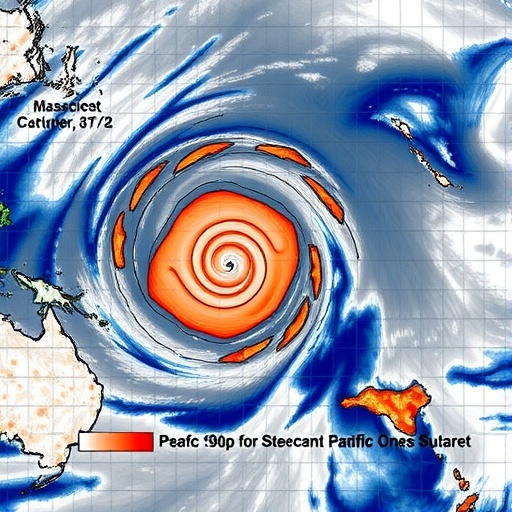
In the intricate dance of Earth’s climate system, the Hadley circulation stands as a colossal atmospheric engine, redistributing heat from the equator toward the subtropics and profoundly impacting weather patterns across the globe. However, understanding its ongoing shifts amid climate variability has perplexed climatologists for decades. Recent cutting-edge research by Hasan and Larson, published in Communications Earth & Environment in 2026, dives deep into this enigmatic problem, revealing that diverse internal variations in tropical Pacific sea surface temperature (SST) patterns can precipitate strikingly similar uncertainties in the long-term trends of the Hadley circulation.
At the heart of this research lies the tropical Pacific Ocean, a region whose SST fluctuations are not merely seasonal curiosities but pivotal drivers of global climate phenomena such as El Niño and La Niña. These internal SST patterns, characterized by intricate spatial and temporal variability, modulate atmospheric circulations on vast scales, yet their precise influence on the Hadley circulation’s variability and trend projection has remained elusive. Hasan and Larson meticulously disentangle these complex SST patterns to elucidate their role in generating comparable degrees of uncertainty in our predictions of Hadley circulation trends.
Using a combination of observational data, state-of-the-art climate model simulations, and advanced statistical techniques, the authors identify distinct SST configurations in the tropical Pacific that act as primary modulators of atmospheric convection and the resulting large-scale circulation patterns. Crucially, despite differences in the spatial distribution and evolution of these SST patterns, each can induce remarkably similar effects on the projected trends of the Hadley circulation. This finding challenges the prevailing notion that divergent climatic forcings necessarily produce distinct atmospheric responses, underscoring a nuanced intrinsic complexity within the climate system.
One of the pivotal technical insights of the study centers on the interplay between the Walker circulation—a critical zonal atmospheric circulation in the tropical Pacific—and the meridional Hadley circulation. Variations in SST across the central and eastern tropical Pacific can shift convection patterns eastward or westward, thereby altering the vertical and latitudinal gradient of atmospheric heating that fuels the Hadley circulation. Hasan and Larson’s analysis reveals that different SST anomaly patterns can mimic each other’s influence by adjusting the convection intensity and location, thus driving comparable uncertainties in Hadley circulation projections.
The implications of this uncertainty cascade significantly into global climate modeling and weather forecasting. The Hadley circulation is integral to defining precipitation zones, including deserts and monsoon regions, and modulates the intensity and frequency of tropical cyclones and mid-latitude weather extremes. Thus, unraveling the sources of variability and uncertainty in its trend projections directly impacts our ability to anticipate shifts in drought-prone and flood-prone areas and to prepare for the socio-economic challenges posed by climate change.
Furthermore, Hasan and Larson’s work emphasizes the role of internal climate variability—variations arising from the climate system’s own dynamics rather than external forcings like greenhouse gas emissions—in contributing to uncertainty in circulation trends. This insight calls for refined approaches in climate modeling that can better represent and simulate internal variability modes. It also advocates for leveraging longer observational records and paleoclimate proxies to constrain these internal variations more robustly.
Methodologically, the study innovates by employing empirical orthogonal function (EOF) analysis to dissect the spatial patterns of tropical Pacific SST variability and then correlates these with shifts in Hadley circulation strength and extent, as diagnosed through atmospheric reanalysis data. By synthesizing model outputs with empirical observations, Hasan and Larson provide a compelling framework that advances beyond simplistic SST indices to a more comprehensive pattern-based understanding of ocean-atmosphere interactions.
Intriguingly, their results suggest a level of degeneracy in the climate system’s response to different SST forcing patterns—a concept known in dynamics as non-uniqueness. This means that multiple internal states of the tropical Pacific can produce similar atmospheric circulation responses, complicating efforts to attribute observed trends to specific causes or project future changes with high confidence. This degeneracy challenges climate scientists to rethink how predictive skill is assessed and may prompt new lines of inquiry into how to break these response symmetries.
The study also touches upon the feedback mechanisms inherent in the coupled ocean-atmosphere system. For instance, changes in Hadley circulation influence surface wind patterns, which in turn affect ocean upwelling and SST distributions, potentially reinforcing or dampening initial SST anomalies. Understanding these feedback loops is crucial for constraining uncertainty and improving model simulations, a theme Hasan and Larson highlight as an important future research direction.
Moreover, by analyzing multi-model ensembles from climate projection archives, the authors uncover consistent patterns in how models represent the interplay between tropical Pacific SST variability and Hadley circulation trends, shedding light on model biases and systemic uncertainties. This assessment aids in identifying which aspects of SST pattern representation require improvement to enhance the realism of future climate projections.
The ramifications of this work extend beyond academia. Policymakers, climate adaptation planners, and disaster risk managers rely on accurate predictions of circulation changes to make informed decisions on water resource management, agricultural planning, and infrastructure development. Hasan and Larson’s findings underscore the necessity of incorporating internal variability and multiple SST pattern scenarios in climate risk assessments, fostering a more resilient approach to anticipating climate impacts.
Furthermore, this research invigorates ongoing debates around the influence of anthropogenic versus natural variability in shaping observed climate trends. By isolating the internal tropical Pacific SST patterns as significant contributors to Hadley circulation uncertainty, the study highlights the intricate balance between human-induced forcings and the climate system’s own variability, urging nuanced narratives in climate communication and policy.
In conclusion, Hasan and Larson’s 2026 study represents a major stride in dissecting the conundrum of Hadley circulation trend uncertainty by spotlighting the pivotal role of distinct internal tropical Pacific SST patterns. Their work not only advances fundamental understanding of ocean-atmosphere coupling but also charts a path toward reducing uncertainty in climate projections that are critical to global societal resilience. As the climate science community continues to grapple with the challenge of predicting complex, intertwined components of Earth’s system, studies like this underscore the power of detailed, integrated analysis of internal variability to unlock new frontiers of knowledge.
Cite Scienmag News
Violet Maxwell. (June 13, 2026). Tropical Pacific Patterns Fuel Hadley Circulation Uncertainty. Scienmag. https://scienmag.com/tropical-pacific-patterns-fuel-hadley-circulation-uncertainty/
Violet Maxwell. "Tropical Pacific Patterns Fuel Hadley Circulation Uncertainty." Scienmag, 13 June 2026, https://scienmag.com/tropical-pacific-patterns-fuel-hadley-circulation-uncertainty/. Accessed 4 September 2026.
Violet Maxwell. "Tropical Pacific Patterns Fuel Hadley Circulation Uncertainty." Scienmag. June 13, 2026. https://scienmag.com/tropical-pacific-patterns-fuel-hadley-circulation-uncertainty/


