


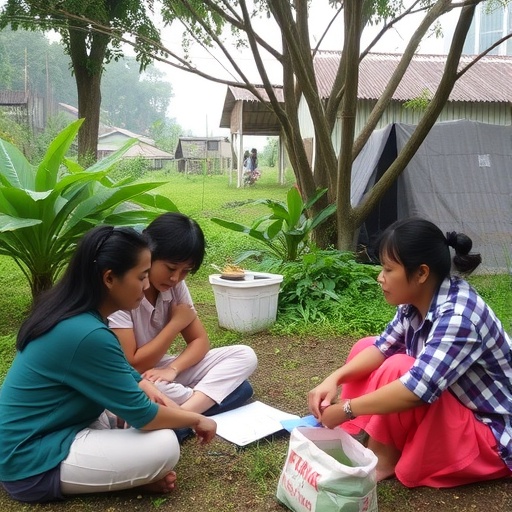
Air pollution research has entered a new phase in Thailand, where the most important line of defense against microscopic airborne particles may not be a laboratory instrument or a government alert, but a trusted health worker walking from house to house. A study by N. Songsin, M. Hama, N. Ruangram and colleagues examines how village health volunteers in rural Thai communities understand the dangers of fine particulate matter and how that knowledge shapes the steps they take to prevent exposure. Published in Scientific Reports in 2026, the cross-sectional study focuses on environmental health literacy and preventive behavior related to PM2.5, a pollutant small enough to penetrate deep into the respiratory system and, in some circumstances, enter the bloodstream.
PM2.5 refers to particulate matter with an aerodynamic diameter of 2.5 micrometers or less. These particles can be produced by vehicle exhaust, industrial activity, household combustion, construction and agricultural burning. In Thailand, seasonal haze can be intensified by landscape fires and crop-residue burning, creating recurring periods when rural communities face unhealthy air. Unlike larger dust particles, PM2.5 may remain suspended for long periods and travel across administrative boundaries. Its small size also allows it to bypass some of the body’s natural filtration mechanisms. When inhaled, the particles can reach the bronchioles and alveoli, where they may trigger inflammation, oxidative stress and changes in normal respiratory and cardiovascular function.
The new research places village health volunteers at the center of this public-health challenge. Thailand’s village health volunteers, often known as community-based health workers, serve as a vital bridge between formal health services and residents in areas where access to clinics, physicians and specialized information may be limited. They may help communicate health advisories, encourage preventive practices, identify vulnerable residents and support local responses during periods of environmental danger. Their effectiveness, however, depends on more than simply receiving information. They must be able to find, interpret, evaluate and apply health information in real-world conditions—abilities that together form the basis of environmental health literacy.
Environmental health literacy is broader than awareness. A person may know that PM2.5 is harmful but still be unable to interpret an air-quality index, identify the most reliable source of pollution information or determine what action is appropriate when conditions deteriorate. Literacy includes understanding exposure pathways, recognizing symptoms, judging the credibility of warnings and translating technical guidance into practical decisions. For a village health volunteer, that may mean explaining why an ordinary cloth mask offers limited protection against fine particles, advising residents to reduce time outdoors during high-pollution periods or helping households decide when ventilation could worsen indoor air quality rather than improve it.
The connection between knowledge and behavior is scientifically important because pollution prevention is rarely a single decision. Exposure depends on concentration, duration and the effectiveness of protective measures. A person’s total inhaled dose can increase when they exercise outdoors, work near smoke or spend many hours in a polluted environment. Fine-particle concentrations can also vary sharply between outdoor and indoor spaces, depending on building design, filtration, cooking activities and the movement of air. Effective guidance therefore requires more than a general warning to “avoid pollution.” It requires context-specific communication about masks, indoor air, vulnerable groups, work routines and the timing of outdoor activities.
The study’s cross-sectional design offers a snapshot of these relationships among village health volunteers in Thai rural communities. Researchers using this design typically collect information on participants’ knowledge, perceptions, access to information and self-reported behaviors during a defined period, then examine how different factors are associated with one another. Such a method can reveal whether higher environmental health literacy tends to occur alongside stronger preventive practices, and it can identify gaps that public-health programs may need to address. It cannot, by itself, prove that improved knowledge causes a particular behavior, because exposure to information and behavior are measured at roughly the same time. That distinction is crucial when interpreting findings about health communication.
The research arrives at a moment when PM2.5 has become a highly visible health issue across Asia and beyond. Air-quality monitoring networks now provide near-real-time readings, but numbers alone do not guarantee protection. A pollution map may display a color-coded warning without explaining what the reading means for a child with asthma, an older adult with heart disease, a pregnant person or a farmer whose work cannot easily be moved indoors. Community health workers can translate those abstract measurements into locally meaningful advice. They can also help counter misinformation, clarify uncertainty and reach residents who may not regularly use smartphones or social media.
That communication role is especially significant in rural settings, where sources of exposure and available responses may differ from those in cities. Rural residents may live near agricultural burning, work outdoors, use solid fuels or face limited access to air purifiers and sealed indoor spaces. Preventive recommendations must therefore be realistic, affordable and compatible with local livelihoods. Telling people simply to remain indoors may be impractical for agricultural workers; recommending high-efficiency filtration may be financially out of reach for some households. Environmental health literacy programs are most effective when they combine technical accuracy with an understanding of local constraints, social trust and the daily decisions people actually make.
The Thai study also highlights a broader lesson about modern public health: environmental protection increasingly depends on the quality of the information people can use. Monitoring stations can measure particle concentrations, satellites can track smoke and researchers can calculate disease risks, but those systems have limited value if warnings do not reach communities or fail to inspire practical action. By examining both literacy and preventive behavior among village health volunteers, Songsin and colleagues direct attention toward the human infrastructure needed to make air-quality science useful. Their work underscores the importance of training trusted local communicators who can turn a rapidly changing pollution forecast into clear, evidence-based guidance for families. As PM2.5 episodes continue to challenge communities, that connection between measurement, understanding and action may prove as important as the technology used to detect the particles themselves.
Cite Scienmag News
Russell Cooper. (August 13, 2026). Thai Village Health Volunteers’ Pollution Knowledge Linked to PM2.5 Prevention Behaviors. Scienmag. https://scienmag.com/thai-village-health-volunteers-pollution-knowledge-linked-to-pm2-5-prevention-behaviors/
Russell Cooper. "Thai Village Health Volunteers’ Pollution Knowledge Linked to PM2.5 Prevention Behaviors." Scienmag, 13 August 2026, https://scienmag.com/thai-village-health-volunteers-pollution-knowledge-linked-to-pm2-5-prevention-behaviors/. Accessed 3 September 2026.
Russell Cooper. "Thai Village Health Volunteers’ Pollution Knowledge Linked to PM2.5 Prevention Behaviors." Scienmag. August 13, 2026. https://scienmag.com/thai-village-health-volunteers-pollution-knowledge-linked-to-pm2-5-prevention-behaviors/


