


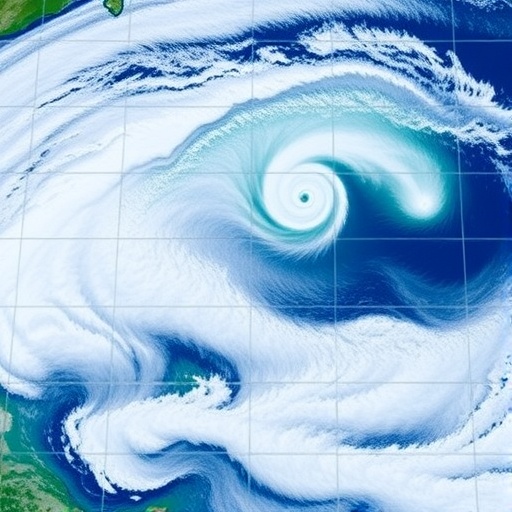
In a breakthrough that could revolutionize the way we predict and prepare for some of the most devastating natural disasters on Earth, a team of scientists has unveiled a novel forecasting method for strong tropical cyclones by integrating the dynamics of ocean waves at the air–sea interface. This pioneering approach emerges from the intricate dance between the atmosphere and ocean surface, revealing how ocean waves amplify our understanding of cyclonic behavior and intensity with unprecedented accuracy.
Tropical cyclones, often referred to as hurricanes or typhoons depending on their location, have long challenged meteorologists due to their complex and chaotic nature. These storms draw energy from warm ocean waters, and their development hinges on a dynamic exchange of energy and momentum across the ocean’s surface. Traditional forecast models primarily centered on atmospheric parameters and sea surface temperatures, often overlooking or simplifying the role of the ocean wave field. However, this new research highlights that ignoring ocean wave dynamics neglects a critical piece of the storm generation puzzle.
The core insight driving the improvement is the enhanced representation of the air–sea interface, where the interaction between atmospheric winds and ocean waves creates a feedback loop that critically influences cyclone strength. Previously, models treated the ocean surface as a relatively static boundary; in reality, the ocean’s surface is a living, oscillating interface. The frictional forces, wave-induced momentum transfer, and turbulent exchanges at this interface are now shown to be pivotal in modulating the storm’s energy uptake and structural evolution.
By incorporating realistic ocean wave parameters such as wave height, direction, and phase speed into coupled atmosphere-ocean models, Li, Zhao, Shu, and their colleagues have captured the nuanced mechanisms that govern cyclone intensification. Their strategy involves advanced numerical simulations that dynamically adjust storm characteristics in response to the evolving sea state. The results are remarkable: forecasts of cyclone intensity and track become considerably more precise, enabling earlier and more reliable warnings.
One of the major challenges addressed by this study was the accurate parametrization of wave-induced air-sea fluxes within complex fluid dynamics equations. This required integrating extensive oceanographic data sets and leveraging high-performance computing resources to simulate the interplay between wind stress, wave breaking, and surface roughness. The cutting-edge model advances traditional bulk flux approaches by resolving wave-specific turbulence effects, which have profound impacts on momentum transfer mechanisms.
Among the innovative techniques employed, the researchers utilized satellite-derived wave height measurements and coupled these with in-situ buoy data to validate their simulations. This multi-source data fusion established a robust empirical foundation that enhanced the fidelity of the model’s wave-atmosphere interaction module. Such a detailed calibration allowed the prediction system to dynamically respond to real-time sea conditions, improving situational awareness during rapidly evolving storm events.
The implications of this research extend beyond the academic realm, bearing significant potential for disaster risk reduction and climate adaptation strategies. Enhanced cyclone forecasts translate directly into improved evacuation planning, infrastructure resilience, and allocation of emergency resources. Economic losses and human casualties can be significantly mitigated when communities receive timely and accurate information about the expected path and strength of approaching storms.
Moreover, this approach has ramifications for understanding the feedback effects of climate change on tropical cyclone behavior. As global ocean temperatures rise and wave patterns evolve, the newly developed model will be instrumental in projecting how future tropical cyclone activity might shift under various climate scenarios. This capability equips policymakers and scientists with a powerful tool to anticipate changes in storm dynamics and fortify preparedness protocols accordingly.
The research also opens avenues for refining other meteorological phenomena influenced by air-sea interactions, such as monsoons and mid-latitude storms. The comprehensive representation of ocean wave effects incorporated in the model sets a precedent that could lead to a new generation of weather and climate prediction systems, marked by enhanced precision and reliability.
Technologically, this advancement also underscores the importance of interdisciplinary cooperation among meteorologists, oceanographers, computer scientists, and engineers. The successful integration of ocean wave dynamics necessitated innovations in numerical modeling techniques, data assimilation methods, and computational frameworks. Such collaborative efforts exemplify the future direction of environmental science, where complex earth systems are studied holistically.
The study is expected to catalyze further research into the microscopic processes at the air-sea boundary layer, an area still fraught with uncertainties. By fostering a deeper understanding of how ocean surface conditions influence atmospheric turbulence and energy transfer, scientists hope to unravel the remaining mysteries surrounding storm genesis and intensification.
In conclusion, the integration of ocean wave dynamics into tropical cyclone forecasting marks a paradigm shift, reinforcing the critical role of the ocean surface in influencing atmospheric phenomena. The enhanced model opens unprecedented opportunities for accurate prediction, ultimately promoting better preparedness and response to these formidable storms. As the climate continues to change, tools like this will become indispensable for safeguarding lives and communities worldwide.
Cite Scienmag News
Violet Maxwell. (June 13, 2026). Better Cyclone Forecasts by Including Ocean Waves. Scienmag. https://scienmag.com/better-cyclone-forecasts-by-including-ocean-waves/
Violet Maxwell. "Better Cyclone Forecasts by Including Ocean Waves." Scienmag, 13 June 2026, https://scienmag.com/better-cyclone-forecasts-by-including-ocean-waves/. Accessed 4 September 2026.
Violet Maxwell. "Better Cyclone Forecasts by Including Ocean Waves." Scienmag. June 13, 2026. https://scienmag.com/better-cyclone-forecasts-by-including-ocean-waves/


