


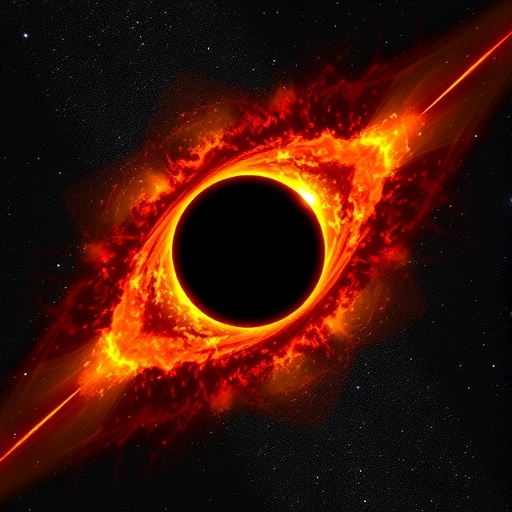
Astronomers using NASA’s James Webb Space Telescope have identified an extraordinarily bright red object in the early universe that may represent a previously unknown class of astrophysical body: a “black hole star.” The source, designated MoM-BH*-1, appears to combine the outward appearance of a gigantic star with the energy output of a rapidly feeding black hole. If the interpretation is correct, the object could also provide a compelling explanation for the mysterious “little red dots” that have appeared throughout JWST observations of the young cosmos.
MoM-BH*-1 was observed as it existed only a few hundred million years after the Big Bang, when the universe was still in its infancy. At that time, the first stars and galaxies were beginning to assemble from largely pristine clouds of hydrogen and helium. Yet this object was anything but faint or ordinary. It radiated approximately 100 billion times more energy than the Sun, an output far beyond what any conventional star can sustain through nuclear fusion. Its apparent diameter may have been comparable to the scale of our Solar System, making it enormous even by the standards of the most extended stars known today.
The object was found during a JWST survey called Mirage or Miracle, or MoM, which was designed to search for extremely distant galaxies and investigate how rapidly the first luminous structures formed. In deep images, MoM-BH*-1 stood out as an intensely bright, unusually red point of light. Astronomers initially considered the possibility that the red appearance resulted from dust, since interstellar dust absorbs shorter wavelengths of light and allows longer, redder wavelengths to dominate. However, the object’s spectrum contained several features that did not fit a conventional dusty galaxy or star.
One of the most important clues was a remarkably deep Balmer break. This spectral feature occurs when hydrogen gas absorbs photons at specific wavelengths associated with electronic transitions in hydrogen atoms. In ordinary stellar atmospheres, the Balmer break can reveal the temperature and age of a population of stars. In MoM-BH*-1, however, the drop in emitted light was far stronger than expected from normal stars. The pattern suggested that the source was surrounded by an exceptionally dense layer of hydrogen, one so thick that it behaved more like a stellar surface than a diffuse interstellar cloud.
The spectrum also showed almost no evidence of elements heavier than hydrogen and helium. Astronomers refer to these heavier elements collectively as metals, even when discussing elements such as oxygen, carbon or nitrogen. In the modern universe, stars and galaxies generally contain metals created by earlier generations of stars. But the early universe had not yet been enriched extensively by stellar explosions, so a metal-poor environment is plausible at cosmic dawn. The near absence of metals in MoM-BH*-1 nevertheless added to the object’s unusual character and helped constrain the possible explanations.
The researchers used computer simulations to test whether a cloud of nearly pure hydrogen could produce the observed red color and spectral break without relying on dust. Their models showed that it could, but only if the gas were extraordinarily dense and arranged as an extended, opaque envelope around a powerful central source. Such an envelope could obscure the source’s inner radiation at selected wavelengths while allowing other light to escape. The result would resemble a huge star from a distance, even though the energy would not be generated by fusion in a stellar core.
Nuclear fusion cannot plausibly account for MoM-BH*-1’s luminosity. Even the most massive stars eventually reach physical limits imposed by radiation pressure, fuel consumption and the stability of their atmospheres. As a star becomes more luminous, the outward pressure of its radiation can overwhelm gravity and drive away the material needed to sustain it. A black hole, by contrast, can release enormous amounts of energy as gas spirals inward. In an accretion disk, gravitational potential energy is converted into heat and radiation before matter crosses the event horizon. This process can power quasars and active galactic nuclei, some of the brightest phenomena in the universe.
In the researchers’ preferred model, MoM-BH*-1 contains a black hole roughly 100,000 times more massive than the Sun. Around it lies a dense, star-like cocoon of hydrogen approximately the size of the Solar System. As gas falls toward the black hole, it would generate intense radiation, while the surrounding envelope would absorb, scatter and reshape that radiation. The envelope would therefore determine much of the object’s observed appearance, producing the red color and deep Balmer break. The proposed structure is neither a conventional star nor a standard exposed quasar, but a black hole embedded inside a massive, luminous atmosphere.
The discovery may have broad implications for the population of little red dots that JWST has found across the early universe. These compact red sources appear in large numbers in observations of galaxies formed during the first billion years of cosmic history, but they are difficult to classify. Some look too bright to be ordinary stellar systems, while their spectra can differ from those of familiar active galaxies. They also seem to become rare or disappear entirely in the modern universe. The black hole star model suggests that at least some of these objects could be young, short-lived phases in the growth of massive black holes, hidden inside dense clouds of primordial gas.
MoM-BH*-1 is particularly valuable because it appears to outshine any surrounding host galaxy, allowing astronomers to study the proposed black hole-star emission almost in isolation. Other little red dots may contain similar objects, but their light could be mixed with radiation from ordinary stars and gas in their host galaxies. Future JWST observations, especially more detailed spectroscopy, will be crucial for testing whether the source contains the predicted signatures of accretion, dense hydrogen and a powerful central engine. If confirmed, black hole stars could offer a new pathway for producing massive black holes so early in cosmic history—and help explain how the universe created its first quasars only a few hundred million years after the Big Bang.
Web References: https://doi.org/10.1038/s41586-026-10846-4
References: Nature, DOI: 10.1038/s41586-026-10846-4
Keywords
James Webb Space Telescope, black hole star, MoM-BH*-1, little red dots, cosmic dawn, early universe, black hole accretion, primordial hydrogen, Nature, astronomy
Cite Scienmag News
Grant Pearson. (August 13, 2026). Astronomers Discover First Black Hole Star, a New Astrophysical Object. Scienmag. https://scienmag.com/astronomers-discover-first-black-hole-star-a-new-astrophysical-object/
Grant Pearson. "Astronomers Discover First Black Hole Star, a New Astrophysical Object." Scienmag, 13 August 2026, https://scienmag.com/astronomers-discover-first-black-hole-star-a-new-astrophysical-object/. Accessed 3 September 2026.
Grant Pearson. "Astronomers Discover First Black Hole Star, a New Astrophysical Object." Scienmag. August 13, 2026. https://scienmag.com/astronomers-discover-first-black-hole-star-a-new-astrophysical-object/


