


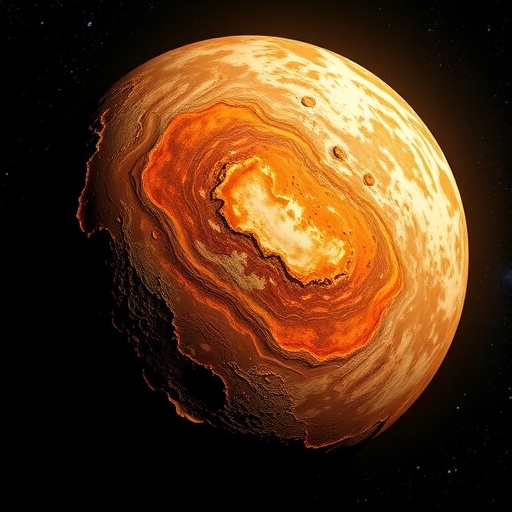
Mercury's volcanic rocks appear to have formed from a far hotter, more deeply melted mantle than scientists previously assumed, according to a new study that for the first time pins down the planet's silicon dioxide content with unprecedented accuracy. The research, led by the Max Planck Institute for Solar System Research (MPS) together with the Universities of Münster and Göttingen, finds that silicon dioxide makes up only about 37 percent of the mass of Mercury's surface — up to 25 percent less than earlier estimates suggested. Because silicon dioxide steadily enriches molten mantle rock as a planet cools, such a low surface abundance points to extreme temperatures in Mercury's interior during the era when its crust was born.
The findings, published on 27 August 2026 in the journal Planetary Research, a Diamond Open Access publication that is freely available to all readers, offer a fresh window onto the earliest chapter of the innermost planet's history. Mercury and Earth followed fundamentally different evolutionary paths. Earth's interior remains geologically restless: volcanism and plate tectonics continually churn and renew the crust, keeping the "Earth pudding" in constant motion. Mercury, by contrast, likely began cooling very early, much like a setting pudding. Roughly one billion years after the planet formed, its volcanic activity ceased and a solid, continuous rock skin settled over its surface. Exactly what that unique volcanic past looked like — and how it sculpted the Mercury we see today — has remained uncertain, but the composition of the surface holds important clues.
Mercury has long puzzled planetary scientists for reasons that extend well beyond the chemistry of its crust. It is the smallest of the eight planets, yet it packs a disproportionate share of its mass into an enormous iron core, giving it a bulk density that far exceeds what its small size would suggest. That dense, metal-rich character is one reason researchers suspect the planet formed under unusual conditions close to the young Sun, perhaps stripped of much of its outer rocky layers early in its history. Its surface, scorched by daytime temperatures that soar to several hundred degrees Celsius and plunged into deep cold at night, bears the scars of eons of impacts alongside vast, smooth volcanic plains that record an era when lava flooded huge tracts of the terrain. Deciphering the composition of those plains is central to reconstructing how the planet assembled, differentiated, and cooled — and that is precisely where the new study makes its contribution.
The compound at the heart of the study is silicon dioxide, or SiO2, made of one silicon atom bonded to two oxygen atoms. On Earth it is virtually ubiquitous: it occurs in pure form as sand and makes up a substantial share of every major volcanic rock type, with basalts, andesites, and granites containing up to 75 percent silicon dioxide. The proportion of silicon dioxide in a lava is also one of the most important knobs controlling how a volcanic rock behaves — it influences the viscosity of the melt, the kinds of minerals that crystallize from it, and the classification geologists assign to the resulting rock. Against that terrestrial benchmark, Mercury's roughly 37 percent stands out as remarkably low, marking the planet's surface as chemically distinct from anything familiar on our own world.
Determining that number, however, was anything but straightforward. No lander has ever touched down on Mercury and no rock samples have ever been brought back from its surface. Researchers therefore have no alternative but to infer the planet's makeup from remote sensing data — measurements gathered by telescopes on Earth or by orbiting spacecraft. The infrared radiation emitted by Mercury's surface carries revealing information about its mineralogy and chemistry, but converting that radiation into reliable statements about composition requires a calibration: a known relationship between the properties of infrared light and the amount of silicon dioxide present. Without such a calibration, the spectral signatures collected from tens of millions of kilometers away remain ambiguous, open to multiple interpretations depending on the assumptions an analyst brings to the data.
Building that calibration was the first of three steps in the team's indirect approach. In the laboratory, the researchers manufactured tiny glass beads, each only about half a millimeter across, with precisely defined proportions of silicon dioxide. They then measured the exact infrared properties of these beads, establishing the relationship between infrared radiation and SiO2 content. "The glass beads serve a similar function to calibration weights on a scale," explained Iris Weber of the University of Münster. "Their weight is known precisely. They therefore allow us to correctly interpret the scale's balance. Similarly, the glass beads allow us to draw the correct conclusions from the properties of the infrared radiation." In other words, the beads gave the team a set of reference standards against which the ambiguous signals from distant planetary surfaces could be decoded.
To be certain the newly derived calibration relationship held up outside the laboratory, the researchers tested it in a second step on a natural — and far larger — object: the Moon. The Moon offers nearly ideal conditions for such a test. NASA's Lunar Reconnaissance Orbiter has been circling the Moon since 2009, measuring the infrared radiation from its surface with high spatial resolution. Using this data, the team produced the first complete map of the silicon dioxide content of the lunar surface. Crucially, rock samples returned to Earth from various lunar regions — collected during both crewed and unmanned missions — allowed the researchers to verify that their mapped values matched reality. Where the orbiter's data and the laboratory calibration indicated a particular silicon dioxide abundance, the actual Apollo-era and robotic samples confirmed it. "The Moon is a kind of touchstone for us — and an important conceptual stepping stone on our way to Mercury," said Christian Renggli, lead author of the study and head of the "Experimental Laboratory Magma Ocean" research group at MPS. That ability to check a remote-sensing result against physical ground truth is rare in planetary science, and it is precisely what made the Moon the indispensable proving ground for the method.
Only after passing this "Moon test" did the team turn to Mercury, applying their validated calibration to infrared data collected from Earth. Among the sources of such data was the Bok Telescope at Steward Observatory in Arizona. Telescopic observations of Mercury are notoriously difficult: the planet's small apparent size, its proximity to the Sun in the sky, and its hot surface all conspire to degrade the quality of measurements. The result was nevertheless the study's central finding: a silicon dioxide mass fraction of about 37 percent, substantially lower than the values researchers had previously assumed for the planet's surface.
That low number carries weighty implications for how Mercury's crust came to be. Silicon dioxide accumulates gradually in the molten mantle of a young planet — the layer beneath the solidifying crust. As the mantle cools, the first rocks to crystallize extract comparatively little silicon dioxide from the melt, so the hot lava that wells up to the surface becomes increasingly rich in silicon dioxide over time. A surface that is poor in this compound therefore indicates that the lavas erupted early in the cooling sequence, from melts generated at very high temperatures deep within the planet. "Our findings suggest that the volcanic rocks on Mercury formed from more deeply melted mantle material than previously assumed," said Renggli. In effect, Mercury's crust preserves a chemical fingerprint of an interior that was hotter, and its melting deeper, than many models had envisioned — a picture consistent with an infant planet still radiating away the heat of its formation and of the giant impacts that punctuated its early history.
The researchers also raise a second possibility for the silicon dioxide deficit: Mercury may once have held more of the compound in its crust but gradually lost oxygen over time. Since silicon dioxide requires oxygen as well as silicon, any large-scale loss of oxygen from the surface environment would chemically alter the apparent abundance of the compound. Such processes are not mere speculation in Mercury's neighborhood — the innermost planet is bathed in an environment where the Sun's radiation and particle wind impinge with far greater intensity than anywhere else in the Solar System, and other data from Mercury have already pointed to an unusually oxygen-poor, chemically reducing surface. The team notes this scenario as a possibility that remains to be explored, and it underscores how much is still unknown about the chemical evolution of the innermost planet, where proximity to the Sun creates conditions unlike anywhere else in the Solar System.
As with any indirect measurement, the study has limitations. Its conclusions rest on remote infrared observations rather than direct sampling, and the calibration was constructed from laboratory glass beads whose textures may not perfectly reproduce the regolith of a planetary surface — the loose, broken, impact-pulverized layer that blankets both the Moon and Mercury and alters how light interacts with rock. The Moon test provided a vital check on the method, and the fact that mapped lunar values could be confirmed against returned samples lends confidence to the approach — but Mercury remains, for now, a world known only from afar. Earlier orbital measurements by NASA's MESSENGER spacecraft, which circled the planet from 2011 to 2015, transformed scientists' understanding of Mercury's surface chemistry but did not resolve the silicon dioxide question with the precision the new calibration now permits. The team therefore hopes to confirm the low silicon dioxide content using data from a far more capable observer: the European Space Agency's BepiColombo mission.
BepiColombo, a mission consisting of two separable probes provided by ESA and JAXA respectively, is scheduled to enter orbit around Mercury in November of this year. The first step of that orbital insertion — separating both probes from the transport module — is set for Thursday, 3 September 2026. Once in orbit, BepiColombo's MERTIS instrument, developed and built under the leadership of the German Aerospace Center (DLR) together with the Institute for Planetology at the University of Münster, will record infrared data that is significantly more precise and at much higher spatial resolution than anything obtained from Earth-based telescopes. From orbit, MERTIS will be able to distinguish individual geological provinces — volcanic plains, impact basins, and crater ejecta — and map how silicon dioxide varies among them, something Earth-bound telescopes cannot achieve. "Our study lays the groundwork for deriving the most accurate information possible about the silicon dioxide content of Mercury's surface from BepiColombo's measurements," said Renggli. The laboratory calibration, in other words, will be ready and waiting the moment the spacecraft's first science data begin to flow.
Cite Scienmag News
Grant Pearson. (August 31, 2026). Mercury’s crust formed by extreme volcanism. Scienmag. https://scienmag.com/mercurys-crust-formed-by-extreme-volcanism/
Grant Pearson. "Mercury’s crust formed by extreme volcanism." Scienmag, 31 August 2026, https://scienmag.com/mercurys-crust-formed-by-extreme-volcanism/. Accessed 3 September 2026.
Grant Pearson. "Mercury’s crust formed by extreme volcanism." Scienmag. August 31, 2026. https://scienmag.com/mercurys-crust-formed-by-extreme-volcanism/


