


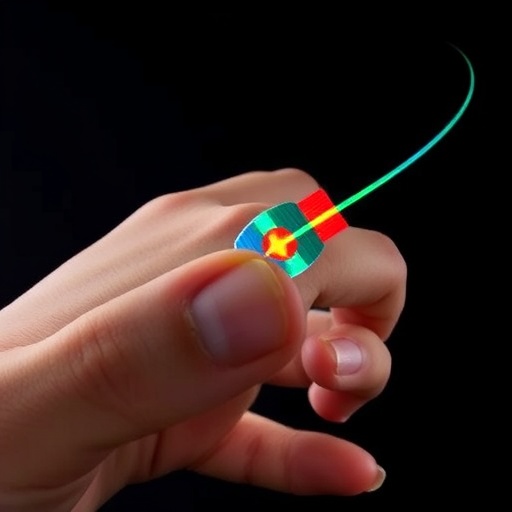
A soft, wearable optical sensor that wraps around a fingertip can capture the arterial pulse from the finger and deliver both heart rate and respiratory rate with accuracy comparable to a commercial pulse oximeter, according to a new study describing the design, fabrication and metrological characterization of a Fiber Bragg grating (FBG) sensor embedded in flexible silicone rubber for finger plethysmography.
The work, led by researchers at Vellore Institute of Technology in Chennai, India, addresses a persistent weakness of existing FBG-based cardiorespiratory sensors. Most reported systems monitor heart rate (HR) and respiratory rate (RR) from chest-wall motion using elastic straps, a configuration that is non-invasive but vulnerable to wear and tear over long-term use, and in which stretching the sensor to maintain skin contact can lead to fiber breakage. Finger plethysmography offers an alternative route: it is a well-established technique that records the arterial pulse waveform by detecting blood-volume changes at the fingertip during each cardiac cycle. Because the pulse waveform is modulated by respiration — through baseline wander, amplitude modulation and frequency modulation — the respiratory signal can be extracted from it with suitable algorithms. Previous finger-based FBG studies, however, relied on bare gratings mounted in silicone diaphragms or 3D-printed holders, focused only on cardiac parameters, and lacked a wearable design adaptable to different individuals. The new sensor, the authors state, is the first to demonstrate simultaneous HR and RR measurement from finger plethysmography using a silicone-embedded wearable FBG.
The sensing element is a 5 mm FBG with a Bragg wavelength of 1540 nm and 80% reflectivity, supplied by RRCAT Indore. An FBG consists of a periodic modulation of the refractive index inside the optical fiber core; when broadband light travels through the grating, a narrow wavelength — the Bragg wavelength — is reflected back. Strain and temperature change both the effective refractive index and the grating period, shifting this wavelength, which forms the basis of the measurement. To protect the inherently fragile grating and make it wearable, the FBG was embedded in Dragon Skin 10 Medium, a soft, biocompatible silicone chosen for its flexibility, ease of fabrication and skin-like texture. The sensing patch was designed as a 20 mm diameter, 2 mm thick disc — circular geometry chosen to match average human fingertip dimensions and to conform to the finger without modification for different users. Fabrication used a customized 3D-printed mold, with a five-hour curing period before the sensor was removed. Data were acquired by a Sentea DM-4120 optical interrogator at 1 kHz for two-minute recordings, stored on a PC via Ethernet.
Because encapsulation alters an FBG’s sensitivity, the team first characterized the embedded sensor metrologically. Strain calibration was performed on a small longitudinal beam instrumented with a reference strain gauge and indicator, with 1 kg weights loaded in increments up to a maximum of 4 kg across three trials, data acquired at 100 Hz and uncertainty evaluated with a t-student distribution at 95% confidence. The strain response was not linear — a quadratic fit yielded an R² of 0.98 versus 0.85 for a linear fit — and the average strain sensitivity was 0.11 ± 0.03 pm/με, roughly an order of magnitude lower than the 1.2 pm/με typical of a bare FBG. The researchers attribute this attenuation to the highly elastic silicone, which limits efficient strain transfer to the embedded grating. Temperature characterization in a mini-tabletop incubator over a 20 °C range produced a linear response with a slope of 10.7 pm/°C, essentially similar to a bare FBG; although the silicone’s thermal expansion coefficient is much higher than silica’s, its low Young’s modulus prevents that deformation from being transmitted, leaving the thermo-optic effect as the dominant contributor. Force testing from 0 to 5 N, applied perpendicular to the patch surface over three loading-unloading cycles, told a different story: sensitivity rose sharply to 30.1 ± 2.2 pm/N with minimal hysteresis of 2.52%, which the team ascribes to the flexible silicone deforming under load and the circular geometry promoting uniform strain transmission. These force results compare favorably with other published sensors based on the same DS-10 matrix.
With the sensor’s behavior established, the team turned to placement. Two volunteers were tested under four conditions — right index and middle fingers, each with palm up and palm down — and the beat-to-beat pulse interval was analyzed. Palm-down conditions showed slightly higher variability because the finger touched the table surface, introducing additional wavelength shifts, while keeping the sensed finger elevated induced involuntary movements that destabilized the output. The most stable, uniform measurement came from the middle finger with the palm facing up. This aligns with prior clinical observations that the middle finger shows higher perfusion, since unlike the index finger it receives blood through both the ulnar and radial arteries. That configuration was adopted for all subsequent trials. Before each recording session, volunteers rested for five minutes, and the sensor was then placed on the skin for three minutes to reach thermal equilibrium with body temperature — a protocol justified by separate experiments showing that the thermal baseline drifts slowly and saturates after roughly 160 seconds, making the temperature component easy to separate from the fast pulsatile signal. The sensor was secured above the distal interphalangeal joint, aligned parallel to the finger, with transparent adhesive tape wrapped around the finger; care was taken to avoid excessive tightness that could restrict blood circulation or add spurious strain.
Signal processing proceeded in MATLAB. The raw wavelength-shift signal was min-max normalized to account for physiological differences in pulse amplitude between volunteers, then filtered with a fourth-order Chebyshev type-II filter. A 0.1–5 Hz band preserved both cardiac and respiratory components, while a narrower 0.5–5 Hz band retrieved the arterial waveform alone, and interquartile-range calculations removed motion-artifact outliers. To test robustness, a volunteer performed deliberate hand movements during a trial; the raw signal showed baseline variations and abrupt shifts from motion artifacts, but the filter suppressed these while preserving the pulse. The processed waveforms displayed the expected arterial morphology: a well-defined systolic peak, a smaller diastolic peak, and an elevated dicrotic notch. Repeatability was assessed by recording the same volunteer on three consecutive days; the waveforms remained uniform with a consistent morphology, differing only in pulse duration as heart rate varied between days, while morphological differences between two volunteers further supported the sensor’s ability to capture individually distinct pulse shapes.
Beyond heart rate, the sensor supports second-derivative analysis of the pulse waveform, known as the acceleration plethysmograph (APG), which represents the acceleration of blood flow and is used to evaluate vascular aging through wave-amplitude ratios such as b/a, c/a, d/a and e/a, plus the aging index (b−c−d−e)/a. For two volunteers aged 18 and 26, the computed ratios fell within the healthy range with small standard deviations; the older volunteer showed increased magnitude of b/a and the aging index with decreases in the remaining ratios, consistent with the increased arterial stiffness expected with age and matching values reported in earlier FBG studies. Signal quality was quantified by signal-to-noise ratio, averaging 39.3 ± 5.9 dB across volunteers with minimal deviation between individuals, indicating clean, repeatable recordings.
Validation against a commercial pulse oximeter — worn on the right index finger while the FBG sensor sat on the right middle finger — showed strong agreement. Peak detection of the processed waveform yielded heart rates within about ±1.4 beats per minute of the reference across volunteers (measured values including 84, 86, 80 and 79 beats/min). For respiratory rate, the team computed the fast Fourier transform of the pulse waveform, which revealed two distinct spectral peaks: a small one in the 0.1–0.5 Hz respiratory band and a larger one around 1–2 Hz corresponding to the cardiac signal. A 0.5 Hz low-pass Butterworth filter extracted the baseline-modulated respiratory waveform, from which peak intervals gave RR values (15–17 breaths/min) averaging within ±1.6 breaths/min of the reference. Bland-Altman analysis found a mean bias of −0.65 beats/min for HR, with 95% limits of agreement of 3.77 and −5.06 beats/min, mean absolute error of 1.9 beats/min and RMSE of 2.2 beats/min. For RR, the bias was 0.39 breaths/min with limits of agreement of 5.79 and −5.02 breaths/min, MAE of 2.2 breaths/min and RMSE of 2.8 breaths/min. Both mean biases sat close to zero, with most data points inside the limits of agreement, although the RR limits were notably wider than the HR limits.
The study’s limitations are acknowledged by the authors themselves. The reference pulse oximeter did not offer continuous monitoring, which would have enabled stronger validation, and the adhesive tape securing the patch, while simple, requires frequent replacement and can wear off with prolonged use. The volunteer sample was small, and the thermal contribution to the wavelength shift, though slow and separable, was neglected on the basis of controlled conditions and short experiment durations. The team plans to fabricate a 3D-printed sensor holder wearable across different anatomies, to validate against a gold-standard reference with a larger sample, and to explore cuffless, continuous blood pressure estimation using the same finger-plethysmography platform.
Even so, the results mark a meaningful step for photonic wearables. Compared with prior FBG pulse studies that measured only cardiac parameters such as pulse transit time, augmentation index or heart rate at the fingertip, radial or carotid arteries, the silicone-embedded circular patch delivers HR, RR and APG simultaneously from a single, comfortable fingertip site. Because FBGs are immune to electromagnetic interference, chemically stable and multiplexable, such sensors could eventually find use in clinical settings — including MRI environments, where conventional electronic sensors are restricted — while the soft silicone construction points toward the comfort and wearability that personalized, continuous cardiorespiratory monitoring will demand.
Cite Scienmag News
Denise Maddox. (August 31, 2026). Design, fabrication and characterization of a wearable Fiber Bragg grating sensor for cardiorespiratory monitoring using finger plethysmography. Scienmag. https://scienmag.com/design-fabrication-and-characterization-of-a-wearable-fiber-bragg-grating-sensor-for-cardiorespiratory-monitoring-using-finger-plethysmography/
Denise Maddox. "Design, fabrication and characterization of a wearable Fiber Bragg grating sensor for cardiorespiratory monitoring using finger plethysmography." Scienmag, 31 August 2026, https://scienmag.com/design-fabrication-and-characterization-of-a-wearable-fiber-bragg-grating-sensor-for-cardiorespiratory-monitoring-using-finger-plethysmography/. Accessed 3 September 2026.
Denise Maddox. "Design, fabrication and characterization of a wearable Fiber Bragg grating sensor for cardiorespiratory monitoring using finger plethysmography." Scienmag. August 31, 2026. https://scienmag.com/design-fabrication-and-characterization-of-a-wearable-fiber-bragg-grating-sensor-for-cardiorespiratory-monitoring-using-finger-plethysmography/


