


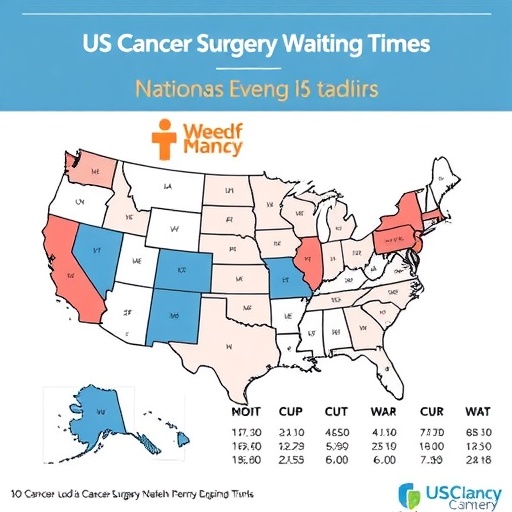
Cancer patients are facing increasingly long waits to begin their initial course of treatment after surgery, according to an Original Investigation scheduled for publication in JAMA Surgery. The study describes a sustained rise in waiting times since 2012, with the most pronounced increases occurring at high-volume academic medical centers and among patients referred to hospitals for definitive cancer care. The findings place growing attention on a less visible stage of cancer treatment: the interval between a patient’s operation and the start of the next planned therapy. For patients and families, that interval can represent a period of uncertainty. For health systems, it is a measurable indicator of how effectively complex care is coordinated after a technically successful operation.
The term “first-course therapy” refers to the initial treatment plan delivered after a cancer diagnosis and surgical evaluation. Depending on the tumor type, stage, pathology results, and the patient’s overall health, that plan may involve surgery alone, chemotherapy, radiation therapy, targeted treatment, immunotherapy, or a sequence of several approaches. When surgery is performed as part of definitive treatment, the postoperative period may be used to review the final pathology, determine whether the tumor has been completely removed, assess lymph nodes and molecular markers, and decide whether additional therapy is needed. Each step can generate a new scheduling requirement. Delays may therefore arise not from a single failure, but from the accumulation of small interruptions across pathology, referral, insurance authorization, specialist consultation, treatment planning, and clinical recovery.
The study’s central message is that waiting times have not remained stable over the past decade. Instead, they have steadily lengthened since 2012 among patients undergoing cancer surgery. The pattern is especially notable at high-volume academic centers, institutions that often serve as regional or national referral hubs for difficult, rare, or advanced cancers. These hospitals typically provide highly specialized surgery, complex diagnostics, clinical trials, and multidisciplinary care. Their expertise can make them essential destinations for patients seeking definitive treatment, yet their concentration of referrals may also produce crowded operating schedules, limited specialist availability, and competition for treatment capacity. The research highlights the possibility that institutional prestige and clinical complexity can coexist with operational delays that affect the patient journey.
Patients referred for definitive care appear to be another particularly vulnerable group. Referral often occurs when a local hospital does not offer the necessary procedure, when a tumor requires specialized expertise, or when a diagnosis is uncertain and a second opinion is sought. Although referral can expand access to advanced treatment, it also introduces additional transitions between health systems. Medical records may need to be transferred, pathology specimens re-reviewed, imaging uploaded, and consultations repeated. A patient may move from a community clinic to a regional hospital and then to an academic center, with each transfer creating opportunities for information loss or scheduling delays. The study’s findings suggest that the benefits of centralized expertise must be matched by systems capable of moving patients through those networks without unnecessary waiting.
The consequences of delay are not identical for every cancer or every patient. Some postoperative intervals are clinically necessary. Surgeons may need time for wounds to heal, complications to resolve, or a patient’s nutritional and functional status to improve before additional treatment can begin. Pathology and molecular testing may also require days or weeks, particularly when a tumor’s treatment depends on specialized laboratory analysis. The challenge is distinguishing medically appropriate waiting from avoidable delay. A longer interval may be harmless in one clinical setting but consequential in another, depending on tumor biology, disease stage, recurrence risk, and the effectiveness of the planned therapy. For this reason, monitoring systems must measure more than a simple calendar interval; they must interpret timing in relation to diagnosis, procedure, recovery, and treatment intent.
From a technical perspective, the postoperative cancer pathway is a coordination problem involving multiple interdependent services. A patient cannot begin adjuvant chemotherapy until the oncology team has received the operative report and final pathology, confirmed adequate recovery, reviewed laboratory results, and secured an infusion appointment. Radiation treatment may require imaging, simulation, treatment planning, and the availability of specialized equipment. If any component operates near capacity, the entire pathway can slow. These delays are sometimes called bottlenecks because the throughput of the overall system is constrained by its most limited stage. In a consolidated health system, the problem may extend across several hospitals and outpatient sites, making it difficult for any single clinician to see where time is being lost.
The investigators argue that system-level strategies are urgently needed to monitor and mitigate delays in surgical cancer care. Such strategies could include standardized time-to-treatment metrics, real-time dashboards, automatic alerts for patients approaching clinically important thresholds, and coordinated scheduling across surgery, pathology, medical oncology, and radiation oncology. Navigation programs may help patients understand the next steps and identify barriers involving transportation, insurance, housing, language, or caregiving. Hospitals could also examine whether referral patterns, operating-room capacity, staffing shortages, or uneven access to subspecialists are contributing to prolonged intervals. Importantly, measurement should be transparent and risk-adjusted. A center treating unusually complex disease should not be judged by the same benchmark as a facility caring for less complicated cases, but complexity should not become an excuse for delays that can be prevented.
The findings also raise questions about the consequences of health-system consolidation. Mergers and acquisitions can create larger networks with shared electronic records, centralized scheduling, and broader specialist coverage. In theory, these capabilities could make it easier to coordinate care. In practice, larger systems may also create more complicated administrative structures, longer referral chains, and uneven distribution of services. A patient may remain within one corporate network while still encountering separate departments, scheduling platforms, and authorization processes. Tracking the interval from surgery to treatment initiation can reveal whether consolidation is improving continuity or merely increasing the number of organizational layers through which a patient must pass. The study frames timeliness as a quality-of-care issue rather than simply an administrative concern.
Timothy R. Donahue, MD, of the University of California, Los Angeles, is the study’s corresponding author. The report is an Original Investigation in JAMA Surgery and is accompanied by an Invited Commentary, signaling broader discussion about how cancer centers should respond to rising treatment delays. The article is identified by the digital object identifier 10.1001/jamasurg.2026.3212. While the study’s full methods, patient characteristics, statistical analyses, and detailed results are contained in the publication, its overarching warning is clear: advances in cancer surgery cannot deliver their full benefit if patients encounter prolonged waits before the next stage of care. In an era of increasingly specialized and consolidated medicine, the speed and reliability of coordination may become as important to cancer outcomes as the operation itself.
Web References: https://doi.org/10.1001/jamasurg.2026.3212; accompanying Invited Commentary: https://doi.org/10.1001/jamasurg.2026.3201
References: Donahue TR et al., Original Investigation, JAMA Surgery, DOI: 10.1001/jamasurg.2026.3212.
Cite Scienmag News
Nathaniel Bowman. (August 13, 2026). US Cancer Surgery Waiting Times: National Trends and Key Predictors. Scienmag. https://scienmag.com/us-cancer-surgery-waiting-times-national-trends-and-key-predictors/
Nathaniel Bowman. "US Cancer Surgery Waiting Times: National Trends and Key Predictors." Scienmag, 13 August 2026, https://scienmag.com/us-cancer-surgery-waiting-times-national-trends-and-key-predictors/. Accessed 4 September 2026.
Nathaniel Bowman. "US Cancer Surgery Waiting Times: National Trends and Key Predictors." Scienmag. August 13, 2026. https://scienmag.com/us-cancer-surgery-waiting-times-national-trends-and-key-predictors/


