


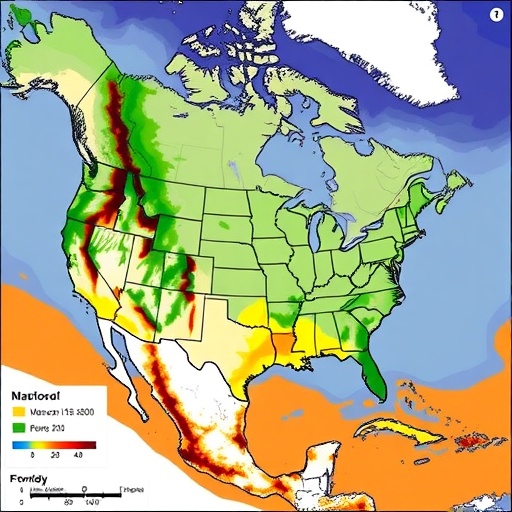
For thousands of years, fire has been one of North America’s most powerful ecological forces—and one of its most misunderstood. A new study by Andrew Tsalickis, Ryan S. Vachula, Anamika V. Karmalkar and colleagues examines how climate, vegetation and human activity combined to shape the continent’s fire regimes throughout the Holocene, the geological epoch that began roughly 11,700 years ago and continues today. Published in Communications Earth & Environment, the research places modern wildfire risk in a much longer historical context, showing that fire has never been controlled by climate alone. Instead, the frequency, intensity and seasonality of burning emerged from a constantly shifting interaction between atmospheric conditions, ecosystems and people.
The Holocene offers scientists a natural laboratory for investigating these interactions because it contains a broad range of environmental conditions, from the relatively cool landscapes that followed the last Ice Age to the warmer climate of the present. During this period, North America experienced major changes in temperature, rainfall, vegetation distribution and human land use. Forests expanded and contracted, grasslands moved across the continent, and communities developed diverse practices for using fire as a tool for hunting, travel, agriculture, habitat management and cultural purposes. By examining fire across this long timescale, researchers can ask a crucial question: when the landscape burned more frequently or more severely, was the main driver a changing climate, a changing ecosystem or changing human behavior?
To reconstruct ancient fire activity, scientists commonly turn to natural archives that preserve evidence of past burning. Lake sediments are particularly valuable because they accumulate in layers, with older material buried beneath younger deposits. Microscopic charcoal particles produced by wildfires can be carried into lakes by wind or runoff and preserved for centuries or millennia. Researchers can date sediment layers using radiocarbon techniques, then measure charcoal abundance and particle size to estimate changes in fire activity through time. Pollen grains and plant remains preserved in the same layers provide clues about vegetation, while chemical and physical properties of the sediments can reveal past moisture conditions, temperature patterns and erosion. Together, these indicators allow scientists to compare fire history with ecological and climatic change.
The study’s central contribution is its focus on human, climatic and ecological drivers as connected components of a single system. Climate affects fire by controlling fuel moisture, drought severity, lightning frequency and the length of the fire season. Ecology determines what can burn: dense forests, dry grasslands, shrublands and mixed woodland landscapes each produce different amounts and types of fuel. Human activity can alter both the quantity and arrangement of vegetation and the probability that a fire will start. A landscape repeatedly burned by people may contain fewer large fuels and experience frequent, lower-intensity fires, while a landscape where fire has been suppressed may gradually accumulate combustible vegetation. The same climate conditions can therefore produce very different fire outcomes depending on ecological structure and human presence.
This distinction is essential because “more fire” does not necessarily mean “more catastrophic fire.” Fire regimes are usually described through several characteristics, including frequency, intensity, severity, size, seasonality and the time required for vegetation to recover. Frequent fires can sometimes reduce fuel loads and maintain open ecosystems, whereas long intervals without fire can allow fuels to build up and connect across the landscape. When drought, heat and strong winds arrive under those conditions, fires may spread rapidly and burn with greater intensity. Conversely, a naturally fire-prone ecosystem may depend on recurring burns to preserve biodiversity and prevent forest encroachment. Understanding these differences allows researchers to distinguish ecological fire from exceptional, high-impact fire rather than treating every increase in burning as equivalent.
The human dimension is especially important in North America, where Indigenous communities have used fire for millennia and developed sophisticated knowledge of local ecosystems. Cultural burning can influence the timing and location of fires, maintain particular plant communities, improve hunting conditions and promote the growth of useful species. Such practices are not identical to uncontrolled wildfire, and their effects can be difficult to detect in continental-scale records. However, long-term fire histories may reveal periods when burning changed in ways that cannot be explained by climate alone. Incorporating human activity into these reconstructions helps challenge older narratives that portray people only as recent disruptors of natural fire systems. In many regions, humans have been active participants in shaping fire-prone landscapes for a very long time.
At the same time, the researchers’ approach highlights why fire history cannot be interpreted through a single universal pattern. North America contains deserts, boreal forests, temperate woodlands, prairies, Mediterranean-climate ecosystems and alpine environments. Each region responds differently to warming, precipitation shifts and vegetation change. In some areas, warmer conditions may increase evaporation and dry fuels, raising the likelihood of fire. In others, greater moisture may stimulate plant growth and create more fuel, with fire risk rising later when that vegetation dries. Changes in forests can also produce feedbacks: burning may open the canopy, alter snow accumulation, change soil moisture and encourage new plant communities, which then influence future fires. Fire is therefore both a consequence of environmental change and a mechanism that creates further change.
These long-term findings carry direct implications for the present. Modern North American landscapes are experiencing rising temperatures, altered precipitation patterns, expanding development and widespread changes in land management. In many regions, decades of fire exclusion have interrupted historical burning patterns, allowing fuels to accumulate. At the same time, climate change is lengthening fire seasons and increasing the atmospheric demand for moisture, a condition known as vapor pressure deficit. High vapor pressure deficit draws water from vegetation and soils, leaving fuels more flammable even when rainfall has not reached historically extreme lows. The result is a growing possibility that climate-driven drying and accumulated fuels will reinforce each other, producing fires that spread faster and resist suppression.
Yet the Holocene perspective also suggests that there is no single solution applicable everywhere. Restoring fire may be beneficial in ecosystems historically shaped by frequent, low- or moderate-intensity burning, but prescribed fire must be adapted to local vegetation, weather, soil conditions and nearby communities. In other places, increasing drought or invasive grasses may make additional burning hazardous or ecologically damaging. Historical records can help identify the range of conditions under which particular landscapes burned and the consequences of different fire intervals. By combining palaeoecological evidence with climate models, satellite observations, Indigenous knowledge and contemporary fire-management data, scientists and land managers can develop strategies that are better matched to regional realities.
The study ultimately reframes North America’s fire story as a dynamic partnership—and sometimes a conflict—among climate, ecosystems and people. The continent’s past does not provide a simple blueprint for the future, but it reveals that fire regimes are capable of changing dramatically when any one part of the system shifts. Ancient charcoal preserved in sediment is more than a record of old flames: it is evidence of how environmental forces and human decisions have repeatedly reorganized landscapes. As wildfire becomes an increasingly visible consequence of climate change, understanding those long-term relationships may be critical for distinguishing what is historically normal, what has been disrupted and what kinds of fire management could make future ecosystems more resilient.
Cite Scienmag News
Violet Maxwell. (August 13, 2026). How Climate and Human Activity Shaped North American Fires During the Holocene. Scienmag. https://scienmag.com/how-climate-and-human-activity-shaped-north-american-fires-during-the-holocene/
Violet Maxwell. "How Climate and Human Activity Shaped North American Fires During the Holocene." Scienmag, 13 August 2026, https://scienmag.com/how-climate-and-human-activity-shaped-north-american-fires-during-the-holocene/. Accessed 3 September 2026.
Violet Maxwell. "How Climate and Human Activity Shaped North American Fires During the Holocene." Scienmag. August 13, 2026. https://scienmag.com/how-climate-and-human-activity-shaped-north-american-fires-during-the-holocene/


