


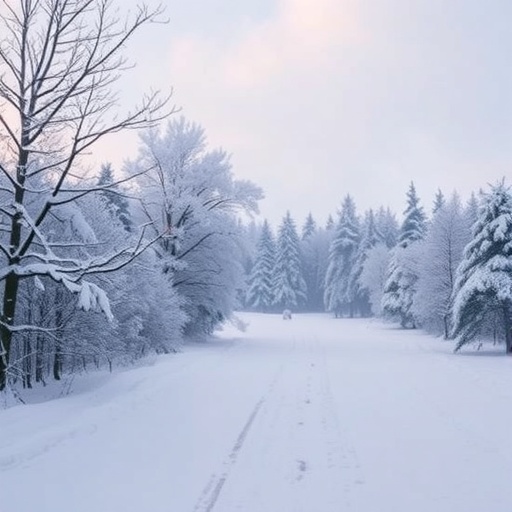
In a groundbreaking study published in 2026, researchers have unveiled compelling evidence of an unprecedented and ongoing reduction in winter snow cover across Europe—a phenomenon traced back over six centuries through one of the most comprehensive reconstructions ever undertaken. This meticulous investigation leverages historical records, proxy climate data, and modern observational datasets to paint a stark picture of how European winters are shrinking in extent, duration, and intensity, with profound implications for ecology, hydrology, and climate feedback mechanisms.
The international team, spearheaded by Notarnicola, Pimentel, and Bertolin, employed a blend of dendrochronology, historical archives, and early instrumental climatology to reconstruct snow cover patterns dating back to the 14th century. By integrating these diverse data streams through advanced statistical methods and climate modeling, the study achieves an unprecedented temporal resolution. This approach circumvents the limitations of relying solely on modern satellite observations, offering a long-term perspective to contextualize contemporary trends against natural variability.
Europe’s wintertime snow cover, an essential component of its climate system, plays a pivotal role in regulating albedo and surface energy balance. Snow acts as a reflective barrier, sending solar radiation back into space, thereby cooling the atmosphere. The study’s findings indicate that the spatial extent of snow cover during winter months has contracted significantly over recent decades, far exceeding natural fluctuations observed in the pre-industrial era. This shrinkage challenges assumptions about the resilience of European winter climates in the face of anthropogenic warming.
One of the most striking revelations is the consistency and acceleration of snow cover reductions, particularly since the mid-20th century. The reconstruction illustrates that while winters during past centuries experienced periods of mild reduction or increase in snow extent due to natural oscillations and volcanic aerosols, none match the ongoing decline in magnitude or pace. This suggests a dominant role of contemporary greenhouse gas emissions in driving these changes, corroborating projections from climate models.
The implications of diminished snow cover extend beyond mere climatic metrics, threatening biodiversity and water resource stability. Alpine ecosystems, renowned for their unique flora and fauna adapted to snow-dominated habitats, face increasing stress as habitat conditions warm and snow duration shortens. Hydrologists caution that reduced snowpack alters the timing and amount of spring and summer streamflows, disrupting agricultural irrigation cycles and hydroelectric power generation reliant on consistent meltwater releases.
Researchers also delve into feedback loops exacerbated by snow cover loss. As snow retreats earlier in the season and its areal extent contracts, the darkening of the land surface increases heat absorption. This accelerates local warming, creating a self-reinforcing mechanism that compounds the effects of global greenhouse gas forcing. Furthermore, changes in snow cover influence atmospheric circulation patterns in the Northern Hemisphere, potentially affecting weather extremes such as heatwaves and precipitation anomalies.
The team’s reconstruction methodology is a tour de force in climate science. By synthesizing proxy indicators like tree ring analysis—which captures moisture availability and temperature signals influencing snow retention—with meticulously digitized chronicles detailing historic snowfall events, the study reconstructs temporal snow cover variation with statistical confidence. These reconstructions are validated against early instrumental records from the 19th and 20th centuries, underlining their robustness.
This research fills a significant gap in snow cover climatology by extending the temporal baseline from a few decades to several centuries. It allows scientists to separate anthropogenic trends from natural variability, a critical distinction when advising policymakers on climate adaptation strategies. The persistent decline in snow cover documented challenges adaptation regarding water resource management, winter tourism industries, and ecosystem conservation.
Moreover, the study’s findings resonate globally, as European winter snow cover serves as a bellwether for similar trends observed in other mid- and high-latitude regions. The researchers emphasize that the mechanisms driving shrinkage—elevated temperatures, altered precipitation patterns, and land-use changes—are interconnected challenges demanding integrated mitigation approaches. The loss of snow cover, thus, is not merely a regional concern but part of a broader global climate disruption narrative.
A particularly alarming aspect uncovered is the potential threshold effects. The analysis suggests that once snow cover diminishes below certain critical extents, feedbacks may push winter climates towards states with drastically reduced or ephemeral snow presence. Such threshold crossing could accelerate the pace of ecological transformations, impacting carbon cycle dynamics through permafrost thawing and terrestrial ecosystem shifts.
Scientists involved highlight the importance of expanding monitoring networks and improving data assimilation techniques to refine future snow cover projections. Novel remote sensing technologies combined with citizen science initiatives hold promise for capturing high-resolution data in near-real-time, aiding early warning of snowpack deficits and informing adaptive water resource policies.
The societal implications of shrinking European winters are vividly illustrated. Winter recreation industries, a cornerstone of many mountain economies, face existential risks as shorter snow seasons reduce viability for skiing and other snow-based tourism. Urban water supplies sourced from snow-fed reservoirs may become less reliable, jeopardizing millions’ livelihoods and increasing competition among agricultural, industrial, and domestic users.
Climate modelers welcome the study’s reconstructions as empirical benchmarks to calibrate predictive tools. The robust historical baseline aids in quantifying climate sensitivity and improving projections under various emissions scenarios. Importantly, the research encourages cross-disciplinary collaboration, integrating climatology, hydrology, ecology, and socioeconomics to holistically address the cascading effects of winter snow decline.
In conclusion, this comprehensive reconstruction by Notarnicola and colleagues transforms our understanding of European winter snow cover trends. It provides irrefutable evidence of a rapid and unprecedented shrinkage ongoing for decades and likely accelerating. The findings serve as a clarion call to bolster climate mitigation efforts, emphasizing that winter landscapes—long cherished cultural and environmental icons—are fundamentally and irreversibly changing in a warming world.
Cite Scienmag News
Violet Maxwell. (June 13, 2026). Six Centuries Reveal Europe’s Shrinking Winters Unprecedented. Scienmag. https://scienmag.com/six-centuries-reveal-europes-shrinking-winters-unprecedented/
Violet Maxwell. "Six Centuries Reveal Europe’s Shrinking Winters Unprecedented." Scienmag, 13 June 2026, https://scienmag.com/six-centuries-reveal-europes-shrinking-winters-unprecedented/. Accessed 4 September 2026.
Violet Maxwell. "Six Centuries Reveal Europe’s Shrinking Winters Unprecedented." Scienmag. June 13, 2026. https://scienmag.com/six-centuries-reveal-europes-shrinking-winters-unprecedented/


