


A growing share of Americans are choosing a life without children, and a new study suggests that where these adults live may be shaped less by regional culture or state policy than by who they are. The analysis, published August 12, 2026, in the open-access journal PLOS One, estimates that the proportion of childfree adults differs sharply across the United States. Yet the researchers found that personal characteristics—including age, sex, relationship status and other demographic factors—were stronger predictors of being childfree than the broader social and economic context of an individual’s state.
The distinction between being childfree and simply not yet having children is central to the study. Researchers define childfree adults as people who do not have children and do not want to have children in the future. This category therefore excludes adults who are childless because of infertility, circumstance, delayed family planning or uncertainty about whether they will eventually become parents. According to figures from the National Survey of Family Growth, the childfree share of non-parents aged 15 to 44 increased from 13.8 percent in 2002 to 29.4 percent in 2023. The new research examines how that expanding population is distributed geographically.
Zachary Neal and Jennifer Watling Neal of Michigan State University analyzed responses from 20,118 adults who participated in an online survey conducted between August 30 and October 8, 2024. The data came from the Civic Health and Institutions Project, a survey initiative designed to examine social attitudes, civic life and institutional conditions across the United States. By linking respondents’ reported reproductive intentions with their state of residence, the researchers estimated the prevalence of childfree adults in each state and tested whether state-level characteristics could help explain the differences.
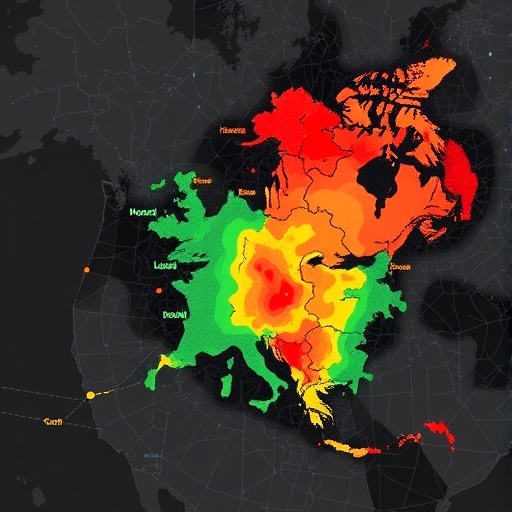
The resulting map reveals substantial variation. California had the highest estimated proportion of childfree adults, at approximately 22 percent, followed by Michigan at 19.9 percent and New Hampshire at 19.4 percent. At the other end of the distribution, Louisiana had the lowest estimated share, at 9.4 percent, while North Dakota and South Dakota each registered about 10 percent. In practical terms, the estimates suggest that roughly one in five adults in some states may be childfree, compared with about one in ten in others.
Despite these differences, the pattern did not form the kind of clear regional clusters researchers might expect if childfree living were primarily driven by a shared political culture or geographic identity. The study found no strong evidence that childfree adults were concentrated in broad regions such as the Northeast, South, Midwest or Southwest. Instead, the highest proportions appeared in certain individual states, making the national distribution more fragmented than a simple cultural map of the country.
Some state characteristics were associated with higher childfree prevalence. Childfree adults were more common in highly populous states and in states with a higher cost of living. These relationships may reflect the pressures and opportunities associated with urbanized economies. Housing, childcare, education, healthcare and career advancement can all influence the perceived financial and logistical consequences of parenthood. Large states also tend to contain metropolitan areas where alternative lifestyles are more visible, social networks are more diverse and traditional expectations about marriage and family may be less restrictive.
However, state-level associations became less important when the researchers considered individual characteristics. Adults who were single, older or male were more likely to be childfree, according to the analysis. These factors do not necessarily operate independently. Relationship status can affect both the likelihood of having children and the expectations surrounding future parenthood, while age changes the probability that a person who currently has no children will eventually become a parent. Sex differences may reflect a combination of reproductive expectations, social pressure, relationship patterns and the way people report their intentions.
The researchers’ statistical approach is important because it separates contextual effects from individual effects. A state may have a high childfree rate not because living there directly causes people to reject parenthood, but because the state contains a larger share of people with characteristics already associated with being childfree. This distinction is known as compositional versus contextual explanation. A compositional explanation points to the makeup of the population; a contextual explanation suggests that the surrounding environment changes individual behavior. In this study, composition appeared to matter more than context.
The findings also complicate efforts to use state policy as a tool for reversing population decline. Governments concerned about falling birth rates sometimes consider policies intended to encourage parenthood, such as financial incentives, expanded childcare, housing assistance or restrictions affecting reproductive decisions. But if childfree intentions are driven predominantly by individual circumstances and durable preferences, state policies may have limited power to change them. The study does not show that state conditions are irrelevant, nor does it establish that people’s choices are completely fixed. It indicates instead that broad state characteristics alone are insufficient to explain why some adults do not want children.
The study has limitations. Because the survey data are observational, the researchers can identify associations but cannot prove that living in a particular state causes someone to become childfree. The analysis also operates at the state level, meaning it cannot reveal how childfree adults are distributed within cities, suburbs or rural communities. Online surveys may introduce sampling and reporting biases, and reproductive intentions can change over time for some respondents. Even so, the results offer one of the clearest national pictures yet of where childfree adults are estimated to live and why geography alone provides an incomplete explanation.
As the childfree population grows, the issue is becoming increasingly visible in debates about demographic change, housing, work and public policy. The new study suggests that the United States does not have a single “childfree region.” Instead, childfree adults are spread across the country, with their prevalence varying from state to state but their individual profiles proving more informative than any simple geographic divide. California and Michigan may have roughly one in five adults who are childfree, while Louisiana and the Dakotas may have closer to one in ten, but the deeper story is national: the decision not to become a parent is shaped primarily by people’s lives, identities and circumstances rather than by a single state-level formula.
News Publication Date: 12-Aug-2026
Web References: https://doi.org/10.1371/journal.pone.0352872
References: Neal ZP, Neal JW (2026) The spatial distribution of the U.S. childfree population: Does state context matter? PLOS One 21(8): e0352872. https://doi.org/10.1371/journal.pone.0352872
Cite Scienmag News
Courtney Benton. (August 13, 2026). Spatial mapping shows individual traits outweigh local context in having children. Scienmag. https://scienmag.com/spatial-mapping-shows-individual-traits-outweigh-local-context-in-having-children/
Courtney Benton. "Spatial mapping shows individual traits outweigh local context in having children." Scienmag, 13 August 2026, https://scienmag.com/spatial-mapping-shows-individual-traits-outweigh-local-context-in-having-children/. Accessed 3 September 2026.
Courtney Benton. "Spatial mapping shows individual traits outweigh local context in having children." Scienmag. August 13, 2026. https://scienmag.com/spatial-mapping-shows-individual-traits-outweigh-local-context-in-having-children/


