


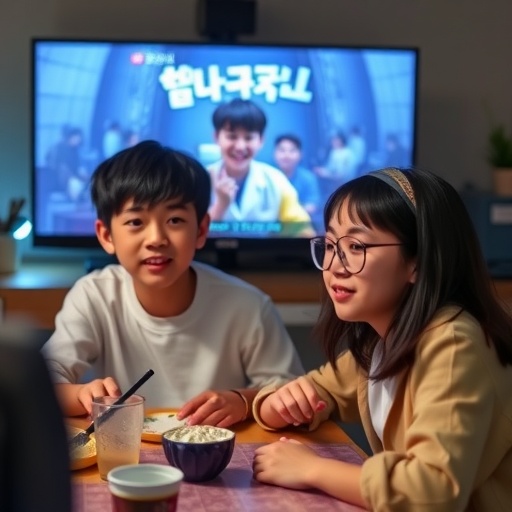
Watching strangers eat enormous quantities of food on screen has become one of the defining digital habits of adolescence, and a new study suggests that the consequences may extend all the way to the dentist’s chair. In an analysis of more than 106,000 South Korean adolescents, researchers found that teenagers who frequently watch Mukbang and Cookbang videos—the wildly popular genres in which hosts consume vast meals or prepare visually seductive dishes—reported significantly more toothache and gum pain or bleeding than those who avoid such content. The association followed a clear dose-response pattern, was only partly explained by known risk factors, and was strongest among girls and younger adolescents, the groups most behaviourally susceptible to digital food media.
The study, published in SSM – Population Health by Seon-Jip Kim of Dankook University, draws on the Korea Youth Risk Behavior Web-based Survey (KYRBS), an anonymous, self-administered national surveillance system conducted annually by the Korea Disease Control and Prevention Agency. The survey uses a stratified, multistage cluster sampling design with schools as the primary sampling unit, yielding nationally representative estimates of health-risk behaviours among middle- and high-school students aged roughly 12 to 18. Kim pooled the 2022 and 2025 waves, both of which asked about Mukbang and Cookbang viewing, and after excluding 15 respondents with missing covariate data, arrived at an analytical sample of 106,005 adolescents from 1,594 schools. All analyses incorporated the survey’s stratification, clustering and weighting through design-based statistical methods, with sampling-design degrees of freedom of 1,378.
The scale of exposure is striking. In the weighted data, 67.8 per cent of adolescents had watched Mukbang or Cookbang content at least occasionally during the preceding 12 months, 37.5 per cent watched at least weekly, and 11.1 per cent viewed it five or more times per week. This places the genre, which originated in South Korea around 2009 and is now distributed globally through YouTube, TikTok and similar platforms, firmly in the category of population-wide exposures rather than niche behaviour. Frequent viewers differed systematically from non-viewers: they were more likely to be female, to have used alcohol or cigarettes, and to report depressive symptoms. They also ate differently, consuming on average 4.61 sugary drinks per week, snacking late at night on 1.67 days per week, and eating fast food 2.39 times per week, compared with 3.84, 1.34 and 1.85 respectively among non-viewers.
To quantify the link with oral health, the study used two self-reported outcomes covering the preceding 12 months: toothache, defined as any aching or throbbing tooth pain, and gingival pain or bleeding. After adjusting for sex, grade, household economic status, depressive symptoms, alcohol and smoking history, toothbrushing frequency, floss use and interdental brush use, viewing frequency remained independently associated with both symptoms. Compared with non-viewers, adolescents watching five or more times per week had 21 per cent higher adjusted odds of toothache (adjusted odds ratio 1.21, 95 per cent confidence interval 1.14–1.28) and 22 per cent higher odds of gingival pain or bleeding (aOR 1.22, 95 per cent CI 1.15–1.30). Even the lightest exposure category, watching three or fewer times per month, was associated with roughly 12 to 13 per cent higher odds, and the trend across categories was highly significant for both outcomes.
The mechanistic heart of the study lies in its mediation analysis. Kim used design-based g-computation within the counterfactual framework to decompose the association into components passing through three dietary behaviours: sugary beverage intake, late-night snacking and fast-food intake. The method deliberately avoids the rare-outcome approximation on which conventional product-of-coefficients estimators rely, an approximation the prevalence of the outcomes here does not satisfy. Counterfactual means were obtained by integrating over the joint mediator residual distribution using 20-point Gauss–Hermite quadrature, with confidence intervals derived from 2,000 nonparametric bootstrap resamples of schools within strata, reproducing the survey design. For the contrast between watching five or more times per week and not watching, the three dietary behaviours jointly accounted for 29.6 per cent of the association with toothache and 18.0 per cent of that with gingival symptoms.
The decomposition revealed a telling pattern. Sugary beverage consumption and late-night snacking each carried statistically significant indirect effects, while fast-food intake did not. The fast-food null, Kim cautions, should not be read as evidence that burgers and fries are benign for teeth. The three mediators are positively correlated, and the fast-food contribution is estimated conditional on the other two, so any shared pathway component gets attributed to the beverage and snacking terms. Moreover, what governs caries risk is the frequency and clearance of sugar exposure rather than eating occasions of any particular food, which a seven-day frequency measure captures only indirectly. Late-night snacking is of particular biological interest because nocturnal reductions in salivary flow prolong oral sugar clearance and sustain low plaque pH; previous observational work has linked eveningness-associated lifestyles—late bedtimes, irregular meals, frequent snacking—with higher caries prevalence in children.
The scientific plausibility of a link between watching food videos and eating differently rests on well-documented neurobehavioural mechanisms. Repeated visual exposure to palatable food activates appetitive responses analogous to direct food cues, a phenomenon described as cue-induced craving and “vicarious eating,” amplified by the parasocial influence of charismatic hosts on adolescent food choice. Crucially, paediatric neuroimaging in 9- to 12-year-olds has shown that dynamic video food cues elicit greater activation in reward circuitry—the amygdala, insula and ventral tegmental area—than static images. This suggests Mukbang and Cookbang content may be neurobehaviourally distinct from earlier-generation food advertising, engaging the brain’s reward system more potently and providing a plausible upstream driver of the dietary behaviours measured here.
One of the study’s most consequential findings is the social patterning of the effect. For toothache, the association was significantly modified by sex (P for interaction < .001) and school level (P = .019). It was much stronger among females (aOR 1.35, 95 per cent CI 1.25–1.47) than males (aOR 1.05, 95 per cent CI 0.95–1.16), and among middle-school students (aOR 1.32, 95 per cent CI 1.21–1.44) compared with high-school students (aOR 1.14, 95 per cent CI 1.05–1.24). Treating age as a continuous variable confirmed the association weakening by roughly 1.2 per cent per year of age. In contrast, the association with gingival pain or bleeding was uniform across every subgroup examined. Kim interprets this asymmetry through the different nature of the two endpoints: gingival bleeding is a short-latency, frequency-driven sign that responds within days to plaque and fermentable-carbohydrate exposure, whereas toothache generally signals a carious lesion that has reached dentine, integrating exposure over months to years and filtering through individual reporting thresholds—a mechanism that would plausibly generate heterogeneity in girls and younger adolescents, whose newly erupted second permanent molars leave occlusal surfaces unusually vulnerable.
The author is careful about what the cross-sectional design can and cannot support. The mediation estimates are described as a design-based statistical decomposition of associations observed at a single point in time, not a verified causal mechanism; a causal reading would require sequential ignorability and a temporal ordering the survey’s measurement windows—which place the seven-day dietary recall inside the twelve-month exposure and symptom windows—cannot establish. Reverse causation remains possible, including the scenario in which adolescents who already prefer sweet, energy-dense foods seek out eating broadcasts, with recommendation algorithms then reinforcing the exposure. Both outcomes are single self-reported items rather than clinical examinations, and the exposure item combines eating-broadcast and cooking-broadcast content, which plausibly differ in portion size, eating pace and commercial intent. Nevertheless, sensitivity analyses adjusting for smartphone use time, sleep duration, sedentary time, perceived stress, dental-service use and academic performance attenuated the estimates only modestly, and the mediated proportions remained stable across alternative model specifications.
The population-health implications may outweigh the modest individual effect sizes. With two-thirds of adolescents exposed and one in nine viewing near-daily, this is the canonical configuration—widespread exposure with small per-person effects—in which population-level prevention outperforms high-risk intervention, a principle dating to Geoffrey Rose’s classic framework. Kim’s analysis also situates the findings within South Korea’s existing regulatory architecture. The Special Act on the Safety Management of Children’s Dietary Life already protects all students through high school and already enumerates “children’s preferred foods”—confectionery, sweetened and carbonated beverages, instant noodles, hamburgers, pizza, fried street foods—that closely mirror the fare of eating broadcasts. What the law’s advertising restriction does not reach is the medium: user-generated video on platforms, with duty-bearers defined as food business operators rather than content creators. Korea previously attempted to regulate “binge-eating-promoting media” under its 2018 National Obesity Management Plan, a proposal that foundered on freedom-of-expression objections in the absence of precisely the population-level outcome evidence this study now provides. The findings do not, on their own, establish that reducing exposure would reduce oral symptoms—longitudinal studies and natural-experiment designs are needed—but they identify the digital food environment as a candidate structural target for adolescent oral-health policy, and give clinicians a practical prompt: asking about food-media viewing, particularly among younger and female patients, may be a worthwhile addition to routine dietary assessment.
Cite Scienmag News
Courtney Benton. (September 3, 2026). Watching Mukbang Videos Linked to Oral Health Problems in Korean Adolescents. Scienmag. https://scienmag.com/watching-mukbang-videos-linked-to-oral-health-problems-in-korean-adolescents/
Courtney Benton. "Watching Mukbang Videos Linked to Oral Health Problems in Korean Adolescents." Scienmag, 3 September 2026, https://scienmag.com/watching-mukbang-videos-linked-to-oral-health-problems-in-korean-adolescents/. Accessed 10 September 2026.
Courtney Benton. "Watching Mukbang Videos Linked to Oral Health Problems in Korean Adolescents." Scienmag. September 3, 2026. https://scienmag.com/watching-mukbang-videos-linked-to-oral-health-problems-in-korean-adolescents/


