


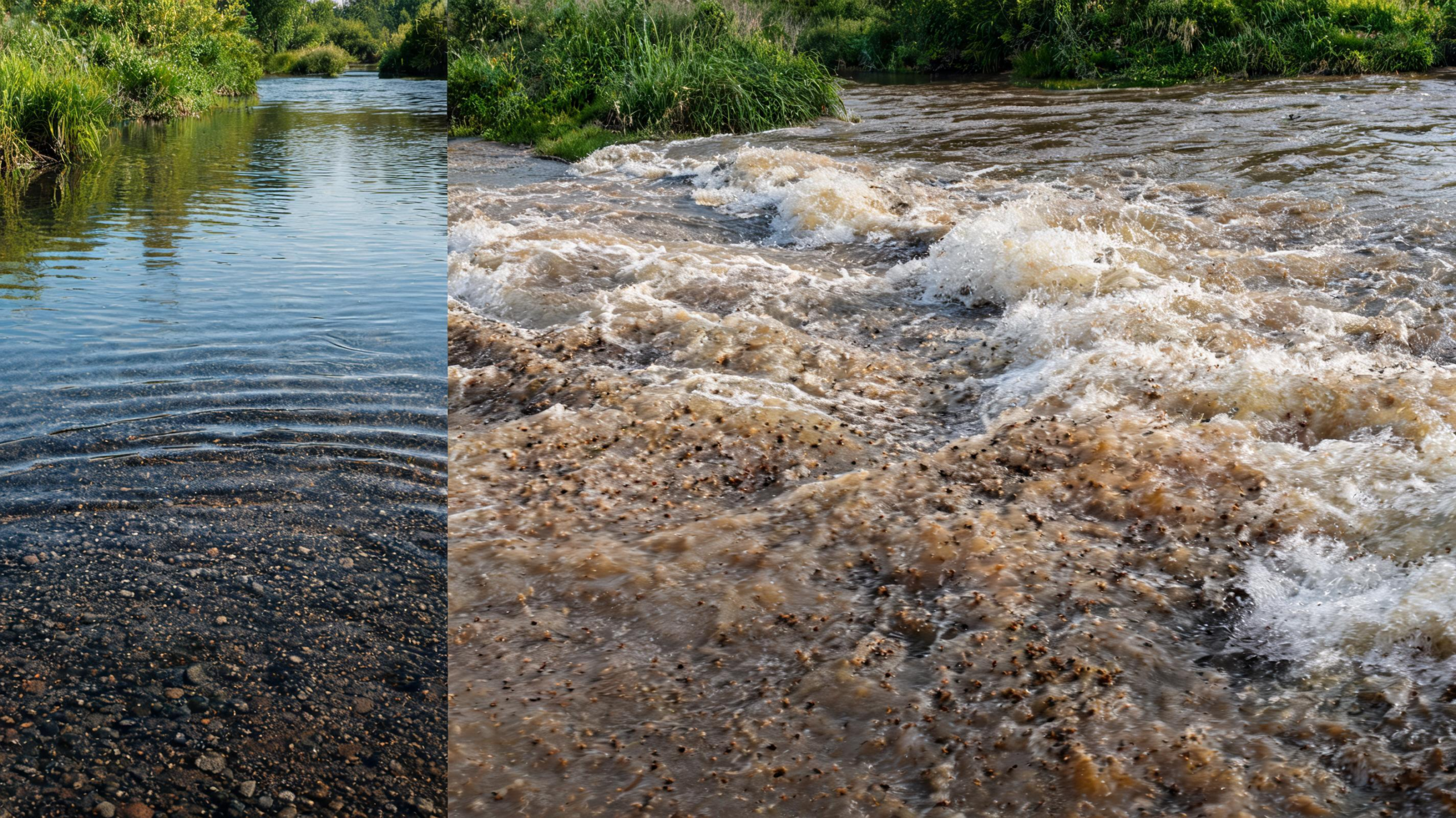
When successive extreme rainfall events hammered southern Brazil between September and November 2023, they did more than flood homes and swell rivers. According to a new study of the Sinos River Basin in Rio Grande do Sul, the floods physically reorganized where toxic trace metals sit in the riverbed, concentrating legacy contamination in downstream sediments without adding any new pollution to the system. The research, published in the journal Discover Geoscience, shows that the movement of fine sediment—silt and clay particles smaller than 63 micrometers—is the dominant force controlling metal distribution after a hydrological disturbance, a finding with major implications for how environmental agencies monitor rivers in an era of intensifying storms.
The Sinos River Basin drains 3,694 square kilometers along a gradient that descends from roughly 850 meters above sea level to nearly sea level, where the river discharges into the Jacuí River Delta near Porto Alegre. The basin is home to about 1.4 million people and hosts a dense mix of metallurgical industries, petrochemical plants, leather tanneries, agriculture, and urban development, making it one of the most heavily urbanized watersheds in the state. Decades of chronic contamination from industrial effluents, untreated domestic wastewater, and urban runoff have left a legacy of metals stored in the river’s bottom sediments. Geologically, the basin is underlain largely by volcanic basalts of the Serra Geral Formation, which naturally enrich local soils and sediments with elements such as aluminum, iron, chromium, nickel, and copper during weathering—a factor the researchers carefully separated from human pollution.
The study’s design exploited a rare natural experiment. A research team from the Federal University of Rio Grande do Sul, led by Ismael Krüger Pescke, Lívia de Oliveira Rozino, and Vera Maria Ferrão Vargas, had already collected sediment samples at five sites along the river’s longitudinal gradient before the floods struck. Gauging-station records showed that monthly mean discharge reached 296.2, 254.4, and 219.9 cubic meters per second in September, October, and November 2023—between 2.41 and 2.93 times the historical monthly averages. After the waters receded, the team returned to three representative sites that preserved the upstream-to-downstream gradient, including a relatively pristine reference site on the Rolante River tributary and the heavily impacted depositional zone at the river mouth.
In the laboratory, the researchers combined an unusually broad set of analytical tools. They measured grain-size distributions using sieving and pipette methods, extracted interstitial water—the water held between sediment grains—by centrifugation and filtration, and quantified fifteen elements including aluminum, arsenic, cadmium, chromium, cobalt, copper, iron, mercury, manganese, nickel, lead, antimony, selenium, vanadium, and zinc. Bulk sediments were analyzed by inductively coupled plasma optical emission spectroscopy, while the far more dilute interstitial waters required the greater sensitivity of inductively coupled plasma mass spectrometry. All analyses were performed in an ISO/IEC 17025-accredited laboratory with certified reference materials. On top of the raw chemistry, the team calculated contamination factors, ecological risk factors, the geoaccumulation index, and Hakanson’s Potential Ecological Risk Index, normalized metal concentrations by the fine-sediment fraction, and computed field-based sediment–interstitial water distribution coefficients.
The statistical results were strikingly clear. Redundancy analysis identified sediment granulometry as the primary driver of metal distribution, with a significance value of p = 0.003, and the first axis explained 56.2 percent of total variance. Spearman correlations revealed strong positive relationships between the fine fraction and lead (ρ = 0.88), zinc (ρ = 0.84), cobalt, aluminum, iron, and manganese (each ρ = 0.83), nickel (ρ = 0.81), and chromium (ρ = 0.76), all statistically significant. The tight correlation between aluminum and iron (ρ = 0.95) reflected their shared lithogenic origin and their role as constituents of reactive oxide and clay minerals that provide abundant sorption sites. Although a permutational multivariate analysis confirmed that overall metal composition shifted between sampling periods, that temporal signal lost its independent significance once the fine fraction was accounted for—meaning the flood’s apparent chemical effect was, in essence, a physical one.
The mechanism is straightforward but consequential. High-energy floodwaters erode and transport fine particles preferentially, and when flows slow in downstream reaches, those particles settle out. Because silt and clay particles carry high specific surface areas, cation exchange capacity, and reactive iron and aluminum oxide coatings, they act as the primary sinks for trace metals. After the event, sand content fell and the silt–clay fraction rose throughout the basin, and the downstream site at the river mouth accumulated the greatest metal load. Fine-fraction normalization sharpened the picture: the downstream site was not merely finer but genuinely enriched in metals per unit of reactive sediment, while an intermediate site showed dilution, likely from an influx of relatively uncontaminated material. The flood, in other words, created a patchwork of enrichment and dilution zones across the basin.
The ecological consequences were quantifiable. At the river mouth, contamination indices showed post-event enrichment of nickel, zinc, copper, and lead, with nickel, zinc, copper, and chromium exceeding Brazilian Level 1 sediment quality guidelines. The Potential Ecological Risk Index climbed from 100.02, in the low-risk category, to 172.06, crossing into the moderate-risk category. The geoaccumulation index shifted the mouth site from unpolluted to moderately polluted conditions. Crucially, the researchers demonstrated that these classifications depend heavily on the choice of background values: global averages such as typical shale compositions can misjudge basalt-rich regions, where natural weathering legitimately elevates chromium, nickel, copper, and zinc. Using the upstream reference site as a local geological background gave a more defensible picture, and the team argues that regional backgrounds, global references, and regulatory thresholds should be treated as complementary tools rather than substitutes.
Perhaps the most consequential discovery came from the interstitial water. Although dissolved metal concentrations were generally low, mercury exceeded Brazilian guideline values in every interstitial water sample—between 0.0003 and 0.0011 milligrams per liter—even though mercury remained below the limit of quantification in the bulk sediments. This means sediment chemistry alone can miss real exposure pathways, since interstitial water is the fraction immediately available for uptake across the biological membranes of bottom-dwelling organisms. Partitioning coefficients revealed metal-specific and site-specific behavior: nickel and zinc showed greater apparent retention in the solid phase after the event, while cadmium, manganese, and chromium responded heterogeneously across sites. At the river mouth, high accumulation coincided with detectable dissolved concentrations, combining contaminant storage with elevated exposure potential at the sediment–water interface—a scenario that could stress benthic organisms and early life stages of fish, consistent with biomarker and histopathological effects previously documented in native Sinos River fish.
The broader message is a warning about conventional monitoring. Routine sampling programs rarely capture the short-lived contamination pulses that follow extreme events, both because storms are unpredictable and because post-flood fieldwork is often logistically difficult and dangerous—indeed, unsafe conditions prevented the team from sampling at two of the five sites after the event, a limitation the authors acknowledge. Yet as climate change increases the frequency and intensity of extreme precipitation worldwide, similar patterns have now been documented after monsoon floods in South Korea, flash floods in former mining areas of Germany, and successive rainfall events in Algeria, suggesting that flood-driven sediment redistribution is a general mechanism rather than a local curiosity. The authors propose an integrated framework combining sediment texture, site-specific geological backgrounds, contamination indices, and sediment–interstitial water partitioning, deployed through adaptive monitoring that combines event-based campaigns with long-term programs. Such an approach, they argue, is essential for distinguishing genuine enrichment from simple sediment redistribution, detecting transient contamination pulses, and protecting the drinking water, fisheries, and recreation that millions of people depend on from rivers that climate change is increasingly turning inside out.
Beyond the immediate findings, the study carries methodological weight for the field of sediment geochemistry. The use of fine-fraction normalization proved decisive in separating two processes that would otherwise be indistinguishable in bulk chemistry: true metal enrichment, where reactive surfaces carry proportionally more contaminant, and simple hydrodynamic sorting, where metal loads rise merely because more reactive fine particles arrived. Without this correction, flood responses across different reaches of a river can appear contradictory, since deposition zones accumulate metals while scour zones shed them.
The partitioning results also underscore why bulk sediment analysis alone offers an incomplete picture of risk. Interstitial water occupies the pore spaces directly in contact with benthic invertebrates, fish eggs, and microbial communities, and its chemistry responds rapidly to shifts in redox conditions, organic matter degradation, and pH that floods can induce. A sediment that appears chemically stable in total concentrations may nevertheless release dissolved metals when flooded, or conversely re-adsorb them as fresh oxide surfaces settle out. Capturing these transient states requires sampling timed to hydrological events, which is precisely what most long-term monitoring programs are structurally unable to do.
The Sinos Basin’s vulnerability is amplified by its water use profile. Public abstraction points along the river supply drinking water to downstream communities, so sediment-derived contamination pulses have direct relevance to human exposure, an alignment with One Health framing that the authors emphasize. Vulnerable populations, including those relying on fisheries and informal water use, face disproportionate exposure. As extreme precipitation intensifies across subtropical regions, the combination of legacy industrial contamination, dense urbanization, and increasing flood frequency makes systems like the Sinos River likely candidates for repeated post-event contamination pulses, reinforcing the case for adaptive, event-triggered monitoring protocols alongside conventional scheduled sampling.
Subject of Research: How extreme hydrological events redistribute trace metal contamination and ecological risk through fine-sediment redistribution in subtropical river sediments
Article Title: Hydrological disturbance reshapes trace metal contamination and ecological risk through fine-sediment redistribution in subtropical river sediments
Article References: Pescke, I. K., de Oliveira Rozino, L., & Vargas, V. M. F. (2026). Hydrological disturbance reshapes trace metal contamination and ecological risk through fine-sediment redistribution in subtropical river sediments. Discover Geoscience, 4(1), Article 342. https://doi.org/10.1007/s44288-026-00692-2
Image Credits: AI Generated
DOI: 10.1007/s44288-026-00692-2
Keywords: trace metals, sediment redistribution, extreme hydrological events, Sinos River Basin, ecological risk assessment, fine sediments, granulometry, interstitial water, contamination indices, flood, Brazil, sediment-water partitioning
Cite Scienmag News
Violet Maxwell. (September 3, 2026). Floods Redistribute Toxic Metals in River Sediments by Moving Fine Particles. Scienmag. https://scienmag.com/floods-redistribute-toxic-metals-in-river-sediments-by-moving-fine-particles/
Violet Maxwell. "Floods Redistribute Toxic Metals in River Sediments by Moving Fine Particles." Scienmag, 3 September 2026, https://scienmag.com/floods-redistribute-toxic-metals-in-river-sediments-by-moving-fine-particles/. Accessed 4 October 2026.
Violet Maxwell. "Floods Redistribute Toxic Metals in River Sediments by Moving Fine Particles." Scienmag. September 3, 2026. https://scienmag.com/floods-redistribute-toxic-metals-in-river-sediments-by-moving-fine-particles/


