


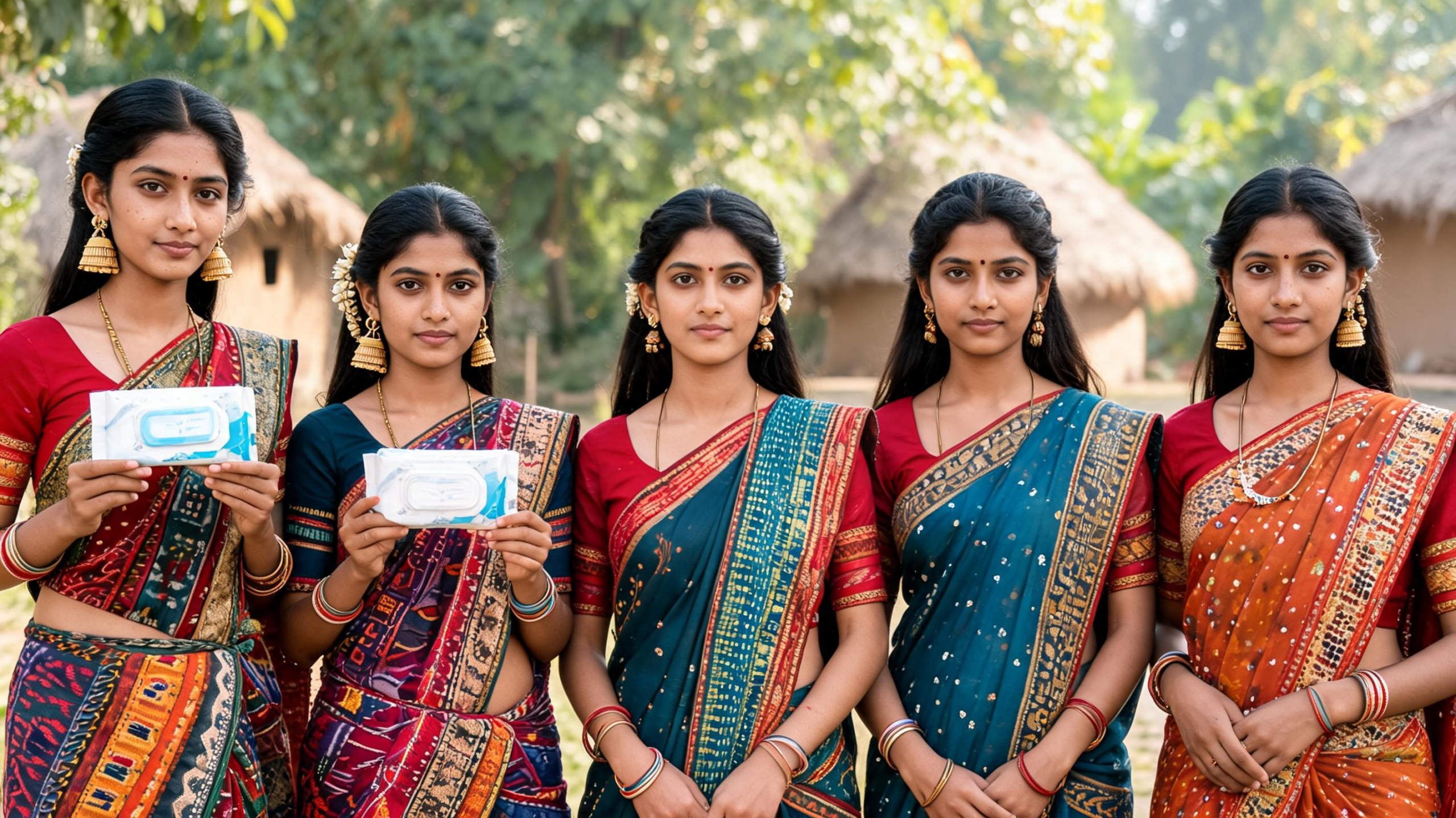
More than one in three young tribal women in India continues to manage her period without exclusive access to hygienic menstrual materials, according to a new nationwide analysis that maps, for the first time at this scale, where the gaps are deepest and which social forces drive them. Drawing on data from the National Family Health Survey-5 (NFHS-5) conducted between 2019 and 2021, researchers at the International Institute for Population Sciences in Mumbai examined the menstrual practices of 44,392 tribal women aged 15 to 24 years, a population that sits at the intersection of economic disadvantage, geographic isolation, and entrenched cultural stigma. Their findings, published in the journal Discover Social Science and Health, reveal that only 65.4 percent of these young women exclusively used hygienic methods during menstruation, leaving a substantial majority gap that national averages have long obscured.
The study’s definition of exclusive hygienic practice was deliberately strict. A woman was counted as practicing exclusive menstrual hygiene only if she used sanitary napkins, locally prepared napkins, tampons, or menstrual cups without simultaneously resorting to unhygienic alternatives such as cloth, ash, or other improvised materials. This distinction matters because mixed use, in which a woman alternates between a sanitary pad and a piece of old cloth depending on availability or cost, is common in resource-poor settings and carries real health consequences, including elevated risks of reproductive and urinary tract infections. By measuring exclusive use rather than any use of hygienic products, the researchers captured a more demanding and arguably more meaningful standard of menstrual health.
The methodological architecture of the study combined three complementary analytical approaches. Descriptive statistics established the overall prevalence of exclusive hygienic practice and its breakdown across states. District-level spatial mapping then visualized the geographic distribution of the outcome, exposing patterns of concentration and clustering that state-level averages conceal. Finally, multivariable logistic regression isolated the independent associations between a suite of socio-economic, demographic, and household characteristics and the likelihood of exclusive hygienic practice, allowing the authors to estimate how each factor contributes while holding the others constant. This triangulation of statistical and spatial techniques is what gives the study its policy relevance: it identifies not only who is being left behind but where interventions should be concentrated.
The determinants the analysis uncovered follow a now-familiar gradient of privilege, but the magnitude of the effects among tribal women is striking. Higher education emerged as one of the strongest predictors, with women who had completed more years of schooling showing substantially greater odds of exclusive hygienic practice than those with little or no formal education. Household wealth exerted an equally powerful influence, reflecting the blunt reality that commercial sanitary products carry a recurring cost that poorer households struggle to absorb. Education likely operates through multiple channels simultaneously: better knowledge of menstrual health, greater bargaining power within the household, higher exposure to health messaging, and improved employment prospects that translate into personal spending capacity.
Age and residence patterned the outcome in opposite and instructive directions. Rural tribal women were less likely to use hygienic methods exclusively than their urban counterparts, a gap that points to the compounded burden of distance from markets, weaker supply chains for menstrual products, and limited privacy and sanitation infrastructure in village settings. Older women within the 15-to-24 age band also showed reduced odds compared with the youngest respondents, a finding the authors interpret as evidence of a generational shift: younger cohorts, exposed to school-based programs, media campaigns, and expanding product availability, appear to be adopting hygienic practices at higher rates than women just a few years their senior. Whether this cohort effect will translate into a population-wide improvement depends on whether supply and affordability keep pace with changing attitudes.
One of the study’s most policy-significant findings concerns sanitation. The availability of improved toilet facilities in the household was positively associated with exclusive hygienic menstrual practice, an association that survived statistical adjustment for wealth and other confounders. The link is intuitive when viewed through the lens of daily menstrual management: a private, safe, water-protected toilet changes what is practically possible during menstruation, enabling washing, secure storage of products, and dignified disposal. The finding suggests that sanitation programs and menstrual health programs are not parallel agendas but deeply intertwined ones, and that investments in household sanitation may deliver measurable co-benefits for menstrual hygiene among the most disadvantaged populations.
The spatial analysis is where the study delivers its most visually persuasive evidence. District-level maps revealed significant regional disparities, with lower odds of exclusive hygienic practice concentrated in central India, a belt that corresponds to many of the country’s predominantly tribal districts, and higher odds in the southern and western regions. Perhaps more important, the maps exposed substantial intra-state variation, meaning that districts within the same state often differed dramatically from one another. This heterogeneity is a direct challenge to uniform national strategies. A state-level average can mask districts where fewer than half of young tribal women use hygienic methods exclusively, and a national program calibrated to the average will inevitably overshoot some areas while leaving the worst-served districts untouched.
The implications for policy flow directly from the structure of the evidence. The authors argue that interventions must move beyond one-size-fits-all national programs and adopt region- and district-specific approaches that integrate multiple levers at once: expanding girls’ education, poverty alleviation, reproductive health awareness campaigns, and improved access to affordable menstrual products. Each lever maps onto a determinant the regression analysis identified. Education and wealth are long-term structural drivers that require sustained investment in schooling and social protection. Product access is a shorter-term supply-side problem that can be addressed through subsidized distribution, local manufacturing, and strengthening last-mile availability in rural and remote tribal areas. Sanitation investment, as the toilet-facility finding demonstrates, belongs squarely within this integrated package rather than being treated as a separate sectoral concern.
The concept of menstrual equity frames the study’s conclusions. Menstrual hygiene management has often been treated as a narrow technical problem solvable by product distribution alone, but the evidence assembled here situates it within a web of poverty, education, sanitation, geography, and social norms. Tribal women in India face compounded disadvantages on every one of these dimensions simultaneously, which helps explain why, despite measurable national progress in hygienic menstrual practice over recent decades, this population continues to lag behind. The 34.6 percent of young tribal women who lack exclusive access to hygienic methods represent not a residual problem but a concentrated one, clustered in identifiable districts and shaped by modifiable social conditions.
What the study ultimately offers is a map of accountability. By quantifying the prevalence, identifying the determinants, and visualizing the spatial clustering of unhygienic menstrual practice among young tribal women, the research converts a diffuse and often silenced public health concern into a set of concrete, locatable, and addressable deficits. The path forward it sketches is demanding, requiring coordination across education, health, sanitation, and social welfare sectors, calibrated to the district level rather than the national average. But it is also concrete. The data now exist to know where the gaps are, who falls into them, and which interventions are most likely to close them. Turning that knowledge into menstrual equity for India’s tribal women is the task the evidence has now made impossible to defer.
The analysis draws on the National Family Health Survey-5, India’s largest nationally representative household survey, which collects information on menstrual hygiene practices as part of its women’s health module. Because the survey covers the full country, it allows researchers to disaggregate findings down to the district level, a granularity rarely available for tribal populations, who are often too small a share of state or national samples to be studied separately. By restricting the sample to women aged 15 to 24 years, the study focuses on the age range in which menstrual practices are first established and in which school attendance, marriage, and childbearing decisions intersect with reproductive health.
India’s tribal communities, officially recognized as Scheduled Tribes, number more than one hundred million people and are concentrated in forested and hilly regions of central, eastern, and northeastern India. These areas historically have had lower coverage of health infrastructure, sanitation, and schooling than the rest of the country, and the central Indian belt identified in the spatial analysis overlaps substantially with this geography. The finding that improved toilet facilities were associated with hygienic practice is consistent with the broader observation that household sanitation shapes what women can do privately during menstruation, particularly in homes where water access and disposal systems are limited.
The emphasis on exclusive use also has implications for how progress is measured. If surveys count any use of a hygienic product as adequate, mixed practices that still expose women to infection risk go undetected, and the apparent gap between tribal and non-tribal populations may be understated. The strict definition adopted here therefore provides a more conservative and arguably more honest benchmark. The open-access nature of the article, published under a Creative Commons licence, means that the district-level evidence base it documents is available to program planners, state health departments, and civil society organizations working on menstrual health in the very regions the maps identify as underserved.
Subject of Research: Determinants and spatial patterns of hygienic menstrual practices among tribal women in India
Article Title: Determinants and spatial patterns of hygienic menstrual practices among tribal Women in India
Article References: Kumar, S., Dwivedi, S. N., & Reshmi, R. S. (2026). Determinants and spatial patterns of hygienic menstrual practices among tribal Women in India. Discover Social Science and Health. https://doi.org/10.1007/s44155-026-00435-1
Image Credits: AI Generated
DOI: 10.1007/s44155-026-00435-1
Keywords: menstrual hygiene, tribal women, India, NFHS-5, spatial analysis, sanitation, menstrual equity, reproductive health, socio-economic inequality, public health, district-level mapping, logistic regression
Cite Scienmag News
Courtney Benton. (September 10, 2026). Two in Five Young Tribal Women in India Still Lack Hygienic Menstrual Products. Scienmag. https://scienmag.com/two-in-five-young-tribal-women-in-india-still-lack-hygienic-menstrual-products/
Courtney Benton. "Two in Five Young Tribal Women in India Still Lack Hygienic Menstrual Products." Scienmag, 10 September 2026, https://scienmag.com/two-in-five-young-tribal-women-in-india-still-lack-hygienic-menstrual-products/. Accessed 4 October 2026.
Courtney Benton. "Two in Five Young Tribal Women in India Still Lack Hygienic Menstrual Products." Scienmag. September 10, 2026. https://scienmag.com/two-in-five-young-tribal-women-in-india-still-lack-hygienic-menstrual-products/


