


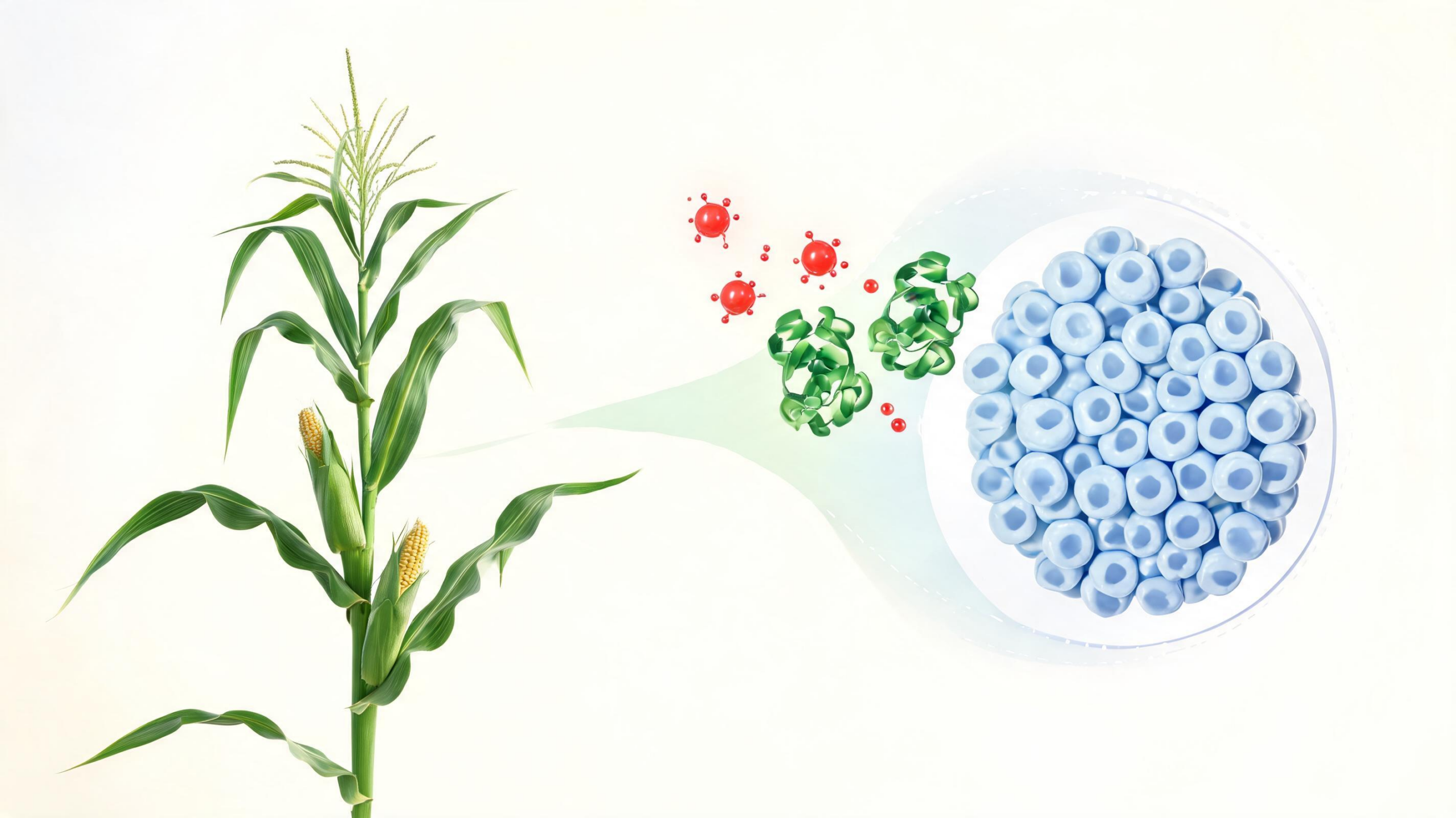
Every leaf, tassel, and ear of corn traces its origin to a dome of actively dividing cells smaller than a millimeter across, hidden at the growing tip of the plant. Scientists have long known that this structure, the shoot apical meristem, depends on elegant genetic circuits such as the CLAVATA-WUSCHEL signaling pathway to keep its stem cell population in balance. Now, a team of researchers in China has revealed an unexpected layer of control that operates at the level of basic cellular chemistry. Writing in the journal Advanced Biotechnology, Ting Guo, Xintong Liu, Ruoshu Yang, Yajie Wang, and Fang Yang, based at Sun Yat-Sen University and Huazhong Agricultural University, describe a redox regulatory module in maize in which a glutaredoxin protein called MSCA1 works together with a superoxide-scavenging enzyme to maintain the precise chemical environment that stem cells need to survive and organs need to form.
The discovery centers on reactive oxygen species, a family of chemically reactive molecules that were once dismissed as dangerous metabolic byproducts. Over the past two decades, biologists working on organisms from fruit flies to flowering plants have come to appreciate that certain reactive oxygen species act as genuine signals, capable of steering cells toward one developmental fate or another. In plant meristems, the two most prominent members of this family, the superoxide anion and hydrogen peroxide, occupy distinctly different territories. Earlier work in the model plant Arabidopsis showed that superoxide accumulates in the central zone of the meristem, where it helps preserve stem cell identity, partly by influencing epigenetic marks such as DNA methylation on target genes. Hydrogen peroxide, by contrast, gathers in the peripheral zone where new organs initiate, where it appears to nudge cells toward differentiation. This spatial segregation turns the meristem into a kind of chemical map, with each reactive oxygen species marking a different developmental region.
What remained unclear was how plants maintain such a carefully patterned distribution of reactive molecules, particularly in crop species. The Chinese team approached the question through maize, a staple cereal whose yield and architecture depend directly on how well its meristems perform. Their attention fell on MSCA1, a CC-type glutaredoxin that the group had previously shown to regulate meristem size, together with its two close relatives ZmGRX2 and ZmGRX5. Glutaredoxins are small oxidoreductase enzymes that modify the redox state of specific cysteine residues on target proteins, and the researchers wanted to know whether these proteins directly shape the reactive oxygen landscape of the meristem rather than merely acting on transcription factors downstream.
To find out, the team assembled a collection of maize mutants carrying disruptions in one, two, or all three of the glutaredoxin genes, all generated in the standard B73 inbred background and grown under controlled greenhouse conditions at Sun Yat-Sen University in Shenzhen. When the researchers measured seedlings fourteen days after germination, a clear pattern emerged. Plants carrying mutations in both msca1 and zmgrx5 were noticeably shorter than their wild-type counterparts, and the triple mutant showed the strongest reduction. Dissection and microscopic measurement of the shoot tips revealed that meristem width and height shrank progressively as more glutaredoxin genes were lost, indicating that the three genes act redundantly to promote meristem development, with MSCA1 and ZmGRX5 shouldering most of the burden. RNA in situ hybridization placed the three genes in leaf primordia initiation sites and developing vascular tissues, precisely the regions where new organs begin their lives.
The transcriptome of the triple mutant told a striking molecular story. RNA sequencing of meristem tissue identified 4,248 differentially expressed genes relative to wild type, with 2,714 genes up-regulated and 1,534 down-regulated. While the down-regulated genes were enriched mainly for basic cellular activities and developmental processes, consistent with the growth defects, the up-regulated genes were heavily concentrated in reactive oxygen related pathways. This transcriptional reprogramming hinted that losing the glutaredoxin module throws the redox machinery of the meristem into disarray. The researchers then turned to a classic histochemical technique, staining seedlings with nitroblue tetrazolium, a compound that precipitates in the presence of superoxide. In wild-type meristems, the stain concentrated in the central zone, confirming that superoxide occupies the stem cell heart of the maize meristem just as it does in Arabidopsis. In the double and triple mutants, that signal faded dramatically, and the degree of fading tracked with the shrinking meristem size.
Pharmacological experiments reinforced the connection between redox state and meristem growth. Treating seedlings with two broad-spectrum radical scavengers, n-propyl gallate and N,N’-dimethylthiourea, reduced meristem size in both wild-type plants and glutaredoxin mutants. The authors are careful to note that these chemicals are not superoxide-specific, so the treatments should be read as perturbations of the general redox environment rather than as precise depletion of a single species. Even so, the results support the broader conclusion that meristem development demands a properly balanced redox state, and that the spatial enrichment of superoxide in the central zone is a feature worth defending.
The search for the molecular mechanism led the team through the maize genome’s repertoire of reactive oxygen metabolism genes. From an initial list of 37 annotated candidates, filtered by tissue-specific transcriptomic data and subcellular localization predictions confirmed in tobacco leaves, the researchers narrowed the field to 16 enzymes for protein interaction screening. Yeast two-hybrid assays identified two superoxide dismutases, ZmCSD5 and ZmMSD2, as interaction partners of MSCA1, and the physical association with ZmCSD5 was independently confirmed by luciferase complementation imaging and bimolecular fluorescence complementation in Nicotiana benthamiana leaves. The choice to prioritize ZmCSD5 for deeper analysis rested on a biochemical rationale: glutaredoxins typically regulate targets through cysteine-dependent thiol modifications, and while ZmMSD2 lacks cysteine residues entirely, ZmCSD5 carries two highly conserved cysteines, at positions 119 and 208, that offer a plausible handle for redox regulation. The authors emphasize that direct modification of these residues by MSCA1 has not yet been demonstrated, leaving an important biochemical question open.
Genetic evidence, however, lined up neatly with the proposed model. Total superoxide dismutase activity was significantly elevated in both the msca1 single mutant and the triple mutant compared with wild type, exactly what one would expect if the glutaredoxin module normally restrains the scavenging enzyme. When the researchers used CRISPR-Cas9 to knock out ZmCSD5, generating frameshift alleles that likely represent null mutations upstream of the conserved copper-zinc superoxide dismutase domain, the resulting plants developed significantly enlarged meristems, the mirror image of the shrunken meristems seen in the glutaredoxin mutants. In situ hybridization showed that ZmCSD5 is expressed throughout the meristem and developing leaf primordia, overlapping with the expression domains of the three glutaredoxin genes. Taken together, these results cast ZmCSD5 as a negative regulator of meristem development and support a working model in which MSCA1 binds to ZmCSD5 and restrains its activity, limiting excessive superoxide scavenging in the central zone and thereby preserving the localized superoxide pool that stem cells require. Because genetic epistasis between MSCA1 and ZmCSD5 has not yet been tested, the authors acknowledge that constructing double mutants will be an important next step to firmly establish the hierarchy.
The findings also complete a broader picture of how glutaredoxins govern maize development. Earlier work from the same group showed that MSCA1 modulates the DNA-binding activity of the bZIP transcription factor FEA4 through redox modification, tuning the transcriptional network that shapes inflorescence architecture. The new study adds an upstream role: the glutaredoxin module maintains the chemical microenvironment, specifically superoxide homeostasis, in which such redox-sensitive targets operate. This dual action, intervening simultaneously in metabolic homeostasis and in downstream transcriptional responses, positions these three glutaredoxins as central hubs of the redox regulatory network controlling maize morphogenesis. Beyond its fundamental interest, the work carries practical weight. Meristem size influences the number of organs a plant can initiate, and ultimately traits such as yield, so the MSCA1-ZmCSD5 module offers plant breeders and molecular biologists a concrete genetic target. As the climate places new stresses on staple crops, understanding how a plant guards the tiny chemical gradient at its growing tip may prove to be one of the more consequential lessons of modern crop science.
Subject of Research: A GRX-SOD redox regulatory module that maintains superoxide homeostasis and shoot apical meristem development in maize.
Article Title: A GRX-SOD module maintains superoxide homeostasis and meristem development in maize
Article References: Guo, T., Liu, X., Yang, R., Wang, Y., & Yang, F. (2026). A GRX-SOD module maintains superoxide homeostasis and meristem development in maize. Advanced Biotechnology, 4(3), Article 36. https://doi.org/10.1007/s44307-026-00133-8
Image Credits: AI Generated
DOI: 10.1007/s44307-026-00133-8
Keywords: maize, shoot apical meristem, glutaredoxin, superoxide dismutase, reactive oxygen species, superoxide homeostasis, MSCA1, ZmCSD5, stem cell niche, plant architecture, redox regulation, CRISPR-Cas9
Cite Scienmag News
Drew Townsend. (September 10, 2026). Superoxide Signal Controls Maize Stem Cell Niche Through a Glutaredoxin Enzyme Pair. Scienmag. https://scienmag.com/superoxide-signal-controls-maize-stem-cell-niche-through-a-glutaredoxin-enzyme-pair/
Drew Townsend. "Superoxide Signal Controls Maize Stem Cell Niche Through a Glutaredoxin Enzyme Pair." Scienmag, 10 September 2026, https://scienmag.com/superoxide-signal-controls-maize-stem-cell-niche-through-a-glutaredoxin-enzyme-pair/. Accessed 5 October 2026.
Drew Townsend. "Superoxide Signal Controls Maize Stem Cell Niche Through a Glutaredoxin Enzyme Pair." Scienmag. September 10, 2026. https://scienmag.com/superoxide-signal-controls-maize-stem-cell-niche-through-a-glutaredoxin-enzyme-pair/


