


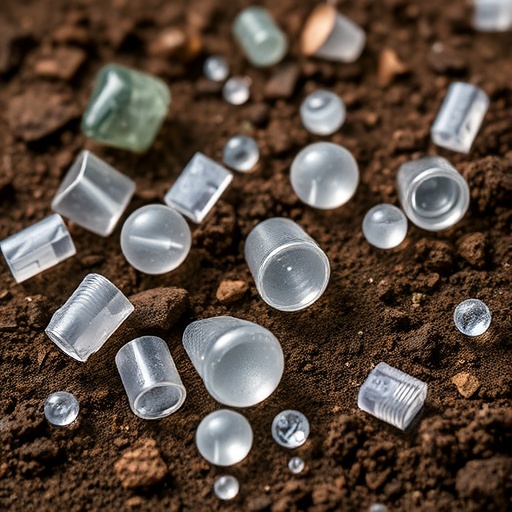
Plastic does not simply disappear when it reaches the soil. It fragments, gathers a living coating, changes how water and chemicals move through the ground, and becomes part of a microscopic ecosystem whose consequences are only beginning to emerge. A new study by Sepehrnia, Azimzadeh, Charlton and colleagues, published in Communications Earth & Environment, examines this hidden interface between soil and microplastics—the “soil plastisphere”—and proposes that its interfacial properties may provide a way to decode how plastic particles behave after entering the environment.
Microplastics are generally defined as plastic particles smaller than five millimetres, although the particles investigated in environmental research can be far smaller. They enter soil through multiple pathways, including the breakdown of agricultural films, the application of sewage sludge, irrigation with treated wastewater, atmospheric deposition, road runoff and the use of plastic-containing products. Once embedded in soil, these particles are exposed to minerals, organic matter, roots, microorganisms, fluctuating moisture and changing chemical conditions. Their environmental behaviour is therefore not determined by the original plastic alone. It is shaped by the constantly changing boundary layer that forms around each particle.
That boundary layer is the central concept behind the plastisphere. A microplastic surface is rarely chemically or biologically inert for long. Organic molecules can adhere to it, mineral particles can become attached, and microorganisms can colonise the surface, producing extracellular polymeric substances—sticky biological materials that help cells remain attached and form biofilms. Together, these processes can transform the particle’s surface chemistry, roughness, electrical charge and wettability. In practical terms, a particle that began as a smooth fragment of polyethylene or polystyrene may become a complex hybrid of plastic, soil minerals, organic compounds and living cells.
The study’s focus on interfacial properties is important because the interface is where environmental interactions occur. A particle’s surface charge can influence whether it attracts or repels clay minerals, dissolved organic matter and ions. Wettability—the tendency of a surface to interact with water—can affect whether the particle remains suspended in soil water or becomes trapped in drier soil regions. Surface roughness may determine how easily microorganisms attach and how strongly the particle is retained by soil aggregates. These properties can influence transport, persistence and the particle’s capacity to carry other substances through the soil environment.
Soil is not a uniform medium. It is a three-dimensional network of pores, channels and aggregates in which water and air move unevenly. Microplastics may travel through large pores during intense rainfall, become lodged in smaller openings, or bind to aggregates and remain near the soil surface. Their movement can also depend on particle shape. Fibres, films, fragments and beads interact differently with pore walls and mineral surfaces. A long, flexible fibre may become entangled in roots or fungal networks, while a compact fragment may be transported with flowing water. By examining the soil–plastisphere interface, researchers can begin to connect these visible differences in particle form with measurable physical and chemical behaviour.
The coating that develops on a microplastic can also alter its ability to interact with contaminants. Hydrophobic organic pollutants may associate with plastic surfaces, while metals and other charged substances may bind to biological films, mineral coatings or organic matter attached to the particle. This does not mean that every microplastic acts as a powerful transport vehicle for pollutants; the outcome depends on the type of polymer, the age and weathering of the particle, the chemistry of the surrounding soil and the properties of the contaminant. The significance of the new research is its emphasis on these conditions rather than treating all microplastics as environmentally identical.
Weathering is likely to be one of the most important forces reshaping the plastisphere. Sunlight, oxygen, mechanical abrasion, wetting and drying cycles, and microbial activity can break chemical bonds or create new functional groups at the plastic surface. Oxidation may make an initially water-repellent material more polar, allowing it to interact differently with water and dissolved substances. At the same time, cracking and abrasion can increase surface area, creating additional sites for biofilm formation and chemical attachment. A particle’s age may therefore be as relevant as its polymer identity when scientists attempt to predict what it will do in soil.
The biological dimension adds another layer of complexity. Microbial communities on microplastics are not necessarily identical to those in the surrounding soil. The surface can create a specialised habitat with different nutrient conditions, oxygen availability and chemical exposures. Microorganisms may also modify the particle’s surroundings by producing enzymes, acids and polymers that influence mineral dissolution, organic-matter binding or the breakdown of other compounds. Roots and soil fauna could further alter these communities by changing moisture patterns, releasing exudates or physically moving particles. Understanding these interactions is essential for determining whether microplastics merely persist as contaminants or become active components of soil processes.
A major challenge for environmental scientists has been translating laboratory measurements into predictions about real landscapes. Experiments performed with clean plastic spheres in purified water can reveal fundamental mechanisms, but they may not represent the behaviour of weathered fragments coated with soil material and biofilms. The approach highlighted by this study seeks to close that gap by treating interfacial properties as measurable indicators of environmental fate. Instead of asking only how much plastic is present, researchers can ask how the particle’s surface has changed, what it is attached to, how it interacts with water and minerals, and whether those properties indicate mobility or retention.
This perspective could improve environmental risk assessment. Models that incorporate surface charge, wettability, roughness, aggregation and biological coatings may better estimate where microplastics accumulate and how long they remain mobile. Such information could help identify vulnerable agricultural soils, improve sampling strategies and clarify whether management practices reduce or redistribute contamination. It may also guide the design of future remediation technologies, including approaches that target particle aggregation, filtration or selective removal. Yet the study’s broader message is not that one universal rule governs microplastics. Rather, it is that their behaviour must be interpreted through the changing interface between plastic and soil.
The research arrives as concern grows over the long-term consequences of plastic contamination in terrestrial ecosystems. Soil is the foundation of food production and a major reservoir of biodiversity, but it has received less public attention than oceans and rivers in discussions of plastic pollution. Microplastics may influence soil structure, water retention, microbial communities and the movement of chemical substances, although the magnitude and ecological importance of these effects vary across conditions. By focusing on the plastisphere as a dynamic boundary rather than a passive coating, Sepehrnia and colleagues offer a framework for understanding why the same type of plastic may behave differently in different soils.
The emerging picture is striking: a microplastic particle is not a static piece of waste but a moving, weathering and biologically active surface. Its environmental identity can change as rapidly as the soil around it changes. Rainfall may mobilise it, drought may concentrate it, minerals may immobilise it, and microorganisms may transform its interface. Decoding those changes could be the key to moving beyond simple counts of plastic particles toward predictive environmental science. As researchers continue to map the chemistry and biology of the soil plastisphere, the smallest fragments of plastic may reveal some of the largest unanswered questions about the future of land ecosystems.
Cite Scienmag News
Violet Maxwell. (August 12, 2026). Soil-Plastisphere Properties Help Decode Microplastics’ Environmental Behavior. Scienmag. https://scienmag.com/soil-plastisphere-properties-help-decode-microplastics-environmental-behavior/
Violet Maxwell. "Soil-Plastisphere Properties Help Decode Microplastics’ Environmental Behavior." Scienmag, 12 August 2026, https://scienmag.com/soil-plastisphere-properties-help-decode-microplastics-environmental-behavior/. Accessed 4 September 2026.
Violet Maxwell. "Soil-Plastisphere Properties Help Decode Microplastics’ Environmental Behavior." Scienmag. August 12, 2026. https://scienmag.com/soil-plastisphere-properties-help-decode-microplastics-environmental-behavior/


