


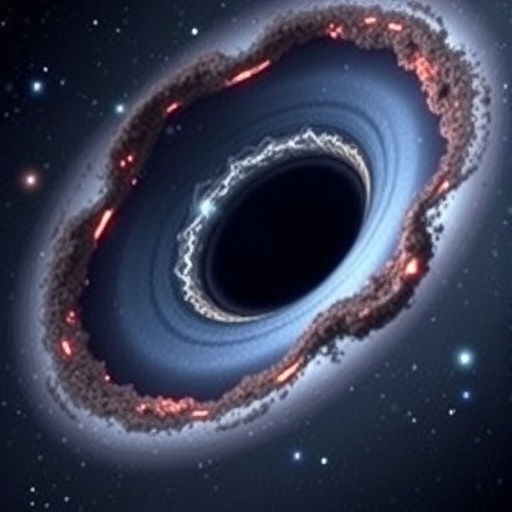
For decades, astronomers have struggled to explain how black holes containing millions or even billions of solar masses could have formed when the Universe was still in its infancy. Now, observations from the James Webb Space Telescope (JWST) may have revealed a previously unknown stage in black-hole evolution: a rapidly growing black hole wrapped in an enormous, dense envelope of gas that makes it shine more like a star than a conventional quasar. The object, named MoM-BH*-1, was observed as it appeared only about 660 million years after the Big Bang, when the Universe was less than five percent of its current age. Its unusual spectrum suggests that it could belong to a new class of cosmic objects known as “black hole stars,” potentially providing a missing link between the first black holes and the supermassive giants now found at the centers of galaxies.
The discovery, reported in Nature by researchers from the Institute of Science and Technology Austria and international collaborators, emerged from the JWST “Mirage or Miracle” survey. The program was designed to investigate distant sources whose appearances could be deceptive: some might be extraordinary galaxies from the early Universe, while others could be nearby objects masquerading as remote cosmic systems. The survey has already produced major discoveries, including the extremely distant galaxy MoM-z14. In the case of MoM-BH*-1, the light detected by JWST began its journey roughly 13 billion years ago. Because the expansion of the Universe stretches light toward longer, redder wavelengths, the object now appears as a faint, highly redshifted source whose spectrum preserves information about the physical conditions surrounding its central black hole.
Unlike the familiar image of a black hole surrounded by a thin, pancake-shaped accretion disk, a black hole star would be concealed within a much larger cloud of gas. Matter falling inward would release enormous amounts of energy, but the surrounding gas would absorb, scatter, and reprocess that radiation before allowing it to escape. The result would be an object whose outward appearance is dominated not by the black hole itself, but by a glowing, turbulent envelope. The proposed black hole stars could reach sizes of approximately 1,000 astronomical units, more than 100,000 times the diameter of the Sun and comparable in scale to the broad regions associated with powerful accretion systems. Their envelopes would remain gravitationally connected to the central black hole while radiating in a way that could imitate the light of a stellar population or a compact galaxy.
MoM-BH-1 is particularly important because its spectrum contains both black-hole-like and star-like signatures. One of the strongest clues is a feature known as the Balmer break, a sharp change in the amount of light emitted across a region of the spectrum associated with hydrogen absorption. In ordinary galaxies, the strength of this feature can reveal the ages and compositions of stars. In MoM-BH-1, however, the Balmer break is unusually pronounced—stronger than those typically observed in star-forming galaxies, dust-free stellar populations, or the enigmatic objects JWST researchers call “little red dots.” The combination suggests that the source is not simply a conventional galaxy filled with young stars. Instead, the spectral shape may be produced when radiation from a growing black hole passes through an exceptionally dense, dust-free gas envelope.
This distinction could help solve a central problem in the study of little red dots. Since their discovery in JWST observations, these compact, intensely red sources have generated competing explanations. Some researchers have argued that they are heavily obscured active galactic nuclei, while others have suggested that their light may come from unusual stellar populations or compact galaxies. A major difficulty has been separating the radiation from a possible central black hole from the light of its host galaxy. MoM-BH*-1 appears to offer a cleaner laboratory because nearly all of the detected emission can be attributed to the central object, with little evidence for a substantial host galaxy contributing to the observed brightness. Its red appearance may therefore be caused not primarily by dust blocking the light, but by gas scattering the radiation and shifting its emergent spectrum toward redder wavelengths, in a process loosely comparable to the way Earth’s atmosphere reddens a sunset.
The researchers modeled MoM-BH*-1 as a small, rapidly growing supermassive black hole embedded in extremely dense and turbulent gas. Under normal circumstances, the energy released by accretion can limit how quickly a black hole grows. As radiation pressure increases, it can push back against the inflowing material, creating a theoretical ceiling known as the Eddington limit. But dense environments may permit “super-Eddington” accretion, in which matter falls inward faster than conventional models allow. If the inflowing gas is sufficiently thick and dynamically complex, radiation can become trapped and carried inward with the material rather than immediately escaping. This would enable the black hole to gain mass at an accelerated rate, potentially allowing a relatively small initial seed to become enormous within a few hundred million years.
That possibility is significant because some quasars observed in the early Universe appear to contain black holes with masses of hundreds of millions or billions of Suns at a time when there should not have been enough time for ordinary growth processes to produce them. Astronomers have proposed several solutions, including the formation of unusually massive “direct-collapse” black-hole seeds, rapid mergers, and episodes of super-Eddington accretion. Black hole stars could provide an observable signature of the latter process. Rather than being a final state, the objects may represent a short-lived phase in which a black hole is growing inside a massive gas reservoir. As the envelope changes, collapses, or is expelled, the system could evolve into a more familiar active galactic nucleus and eventually become the central engine of a luminous quasar.
The connection to little red dots becomes even stronger when the researchers consider MoM-BH*-1’s surroundings. The object lies near a brighter galaxy, and models indicate that the two systems could merge in roughly 100 million years. When the spectra of the black hole star and its neighboring galaxy are combined, the result closely resembles the characteristic appearance of little red dots. This suggests that some of the mysterious JWST sources may not be a single type of object, but systems in which a black hole star is embedded within, or interacting with, a young host galaxy. In that scenario, the compact black hole star would supply the intense central radiation, while the surrounding galaxy would modify the total spectrum seen by distant observers. The result could look like a red, compact, rapidly evolving “baby quasar.”
The discovery is also part of a broader pattern. In March 2025, researchers announced another candidate black hole star, nicknamed “The Cliff,” associated with the period known as cosmic noon, roughly two to three billion years after the Big Bang. That era marked the height of star formation and galaxy growth. A further object identified near cosmic noon was described in a recent Astrophysical Journal Letters study by researchers including ISTA postdoctoral scientist Alberto Torralba and Jorryt Matthee. Finding similar sources at different cosmic epochs suggests that black hole stars may not be restricted to the earliest Universe, although they could have been more common when gas supplies were richer and galaxies were undergoing rapid assembly. Closer examples also offer astronomers an opportunity to obtain higher-quality spectra with ground-based observatories such as the European Southern Observatory’s Very Large Telescope.
The team emphasizes that black hole stars remain a developing interpretation rather than a fully established population, and future JWST observations will be essential for testing the idea. Astronomers will search for additional sources with the same combination of strong Balmer breaks, red continua, and signatures of dense gas surrounding an accreting black hole. Measurements of emission lines, variability, spatial structure, and the relationship between these objects and nearby galaxies could determine whether black hole stars are common precursors to quasars or a rarer phenomenon. If confirmed, they would reshape models of black-hole growth by showing that the earliest black holes could temporarily hide inside star-like cocoons while consuming gas at extreme rates. MoM-BH*-1 therefore offers more than a striking new name: it may be a direct glimpse of the growth phase that allowed the Universe’s first supermassive black holes to become cosmic giants so quickly.
Web References: https://www.nature.com/articles/s41586-026-10846-4; https://www.stsci.edu/jwst/science-execution/program-information?id=5224; https://ista.ac.at/en/news/baby-quasars-growing-supermassive-black-holes/; https://www.mpg.de/25316826/black-hole-stars
References: Nature, DOI: 10.1038/s41586-026-10846-4; Astrophysical Journal Letters, DOI: 10.3847/2041-8213/ae7bfd
Keywords
James Webb Space Telescope, JWST, black hole stars, supermassive black holes, little red dots, baby quasars, cosmic dawn, quasars, super-Eddington accretion, early Universe, astrophysics, Nature, MoM-BH*-1
Cite Scienmag News
Grant Pearson. (August 12, 2026). JWST finds earliest black hole star at cosmic dawn—mirage or miracle? Scienmag. https://scienmag.com/jwst-finds-earliest-black-hole-star-at-cosmic-dawn-mirage-or-miracle/
Grant Pearson. "JWST finds earliest black hole star at cosmic dawn—mirage or miracle?" Scienmag, 12 August 2026, https://scienmag.com/jwst-finds-earliest-black-hole-star-at-cosmic-dawn-mirage-or-miracle/. Accessed 4 September 2026.
Grant Pearson. "JWST finds earliest black hole star at cosmic dawn—mirage or miracle?" Scienmag. August 12, 2026. https://scienmag.com/jwst-finds-earliest-black-hole-star-at-cosmic-dawn-mirage-or-miracle/


