


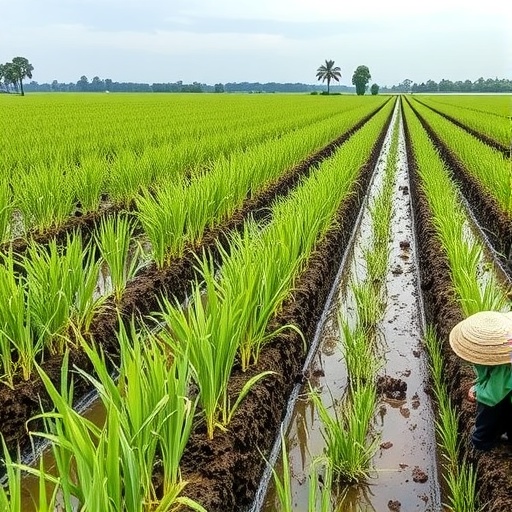
Returning crop straw to rice fields could do far more than recycle nutrients, according to a long-term field study in China. Researchers have found that incorporating straw into soil can increase the amount of organic carbon retained in paddy fields by activating two complementary protection systems. One system physically locks carbon inside stable soil aggregates, while the other chemically binds carbon to iron oxides. Together, these processes may help prevent organic matter from rapidly decomposing and escaping back into the atmosphere as carbon dioxide. The findings offer a detailed explanation of how a familiar agricultural practice could contribute to soil fertility and climate-change mitigation at the same time.
The study, conducted by researchers from the Chinese Academy of Agricultural Sciences, examined a double-cropping rice system at the Qiyang Red Soil Experimental Station in Hunan Province. The field experiment began in 2012 and continued for 11 years, allowing the scientists to study changes that would be difficult to detect in short-term trials. They compared plots receiving mineral fertilizer alone with plots in which straw was returned to the soil, winter green manure was grown using Chinese milk vetch, or both practices were combined. This design enabled the team to separate the effects of straw from those of fertilizer and green manure and to investigate not only whether carbon accumulated, but also how it was stabilized.
The results showed a clear increase in soil organic carbon when straw was incorporated. Compared with mineral fertilizer alone, straw return raised soil organic carbon levels by 13.6 percent. The combination of straw and winter green manure produced an even larger increase, with soil organic carbon 22.7 percent higher than in mineral-fertilized plots without these organic inputs. These gains are important because soil organic carbon influences a wide range of agricultural functions, including nutrient cycling, water retention, soil structure, and microbial activity. However, simply adding carbon-rich residues does not guarantee long-term storage. Much of the material can be decomposed by microorganisms, meaning that the key question is whether the carbon becomes physically or chemically protected from breakdown.
The first protection pathway identified by the researchers involved soil aggregates. Aggregates are clusters formed when mineral particles, organic compounds, roots, microbial products, and metal oxides bind together. Carbon trapped within these structures can become less accessible to decomposer organisms and their enzymes. Straw return encouraged the formation of large aggregates measuring more than 2 millimeters across and improved overall aggregate stability. Mean weight diameter, a widely used measure of aggregate structure, increased by 57.2 percent and 73.1 percent in straw-return treatments compared with corresponding treatments without straw. Larger and more stable aggregates can create internal spaces where oxygen movement, moisture conditions, and microbial access are restricted, slowing the decomposition of organic compounds enclosed within them.
Iron oxides appeared to be central to the formation of this physical protection. In red soils, iron minerals are abundant and can act as microscopic binding agents. They may connect clay particles and organic molecules, forming mineral-organic bridges that strengthen aggregates. The researchers observed that different iron forms occupied different size classes of aggregates. Complexed iron accumulated preferentially in large aggregates, while amorphous iron oxides were enriched in smaller aggregates. These patterns were associated with improved aggregate stability, suggesting that straw did not merely add organic material to the soil. It also altered the mineral environment in ways that promoted the assembly and persistence of carbon-protective structures.
The second pathway involved direct chemical associations between iron and organic carbon. Iron oxides possess highly reactive mineral surfaces that can attract and bind organic molecules through adsorption, ligand exchange, and other mineral-organic interactions. Once attached to iron, carbon compounds may become less available to microorganisms and more resistant to enzymatic degradation. The study found that iron-bound organic carbon accounted for between 21.2 percent and 26.7 percent of total soil organic carbon. This means that a substantial fraction of the soil carbon pool was associated with iron minerals rather than existing as freely decomposable plant material or dissolved organic compounds.
Straw return significantly expanded this iron-protected carbon pool. In plots receiving mineral fertilizer, adding straw increased total iron-bound organic carbon by 41.0 percent. In plots that also received winter green manure, straw increased iron-bound organic carbon by 30.9 percent. The difference between these percentages may reflect interactions among the types of organic matter entering the soil, microbial processing, and the availability of reactive iron surfaces. Plant residues do not necessarily bind to minerals in their original form. Microorganisms can transform straw into smaller, chemically altered compounds, some of which may have a greater affinity for iron oxide surfaces than the original plant polymers.
Spectroscopic measurements provided additional clues about the quality of the stabilized carbon. Important fractions of iron-bound organic carbon became more aromatic, hydrophobic, and molecularly complex under straw-return management. Aromatic compounds contain stable ring-shaped carbon structures, while hydrophobic molecules interact less readily with water and may be less accessible to microbes. Greater molecular complexity can also make organic matter more difficult for decomposer communities to break apart. These chemical changes do not mean that the bound carbon is permanently immune to decomposition, but they indicate a shift toward forms that are more resistant and likely to persist longer in the soil.
The researchers describe the overall process as a dual, iron-mediated carbon preservation system. Straw supplies fresh organic matter and stimulates biological activity, but it also helps reshape the physical and chemical environment of the soil. Iron oxides can reinforce aggregates that shelter carbon from decomposition while simultaneously binding transformed organic molecules to mineral surfaces. This combination is significant because physical and chemical protection can operate at different scales: aggregates restrict access and movement, whereas mineral bonding changes the reactivity and availability of the carbon itself. The study therefore provides a mechanistic explanation for why long-term straw incorporation may produce more durable carbon storage than would be expected from the amount of residue added alone.
The findings also highlight why the success of straw-based carbon management may vary from one region to another. The Qiyang site is a subtropical paddy system with red, iron-rich soil, conditions that may be especially favorable for iron-mediated stabilization. Clay-rich soils with abundant reactive minerals could provide many binding sites, whereas sandy soils or soils with little iron may offer less capacity for mineral protection. Alkalinity, drainage, flooding patterns, temperature, residue quality, and microbial activity could also influence the balance between carbon accumulation and carbon loss. Even so, the results suggest that returning straw to rice fields can simultaneously improve soil structure, increase organic carbon storage, and strengthen the mineral associations that help preserve it. As agriculture faces pressure to maintain productivity while reducing greenhouse-gas emissions, understanding these hidden soil mechanisms could make crop-residue management a more precise and powerful climate strategy.
News Publication Date: 22-Jun-2026
Web References: https://doi.org/10.48130/aee-0026-0015
References: Li B, Huang J, Liu L, Li D, Duan Y, et al. 2026. “Straw return promotes soil organic carbon sequestration through aggregate protection and chemical bonding mediated by iron oxides.” Agricultural Ecology and Environment 2: e018. DOI: 10.48130/aee-0026-0015
Cite Scienmag News
Alan Morgan. (August 12, 2026). Rice straw return boosts carbon storage in paddy soils via iron protection. Scienmag. https://scienmag.com/rice-straw-return-boosts-carbon-storage-in-paddy-soils-via-iron-protection/
Alan Morgan. "Rice straw return boosts carbon storage in paddy soils via iron protection." Scienmag, 12 August 2026, https://scienmag.com/rice-straw-return-boosts-carbon-storage-in-paddy-soils-via-iron-protection/. Accessed 3 September 2026.
Alan Morgan. "Rice straw return boosts carbon storage in paddy soils via iron protection." Scienmag. August 12, 2026. https://scienmag.com/rice-straw-return-boosts-carbon-storage-in-paddy-soils-via-iron-protection/


