


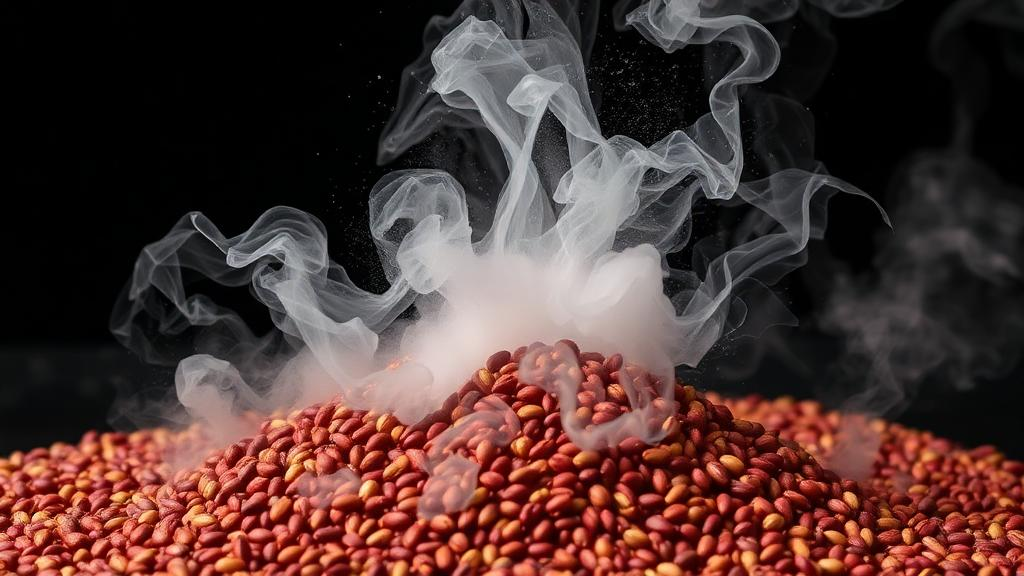
Ancient grains are having a moment, and few crops carry as much historical weight as amaranth. Cultivated by pre-Columbian civilizations and prized for its dense protein, minerals, and bioactive compounds, Amaranthus hypochondriacus has re-emerged as a star of the gluten-free and functional food movement. Now, a new study published in Current Research in Food Science reveals that a dramatic industrial technique known as Instant Controlled Pressure Drop, or DIC, can dramatically reshape the chemical fingerprint of amaranth grain, unlocking phenolic compounds that conventional extraction methods routinely miss while preserving the grain’s prized fatty acid profile.
The research, led by Patricia Rodríguez-Castillo and colleagues at Tecnológico de Monterrey, tackles a fundamental problem in food chemistry. In cereal and pseudocereal grains, many phenolic compounds are not freely floating in the cell interior. Instead, they are esterified or otherwise bound to cell-wall polymers and other macromolecular structures. This bound fraction can represent a large share of the total phenolic pool, and unless the matrix is physically disrupted, standard solvent extraction simply cannot reach it. Hydroxycinnamic acid derivatives of genuine nutritional significance may remain locked inside structural fractions, leading analysts to underestimate the true antioxidant wealth of the seed.
DIC offers a strikingly elegant solution. The process works like a controlled steam explosion: amaranth grains are loaded into a reactor, a preliminary vacuum is drawn, and dry saturated steam is injected until a target pressure is reached. After a precisely timed hold, the pressure is dropped almost instantaneously toward a deep vacuum, at rates exceeding 0.5 megapascals per second. This sudden decompression forces the moisture inside the grain to flash-evaporate, cooling the material instantly while simultaneously causing it to expand and develop a sponge-like network of microstructural alveoli. The resulting porous architecture makes it far easier for solvents to penetrate the matrix and leach out compounds that were previously physically entrapped within the cell-wall network.
To test how these thermomechanical forces translate into chemical changes, the team worked with two Mexican subvarieties of A. hypochondriacus, Laura and Criollo, from the 2023 harvest in Puebla. They designed a rigorous central composite experiment spanning thirteen treatment combinations, with steam pressure ranging from 0.10 to 0.40 megapascals and processing times from 10 to 90 seconds. Treated and untreated grains were then ground, extracted with ethanol, and analyzed by high-performance liquid chromatography to quantify individual phenolic compounds, while the lipid fraction was characterized by gas chromatography-mass spectrometry.
The results for the Criollo variety were remarkable. Total quantified phenolics ranged from a low of 346.14 micrograms per gram under mild conditions to a striking 3035.2 micrograms per gram at moderate settings of 0.25 megapascals and 50 seconds, a condition that more than tripled the untreated control’s 828.38 micrograms per gram. Catechin emerged as the dominant compound in every sample, soaring from 679 micrograms per gram in the control to as much as 2704 micrograms per gram after treatment. Rutin, quercetin, gallic acid, and trans-4-hydroxycinnamic acid all showed statistically significant increases across most treatments, and the most favorable conditions also produced the widest diversity of detected compounds, with seven of eight identified peaks appearing in the chromatograms.
The Laura variety told a more nuanced story, one that underscores how sensitive these responses are to both genetics and processing intensity. Here, the same moderate condition of 0.25 megapascals for 50 seconds again delivered the highest phenolic concentration at 2074.15 micrograms per gram, though this did not differ significantly from the untreated grain. More revealing was what happened under harsher treatment: at 0.36 megapascals for 78 seconds, total phenolics collapsed to just 281.51 micrograms per gram and only three of ten peaks remained detectable. The contrast between this sample and DIC 6, which shared the same pressure but ran for only 22 seconds and displayed nine peaks, suggests that prolonged exposure to high-pressure steam can actively degrade delicate bioactive compounds rather than merely failing to release them.
Response surface modeling and Pareto analysis confirmed these patterns statistically, showing that moderate to high pressure combined with moderate time frames consistently maximized phenolic recovery, while quadratic terms in the fitted equations captured the penalty for pushing conditions too far. The findings align with earlier work by the same group showing improved antioxidant capacity in DIC-treated amaranth, as well as studies on green lentils, grape pomace, and oleaster flour, all of which reported enhanced polyphenol extractability following thermomechanical texturing. Together they paint a coherent picture: the sweet spot lies in enough mechanical disruption to fracture cell walls, but not so much thermal load that phenolics break down.
Crucially, the team also asked whether this violent process damages the lipid fraction, a legitimate concern given that unsaturated fatty acids and minor lipids like squalene are notoriously vulnerable to oxidation and heat. The answer was reassuring. Gas chromatography-mass spectrometry confirmed that amaranth oil remained dominated by nutritionally favorable components: in Criollo, oleic acid accounted for roughly 27 percent, linoleic acid 21 percent, palmitic acid 11 percent, and squalene an impressive 26 percent of the oil. Laura showed a similar pattern with 24 percent oleic, 25 percent linoleic, 20 percent palmitic, and 19 percent squalene. Saturated fatty acids made up only 22 to 30 percent of the total, preserving the grain’s balanced lipid signature.
Squalene deserves particular attention here. This triterpenoid, found in significant quantities in amaranth oil, exhibits documented antioxidant, anti-inflammatory, hepatoprotective, and cardioprotective activities, and it is one of the main reasons amaranth oil commands interest beyond basic nutrition. The study found that processing parameters did influence the relative proportions of specific fatty acids, with lower pressures and longer times favoring higher linoleic acid percentages in Criollo, and lower pressures boosting squalene in Laura, while oleic acid remained largely indifferent to the treatments. Some minor saturated fatty acids, including stearic and arachidic acid, disappeared from certain treatments, echoing similar observations in DIC-processed cardamom seeds and hinting at selective effects on less abundant lipid species.
The broader implications are compelling for the functional food industry. Amaranth’s phytochemical profile, spanning hydroxybenzoic acids, hydroxycinnamic acids, and flavonoids related to quercetin and kaempferol, varies considerably with species, genotype, and growing conditions, which has long complicated its use as a standardized ingredient. This study demonstrates that DIC is not merely a passive processing step but a tunable dial: by adjusting steam pressure and exposure time, manufacturers can deliberately modulate which compounds become extractable and in what quantities, all within processing windows measured in seconds rather than minutes. The fact that catechin remained dominant across all treatments indicates that DIC primarily shifts availability and relative distribution rather than eliminating key constituents. As demand grows for nutrient-dense, plant-based ingredients with verified bioactive content, the image of amaranth grains exploding into porous, antioxidant-rich flour inside a steel reactor may become a familiar sight, bridging five centuries of agricultural heritage with some of the most sophisticated food engineering available today.
Subject of Research: Effect of Instant Controlled Pressure Drop processing on phenolic compounds and fatty acids in amaranth grain
Article Title: Instant Controlled Pressure Drop Processing Modulates Phenolic Composition and Fatty Acid Profile in Amaranthus hypochondriacus Grain.
Article References: Rodríguez-Castillo, P., Teresa-Martínez, G., Alonzo-Macías, M., Téllez-Pérez, C., & Cardador-Martínez, A. (2026). Instant Controlled Pressure Drop Processing Modulates Phenolic Composition and Fatty Acid Profile in Amaranthus hypochondriacus Grain.. Current Research in Food Science, Article 101576. https://doi.org/10.1016/j.crfs.2026.101576
Image Credits: AI Generated
DOI: 10.1016/j.crfs.2026.101576
Keywords: amaranth, Instant Controlled Pressure Drop, phenolic compounds, fatty acids, squalene, catechin, functional foods, HPLC, GC-MS, pseudocereal, antioxidants, food processing
Cite Scienmag News
Alan Morgan. (October 2, 2026). Steam Explosion Trick Unlocks Hidden Antioxidants in Ancient Amaranth Grain. Scienmag. https://scienmag.com/steam-explosion-trick-unlocks-hidden-antioxidants-in-ancient-amaranth-grain/
Alan Morgan. "Steam Explosion Trick Unlocks Hidden Antioxidants in Ancient Amaranth Grain." Scienmag, 2 October 2026, https://scienmag.com/steam-explosion-trick-unlocks-hidden-antioxidants-in-ancient-amaranth-grain/. Accessed 4 October 2026.
Alan Morgan. "Steam Explosion Trick Unlocks Hidden Antioxidants in Ancient Amaranth Grain." Scienmag. October 2, 2026. https://scienmag.com/steam-explosion-trick-unlocks-hidden-antioxidants-in-ancient-amaranth-grain/


